Demand Planning Insights for Mid-Market Manufacturers
Practical guidance on demand planning, forecasting, and supply chain optimization for mid-market companies.
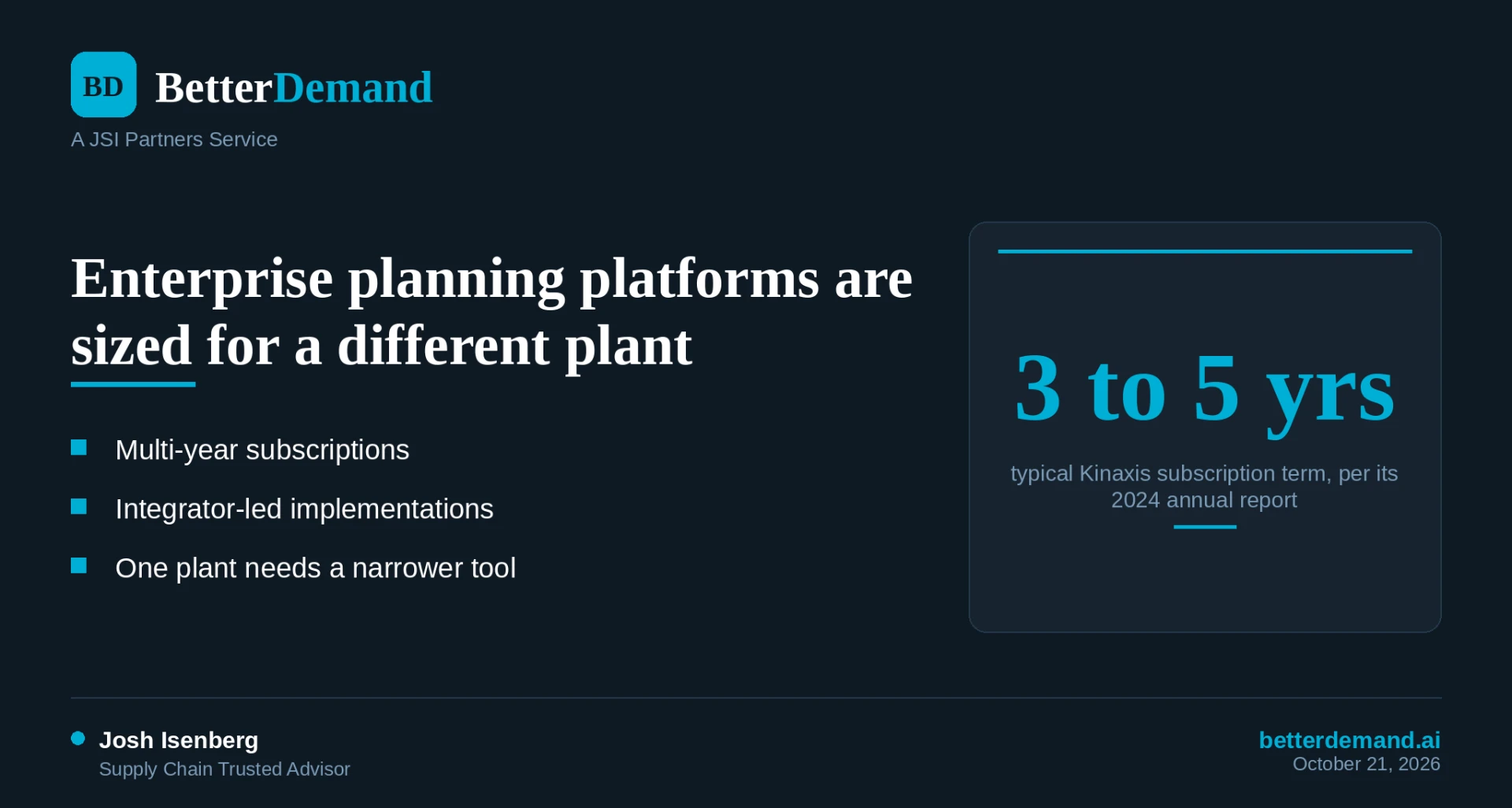
Alternatives to Kinaxis, SAP IBP and o9 for Mid-Market Manufacturers
Kinaxis, SAP IBP and o9 are built for large, multi-site planning programs. Here is what a 20 to 300 person plant needs instead, and the alternatives worth evaluating.
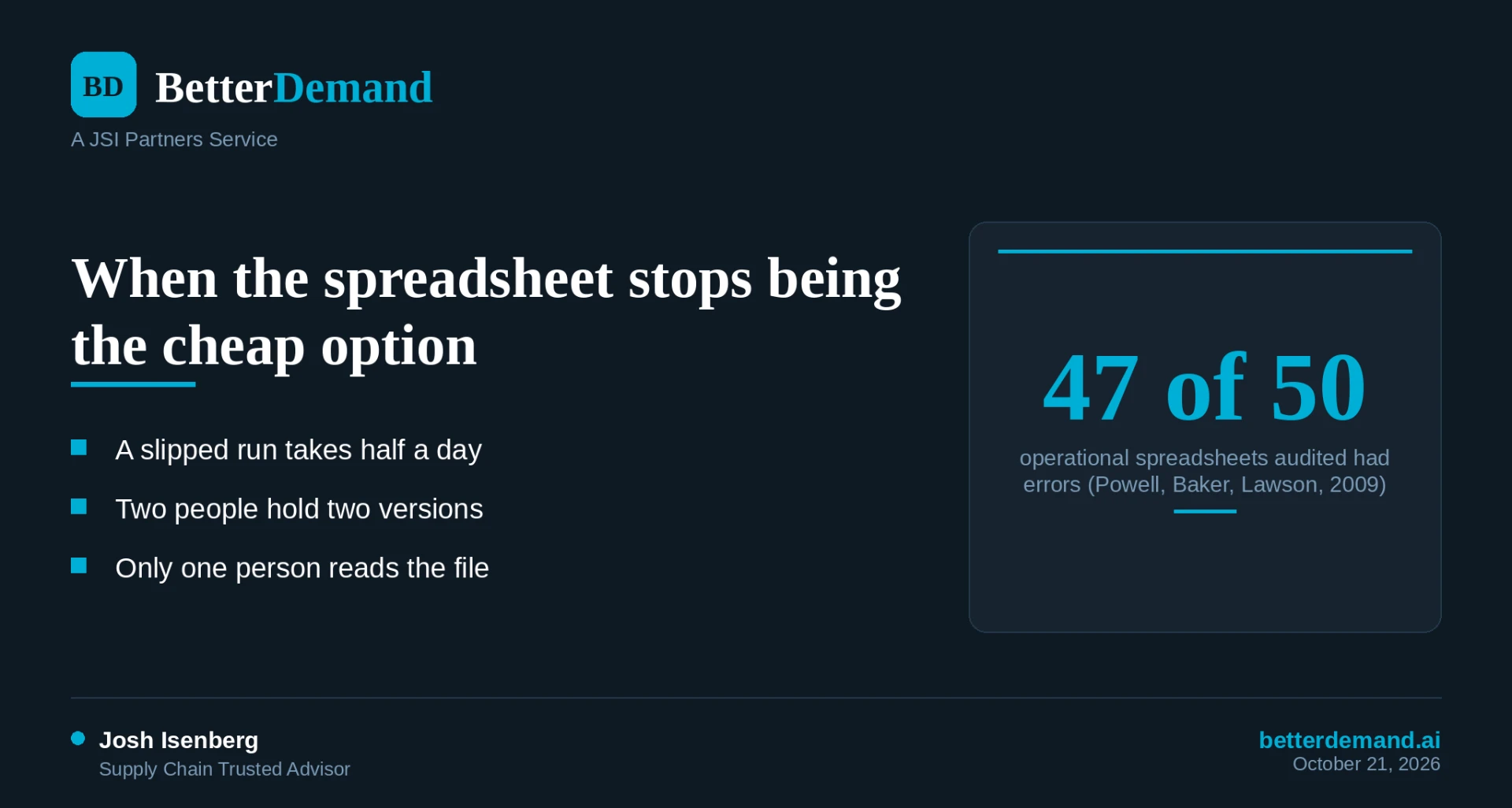
Excel vs Demand Planning Software: When the Spreadsheet Stops Working
Excel is the right planning tool for many plants, for a while. Here are the five signs it has stopped working, what to move out of it first, and what to leave alone.

Demand Planning Software for Food and Beverage Manufacturers
Food and beverage planning breaks generic tools in specific ways: shelf life, lots, changeovers, heat season, DC rhythms. Here is what to require, what to ask in a demo, and which type of tool fits.
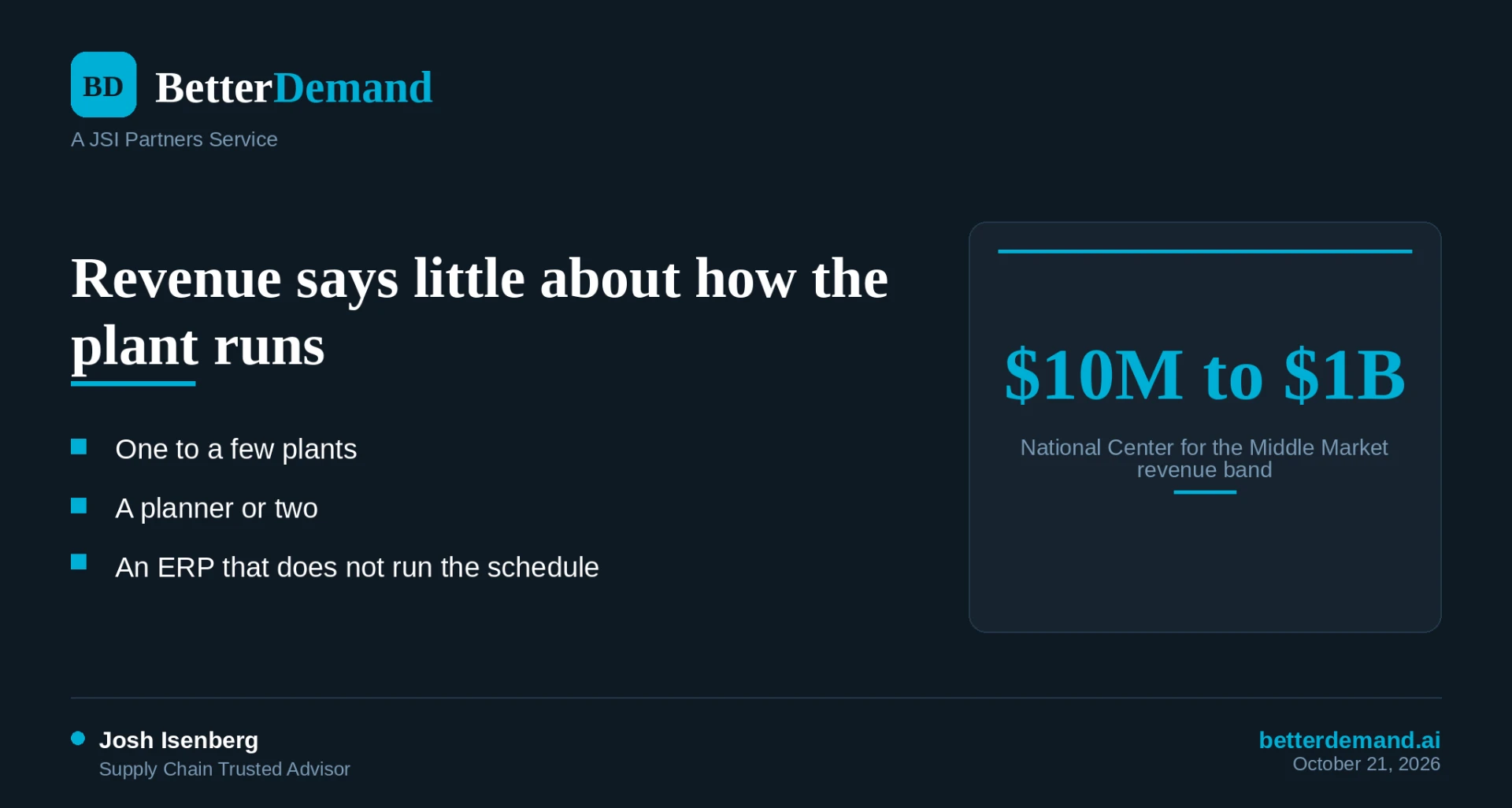
What Counts as a Mid-Market Food Manufacturer? Revenue, Headcount and Planning Needs
Public definitions of mid-market use revenue and headcount, and none of them describe the daily planning problem. Here is what the numbers say and what planning looks like inside a food plant of this size.
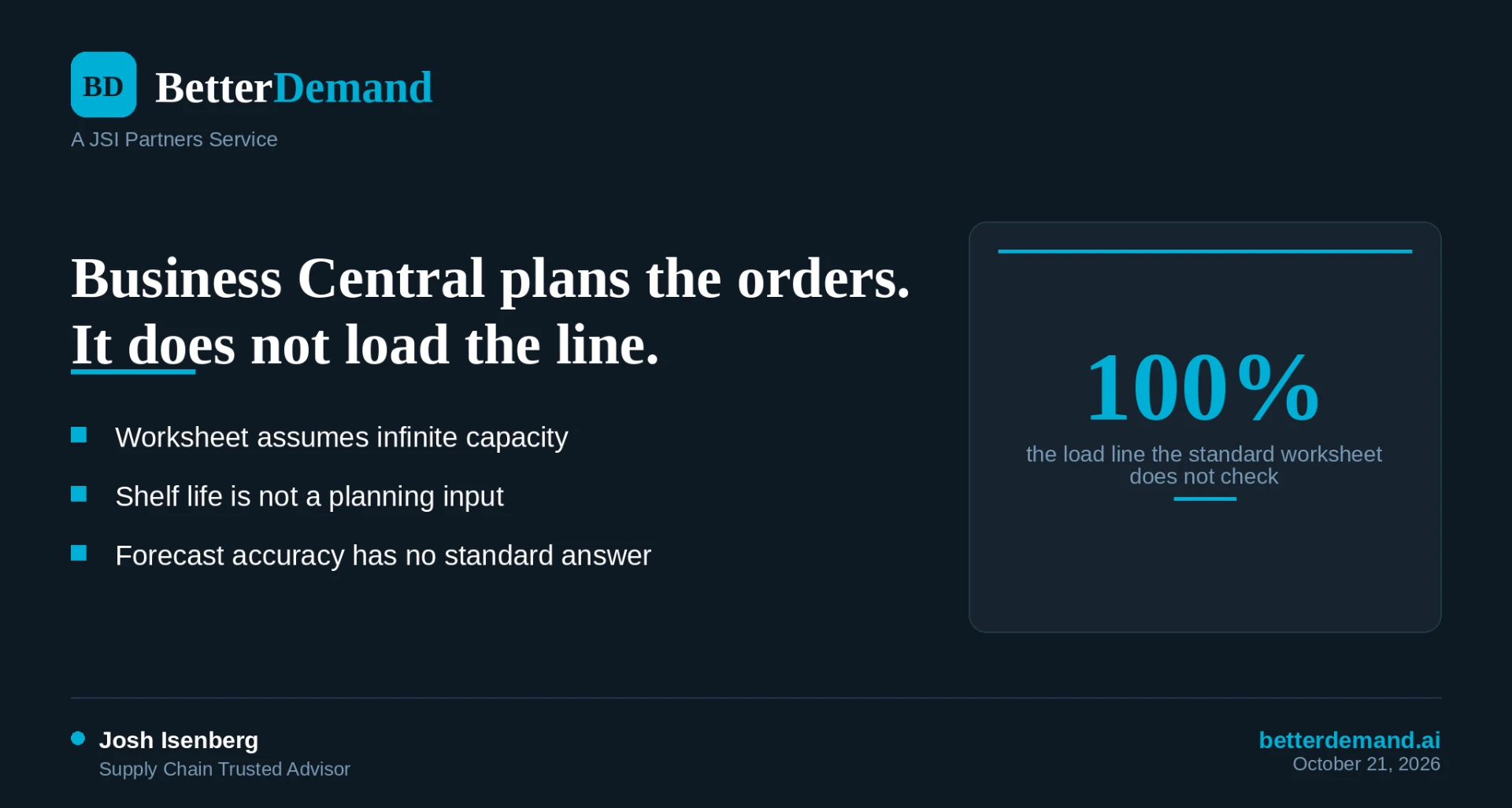
Business Central for Food Manufacturers: Where the Planning Stops
Business Central is a sound system of record for a food plant. Here is what its standard planning covers, where it stops, and what a food manufacturer adds beside it.
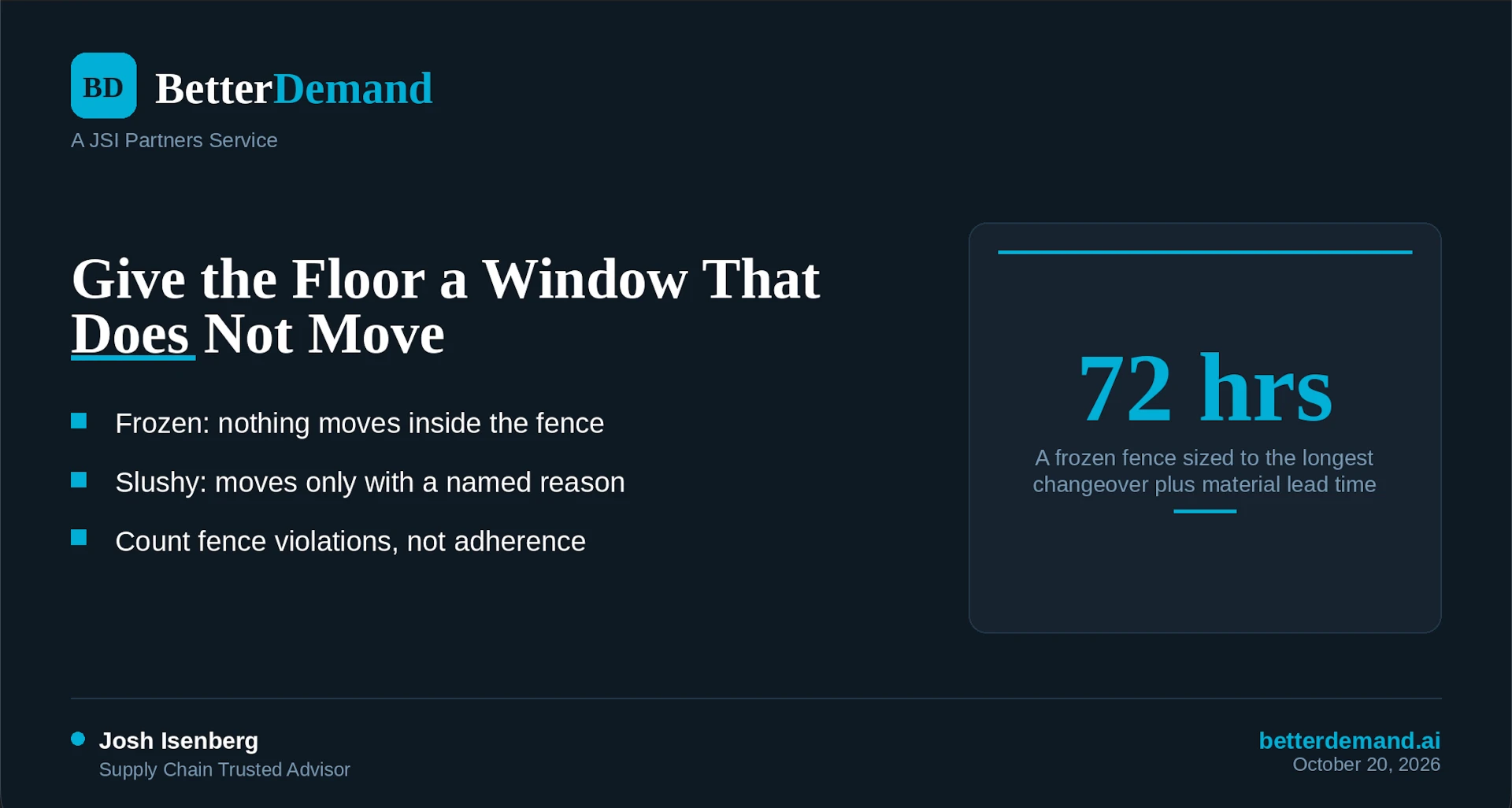
A Frozen Window the Floor Can Trust
A schedule that changes every day teaches the floor to ignore it. A frozen fence, a slushy zone with named reasons, and one violation count fix that in weeks.
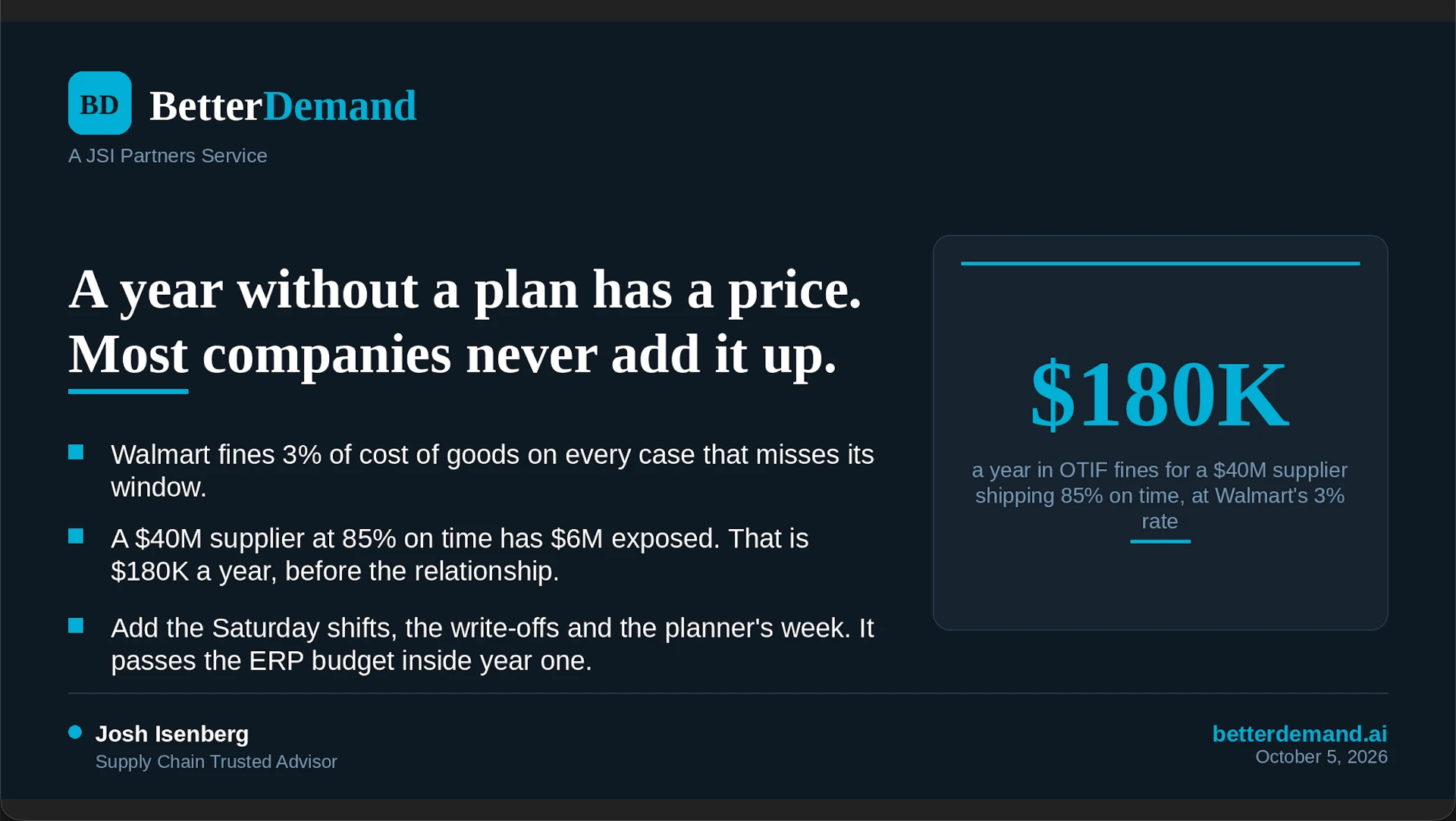
Walmart OTIF: How It Is Scored and What a Supplier Actually Controls
How Walmart's on-time, in-full program measures suppliers, why a plant with perfect fill rates can still fail on time, and the five things a mid-market supplier can fix before the next scorecard.
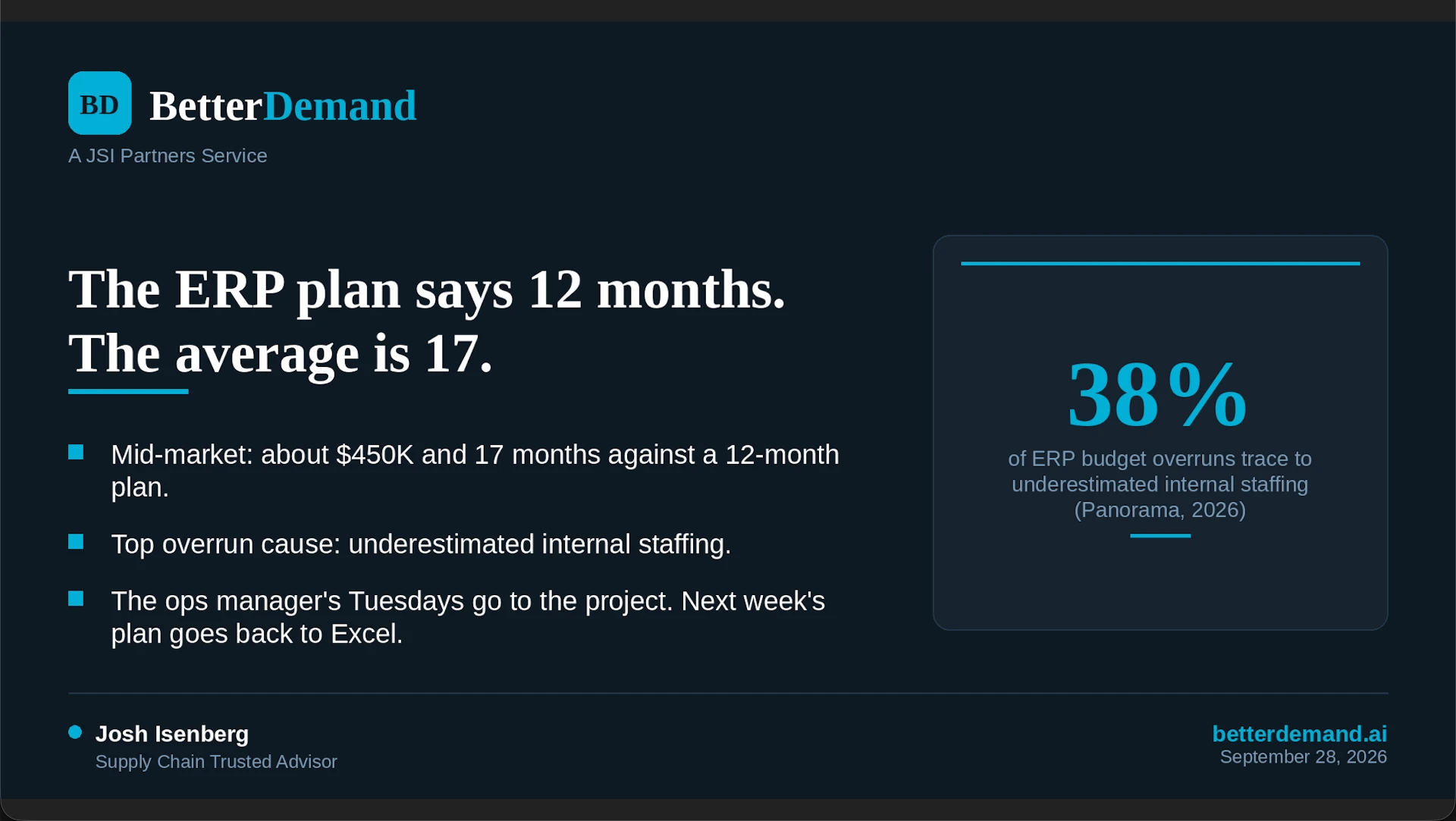
The ERP Plan Says 12 Months. The Average Is 17.
Mid-market ERP projects run 17 months against a 12-month plan, and the leading cause of overruns is internal staffing. Here is the cost nobody budgets, and what to do while the project runs.
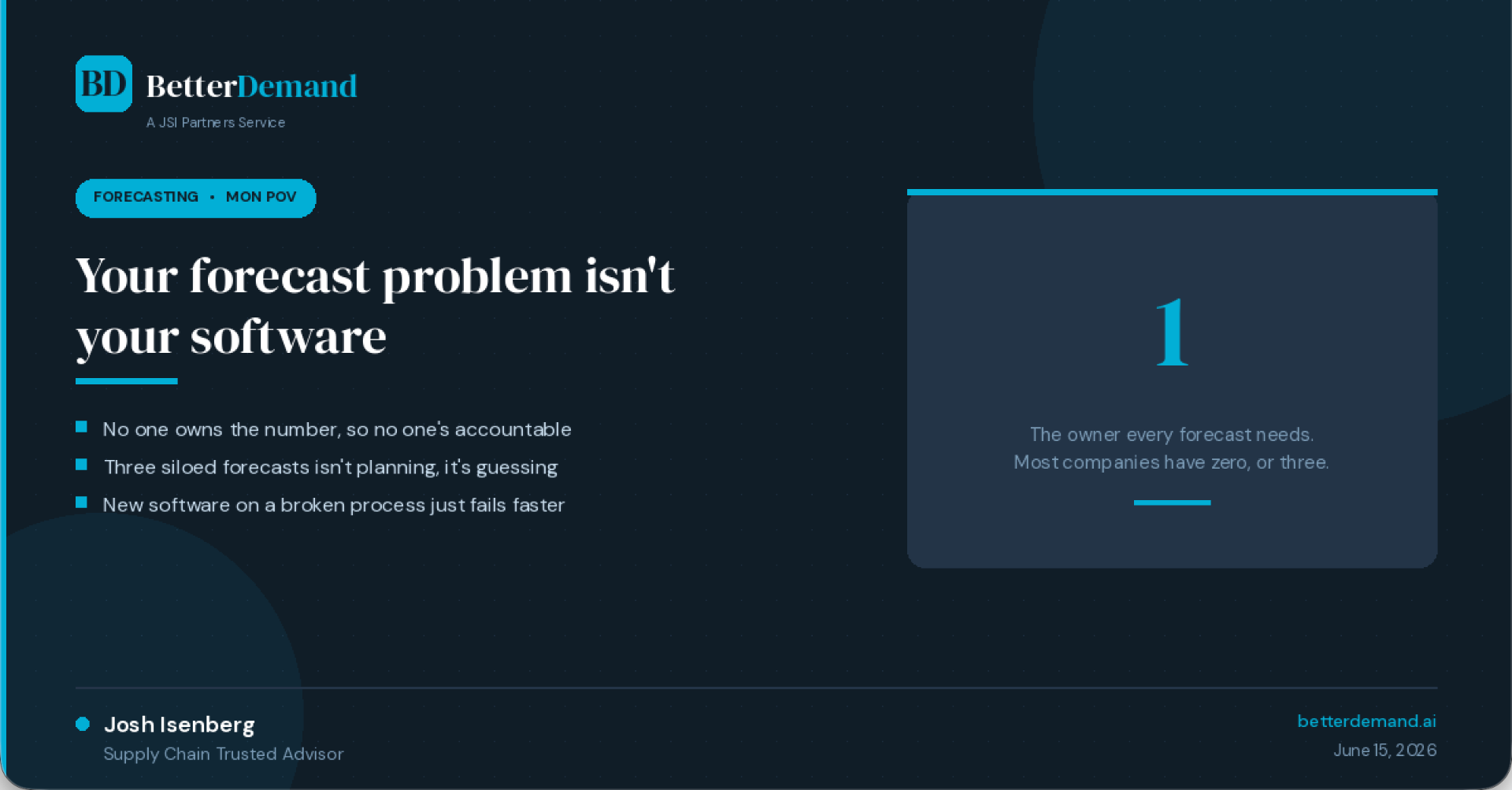
Your Forecast Problem Isn't Your Software
Mid-market companies keep buying tools to fix forecast accuracy. The real issue is ownership and process. Here's what actually moves the number.
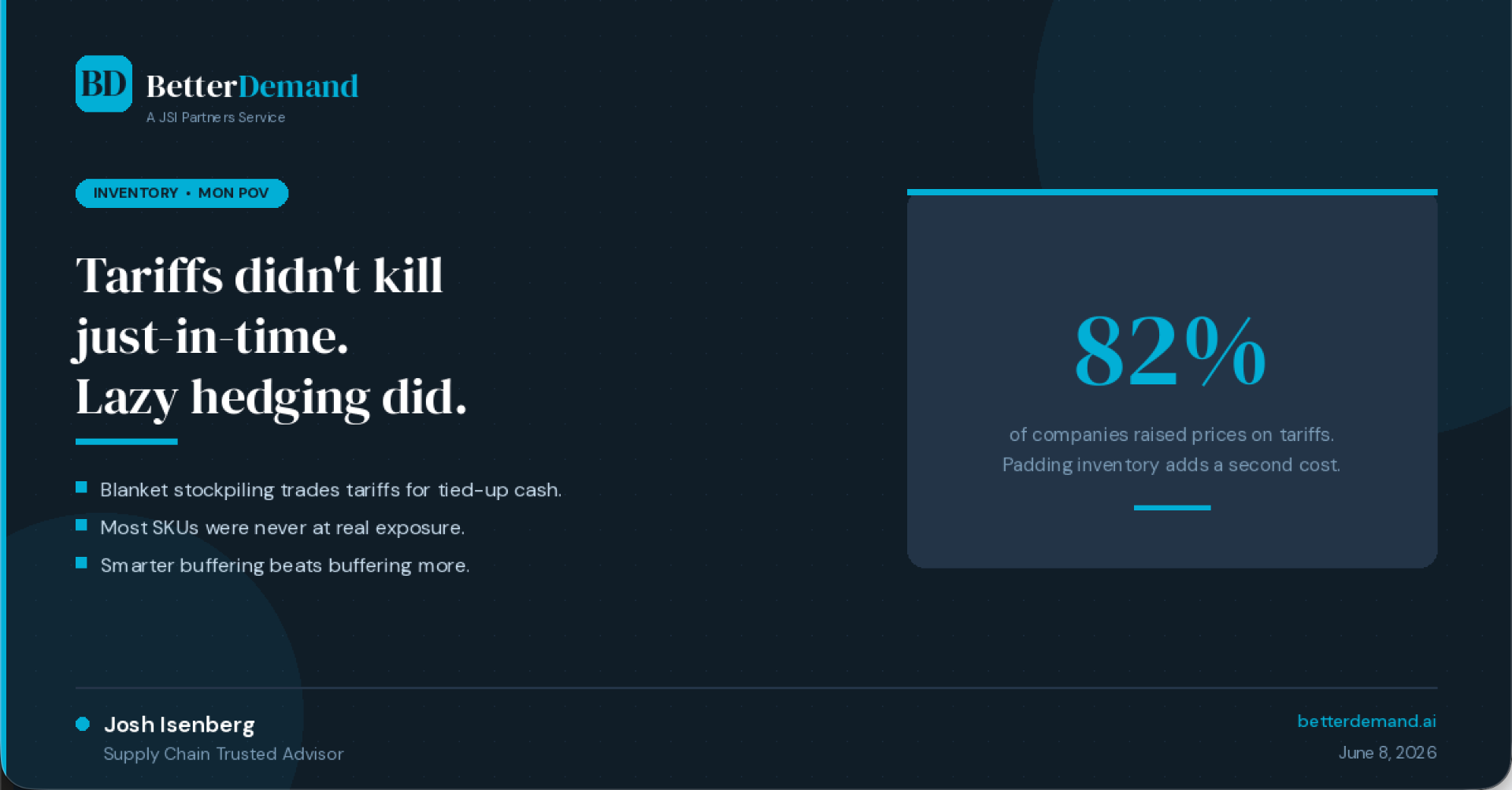
The Just-in-Case Inventory Trap Mid-Market Firms Hit
Tariffs pushed mid-market companies to stockpile everything. Here's why blanket "just-in-case" inventory trades one problem for a costlier one.
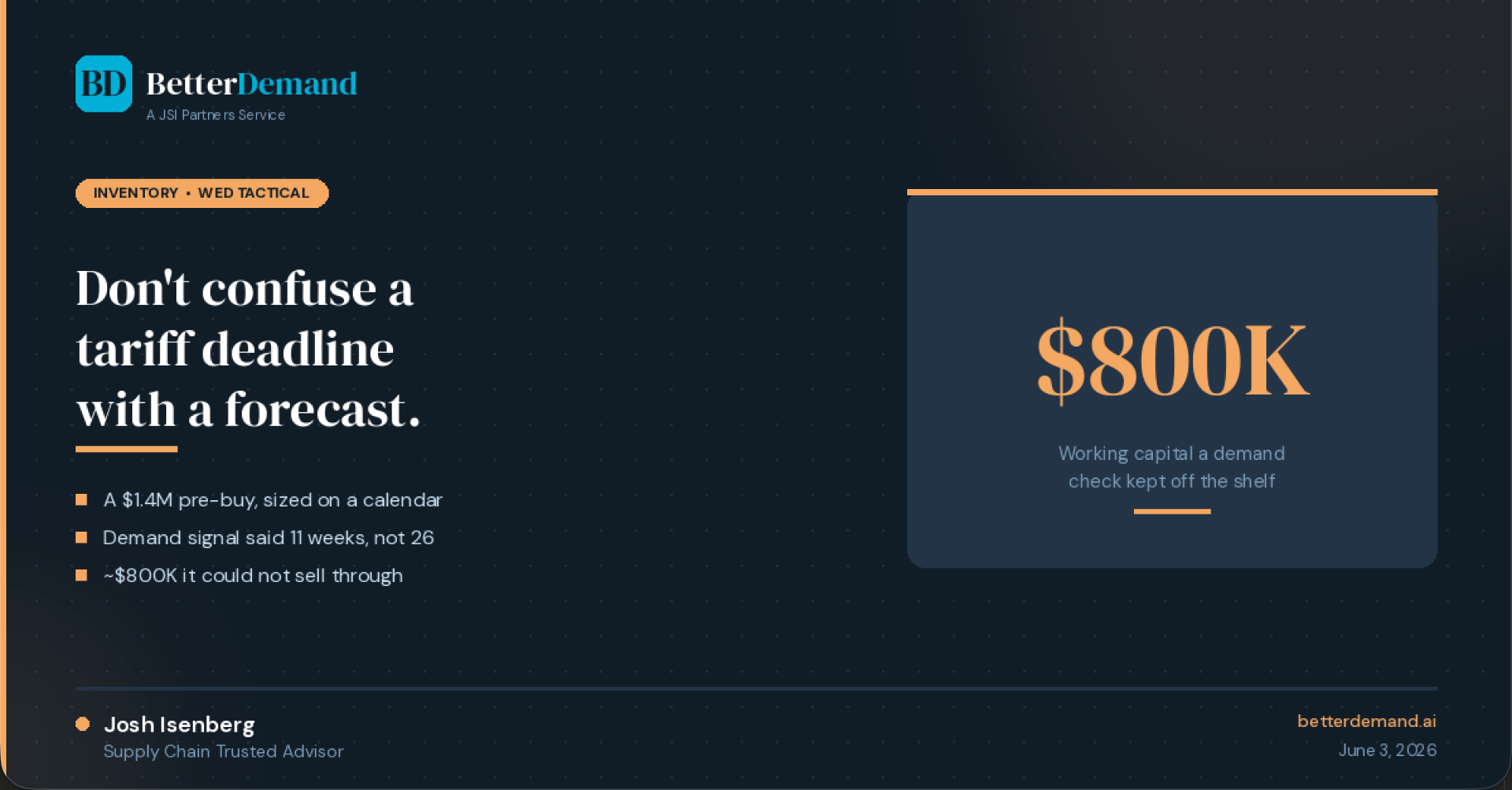
A Tariff Deadline Is Not a Forecast
A mid-market food distributor nearly froze $800K in a tariff pre-buy. Here's how a demand signal sized the decision the calendar couldn't.
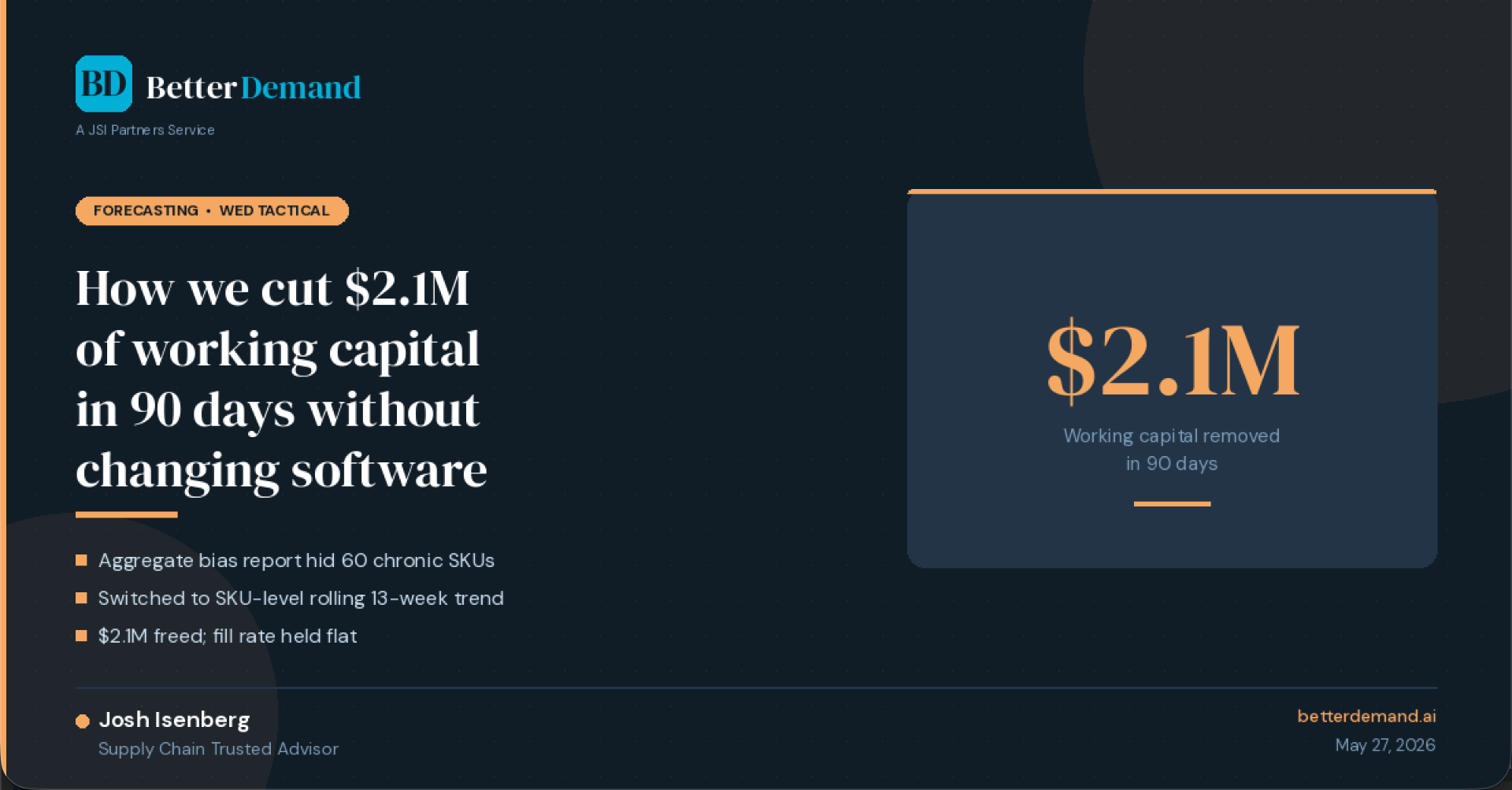
Why Your Forecast Bias Report Is Lying to You
A $90M distributor freed $2.1M of working capital in 90 days by changing how they measured forecast bias — no new software required. Here's the playbook.
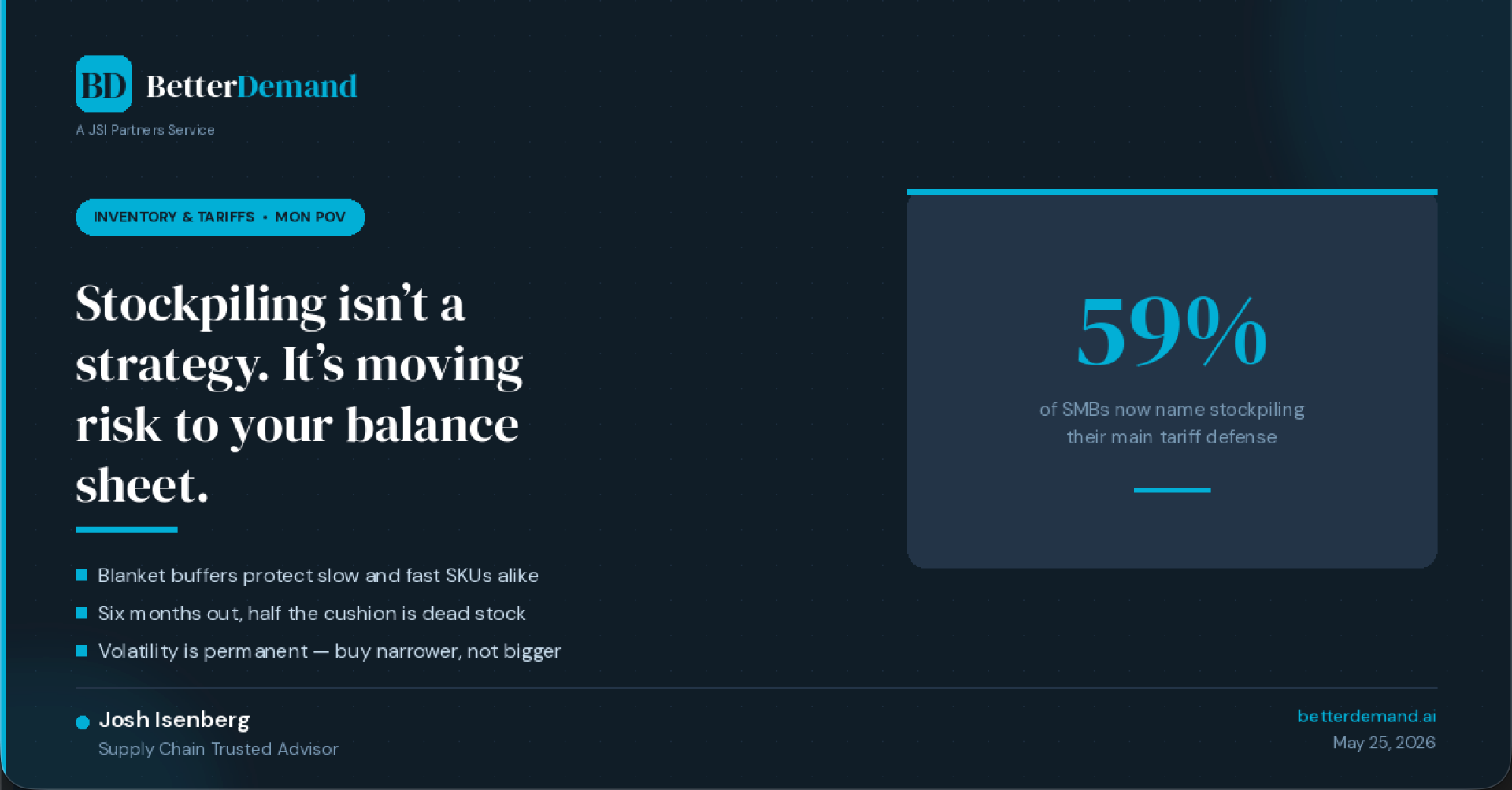
Stockpiling Isn't a Tariff Strategy — It's a Balance Risk
59% of SMBs name stockpiling as their main tariff defense. Blanket safety stock is the most expensive insurance — here's the smarter mid-market move.
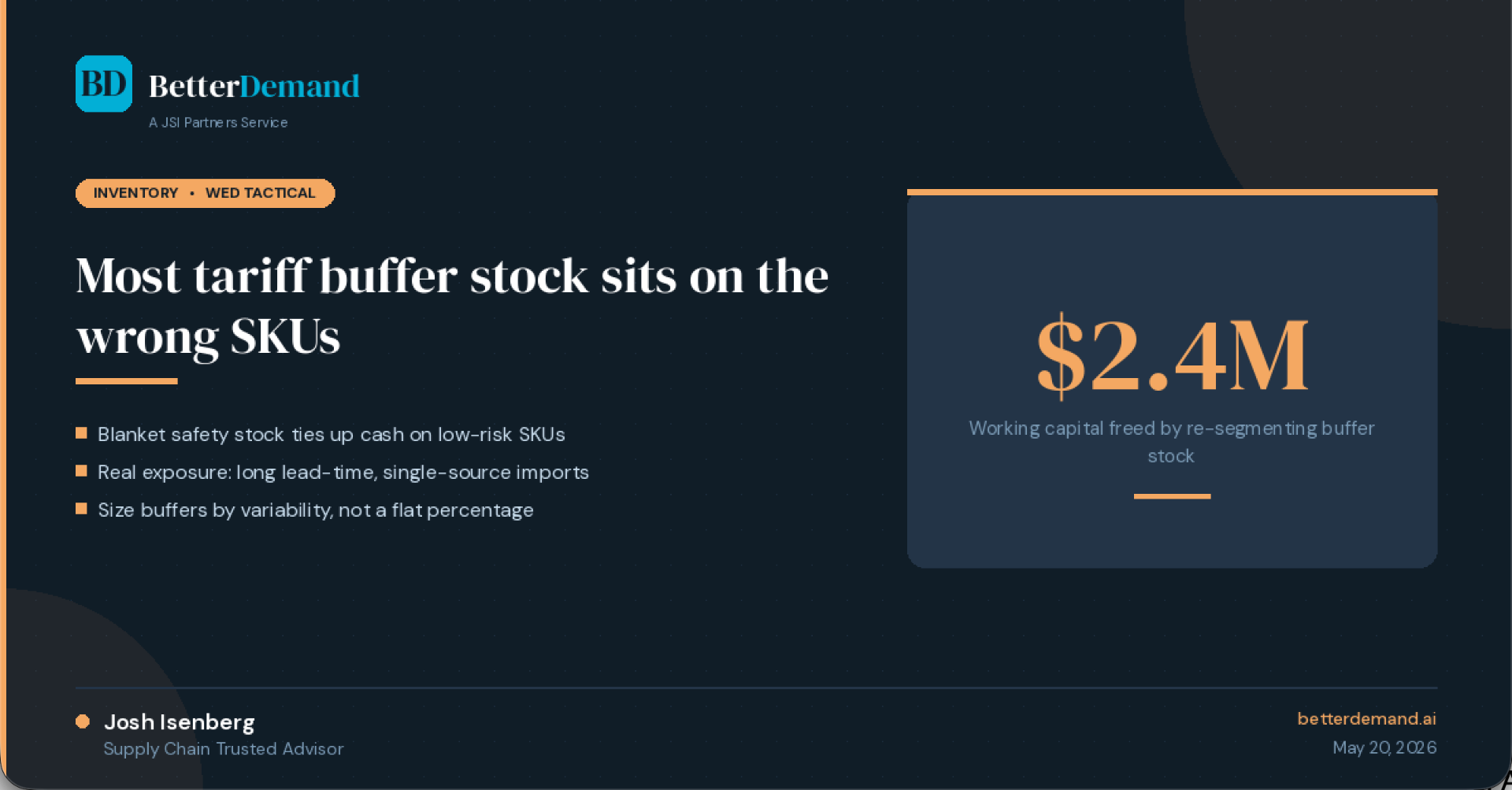
Tariff Buffer Stock: Why Most Teams Cushion Wrong
87% of supply chain leaders raised buffer inventory for tariffs. Most cushioned the wrong SKUs. Here's how to free working capital without losing service.
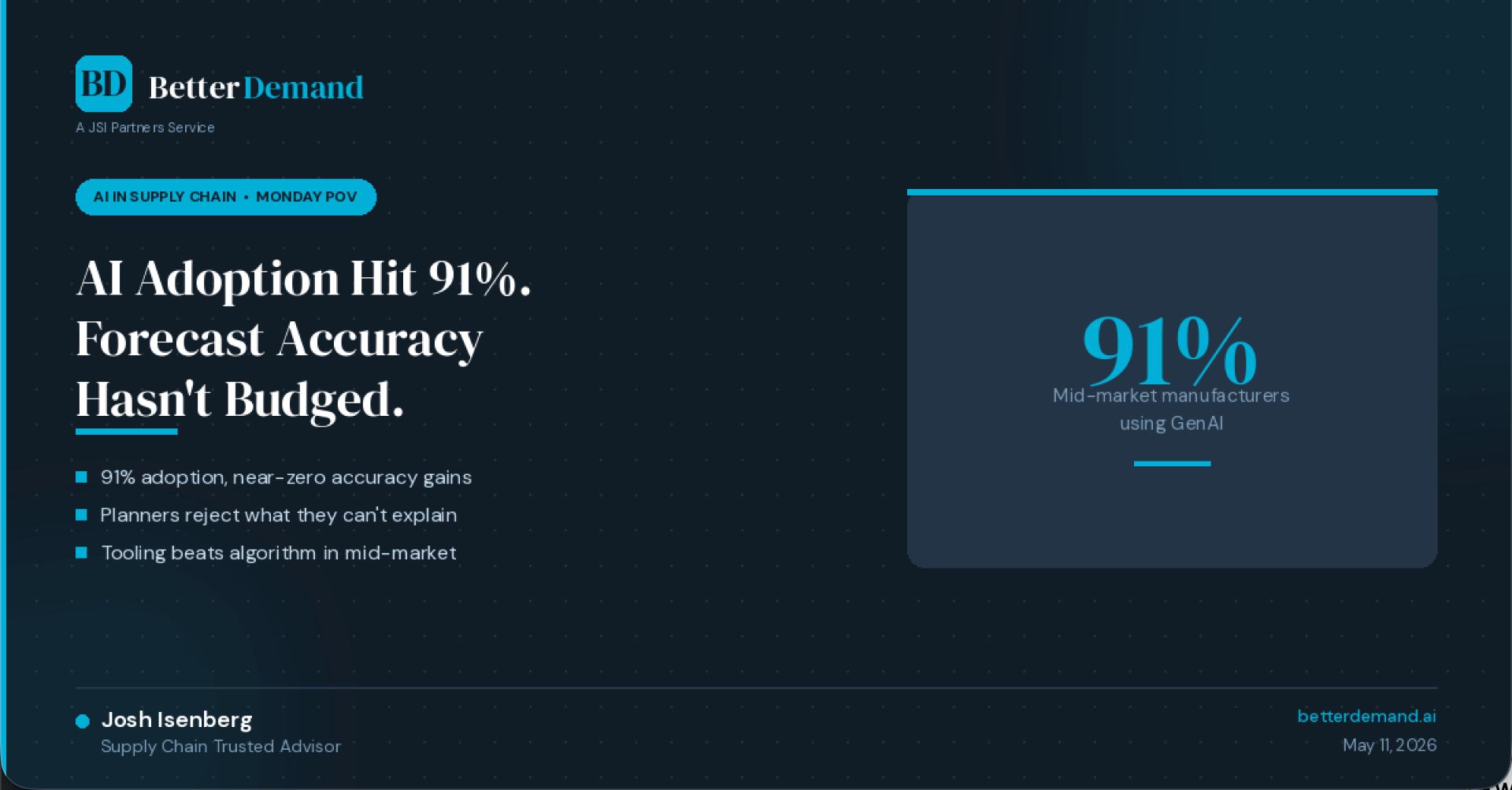
91% AI Adoption, Zero Forecast Change: Pilot Purgatory
91% of mid-market manufacturers use GenAI, but forecasts haven't improved. The real bottleneck isn't the model — it's planner trust and tooling.
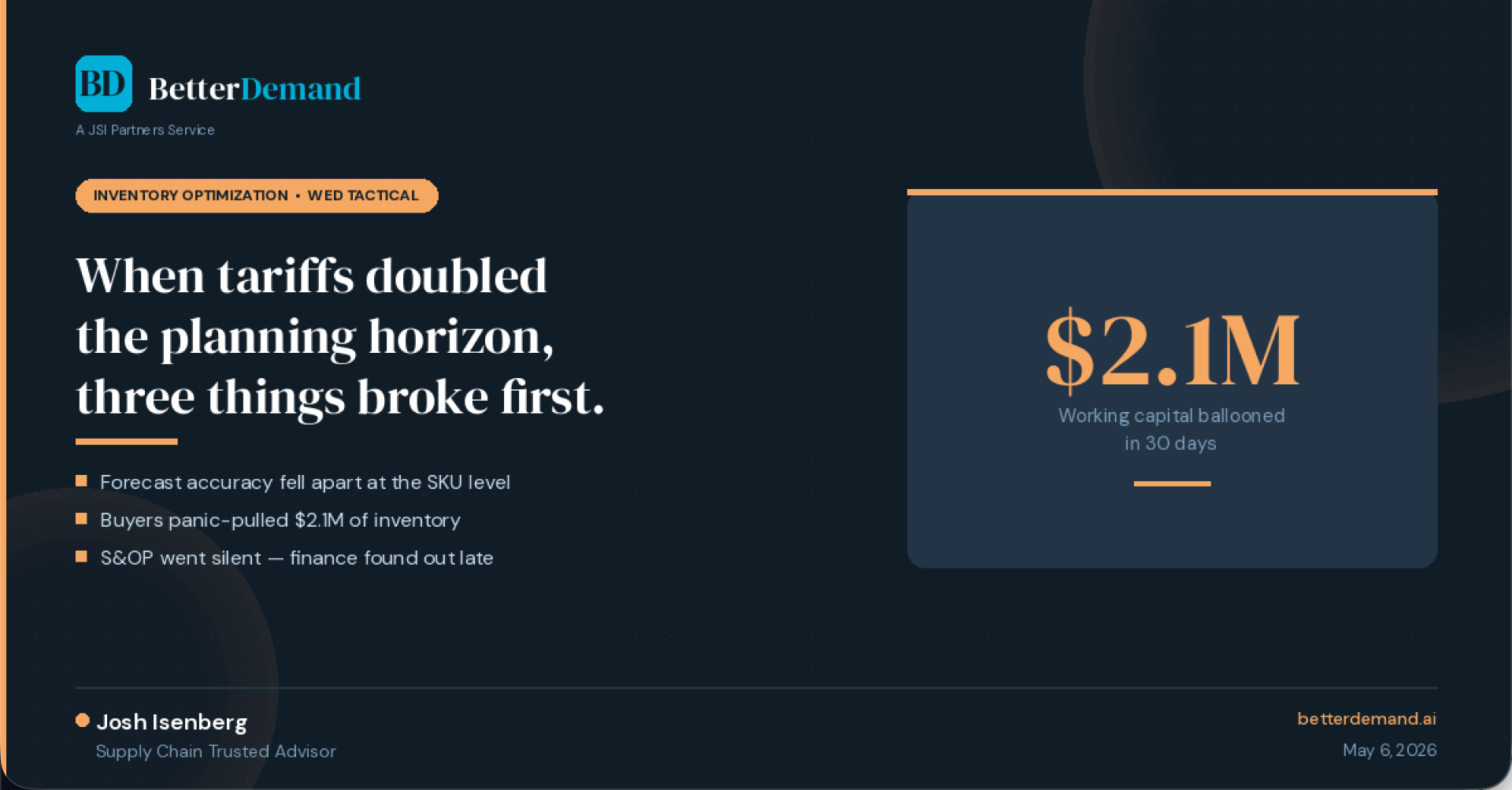
When Tariffs Doubled the Horizon, Three Things Broke
A $60M food distributor doubled its planning horizon under tariff pressure. Forecast accuracy, working capital, and S&OP all broke first. Here's the fix.
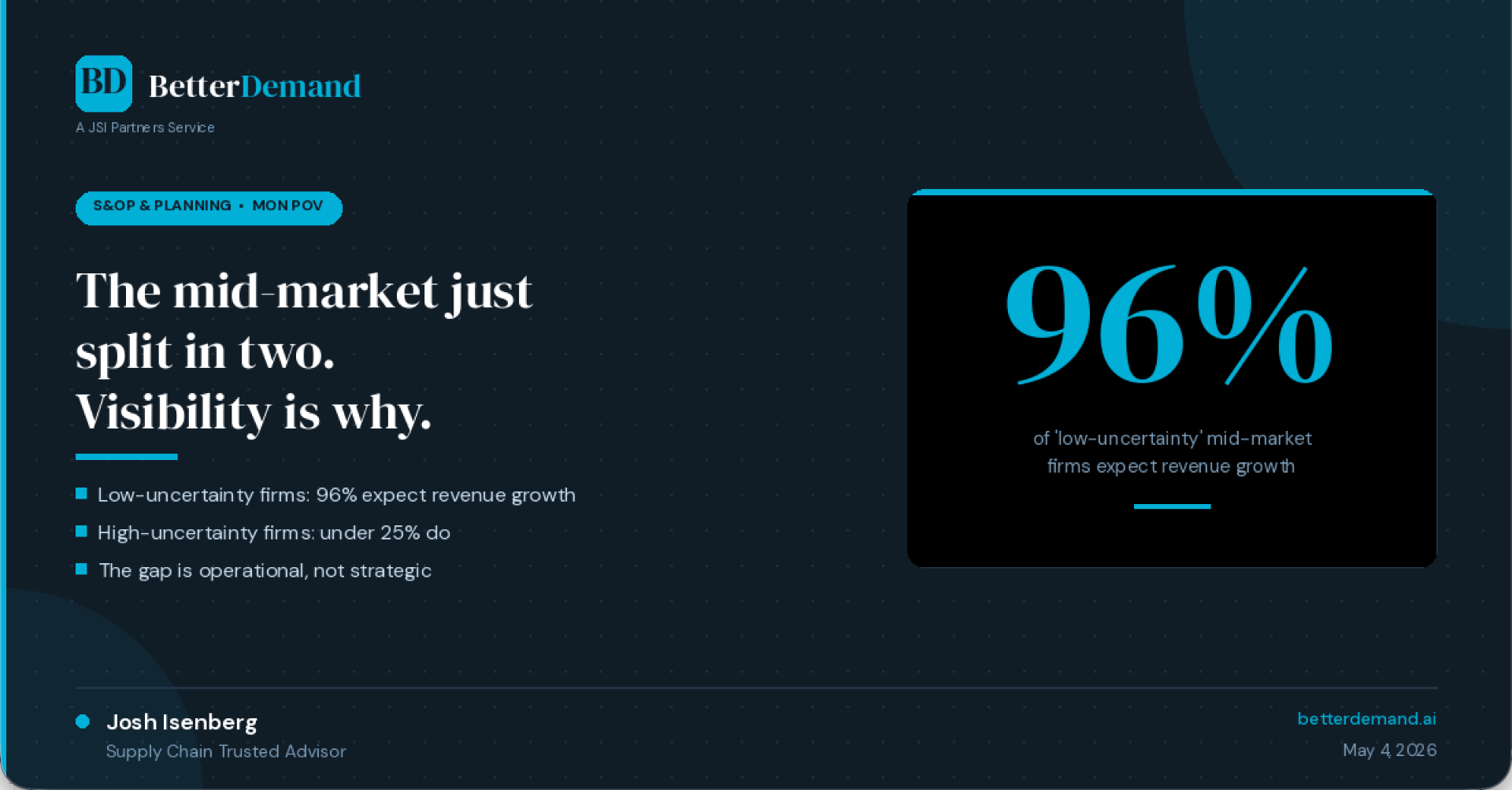
The Mid-Market Just Split in Two — Visibility Is Why
96% of low-uncertainty mid-market firms expect 2026 revenue growth. At high-uncertainty firms, less than a quarter do. Tariffs aren't the gap.
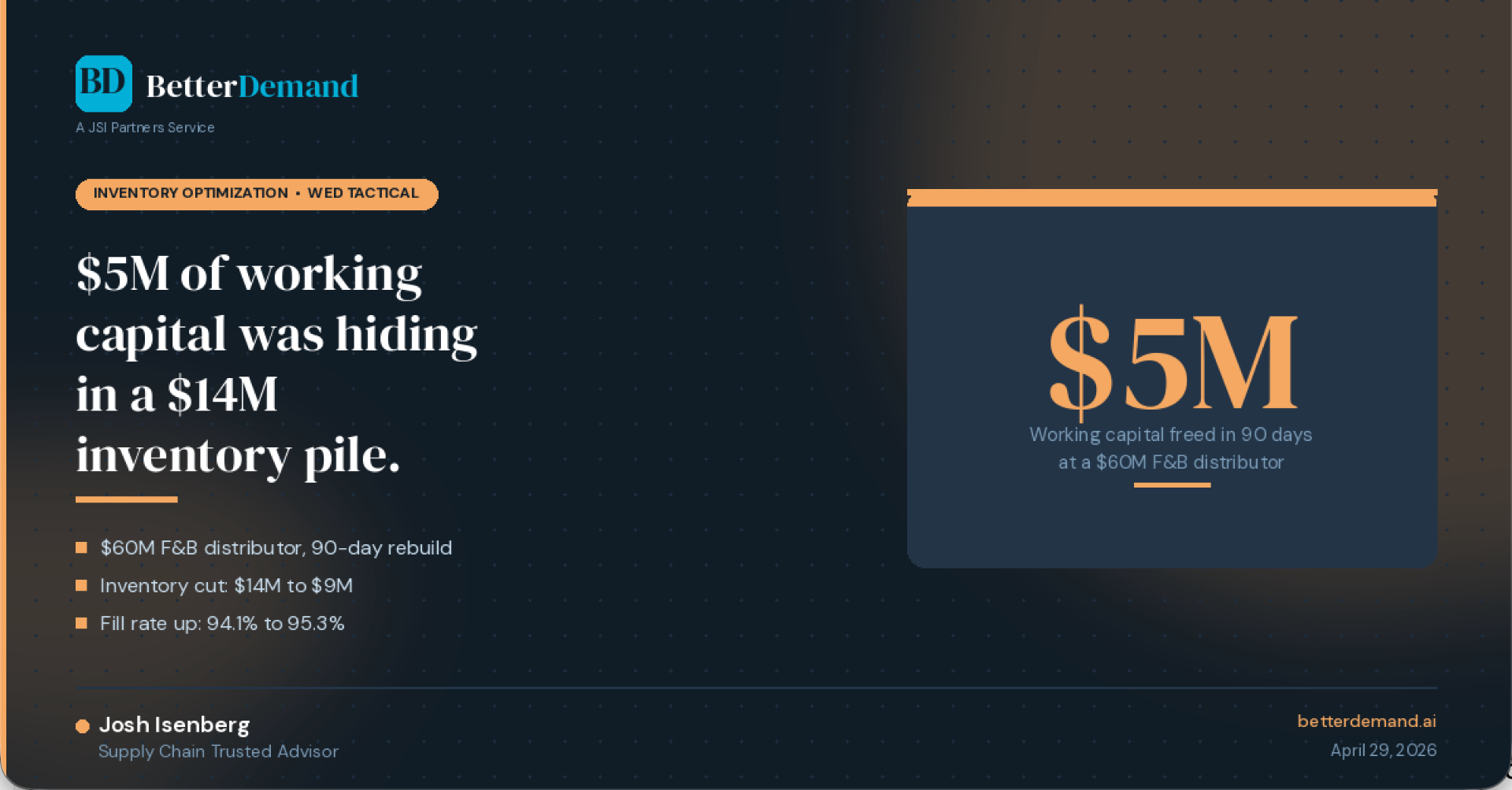
Where $5M Was Hiding in a $14M Inventory Pile
A $60M F&B distributor cut inventory $5M and raised fill rate in 90 days. The trick wasn't cutting harder — it was cutting differently.
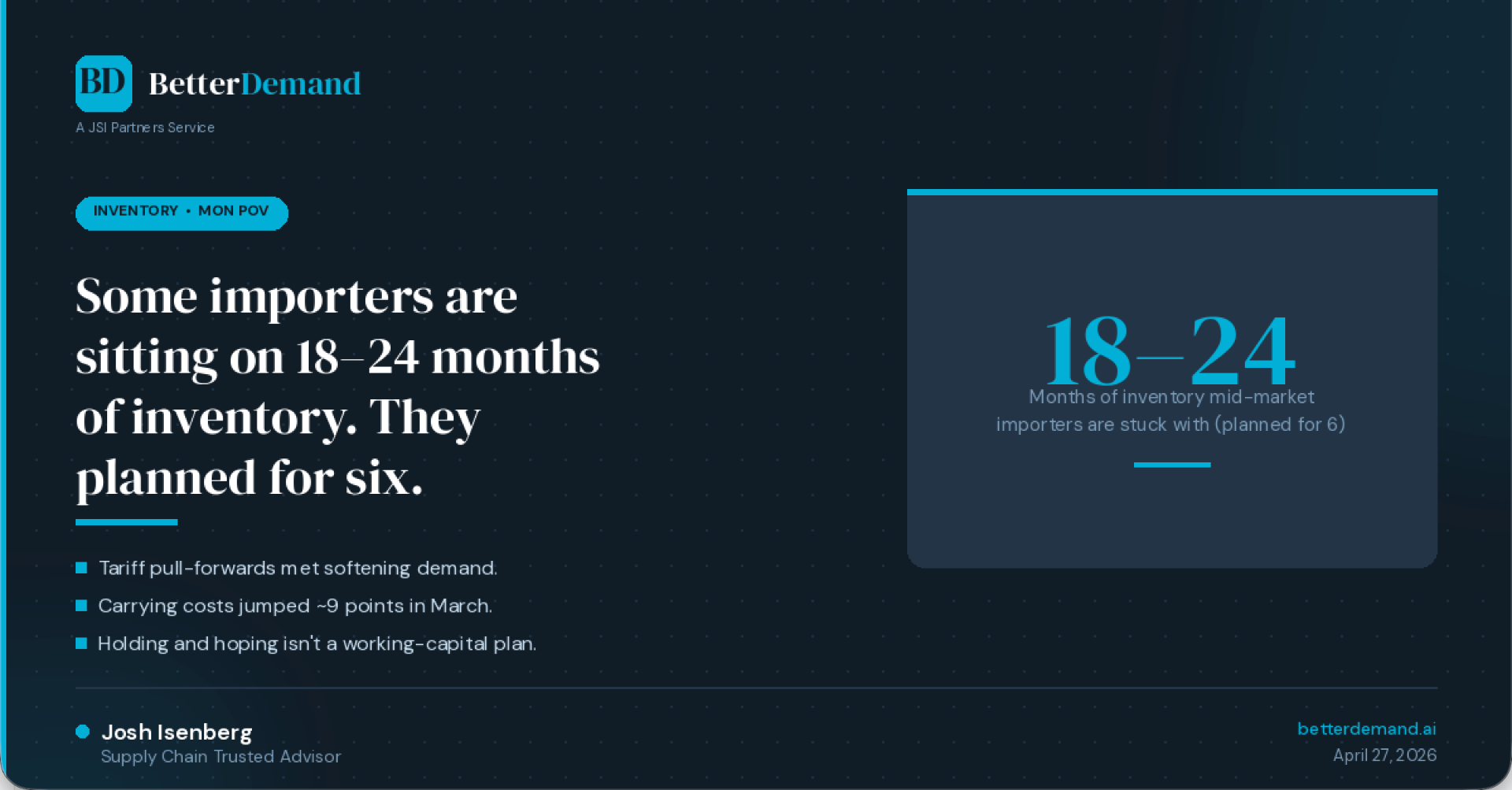
18 Months of Inventory When You Planned for Six
Mid-market importers pulled buys forward to beat tariffs and now hold 18–24 months of stock. The operator playbook to free working capital fast.
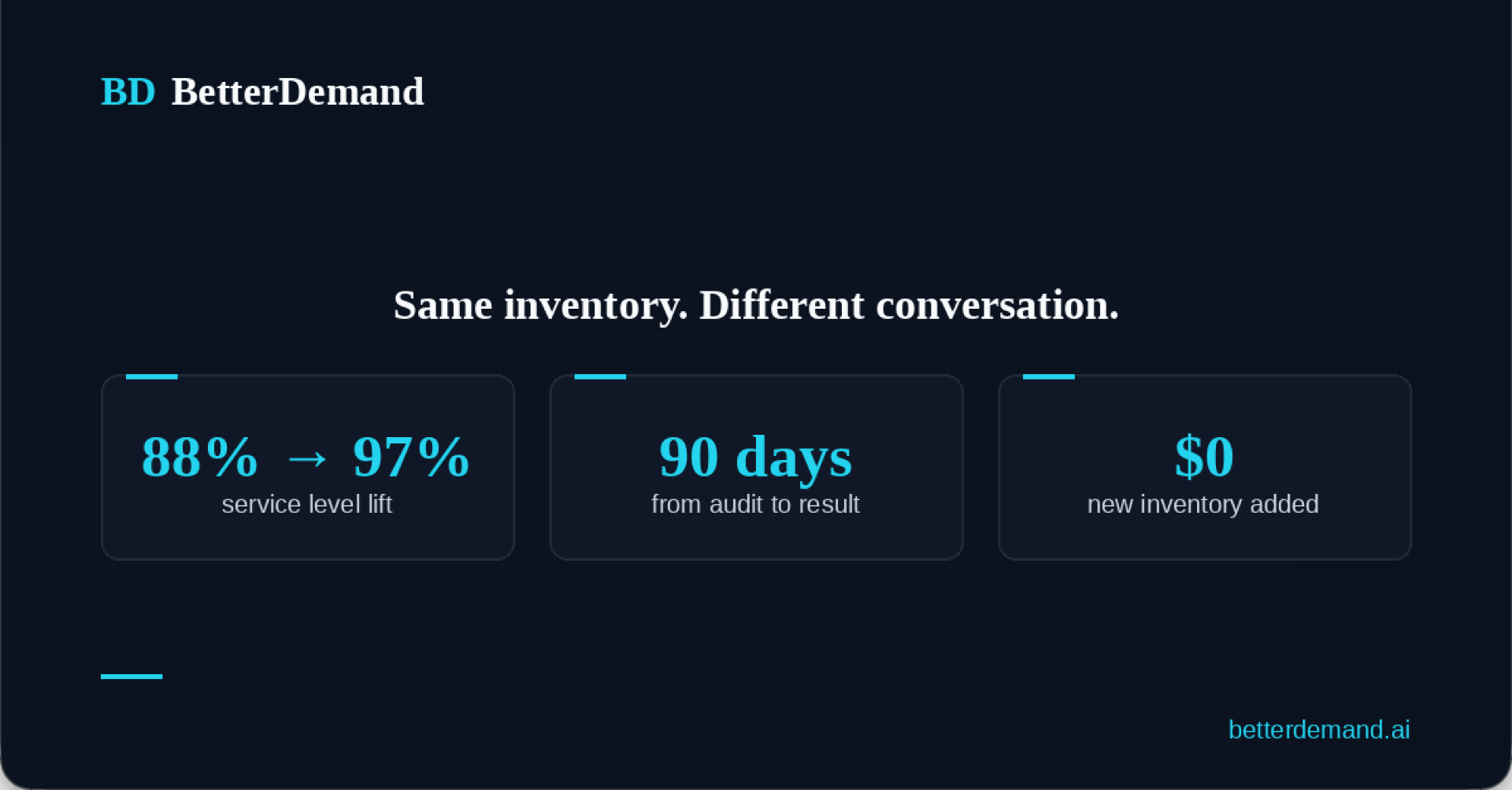
Service-Level Lifts Don't Require More Safety Stock
A four-site manufacturer lifted service levels 9 points in 90 days without adding a dollar of inventory. The fix was a 20-minute weekly meeting.

Why Supply Chain AI Matters More for $50M Companies Than $5B Ones
Enterprise supply chains have 20-person teams. Mid-market has 2 or 3. Here is why an agent is a bigger lever for a $50M company than a $5B one.
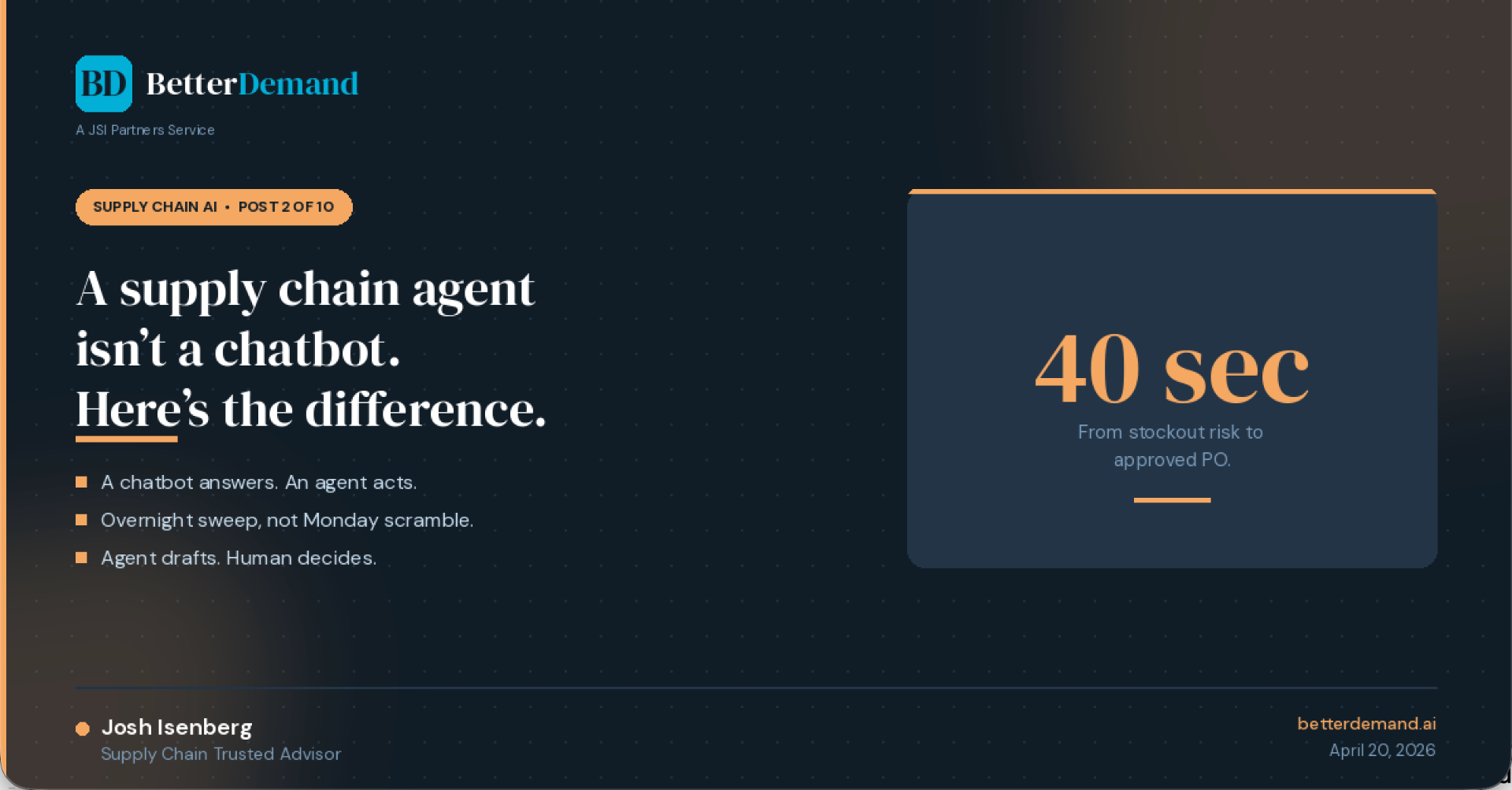
The Difference Between a Chatbot and a Supply Chain Agent
Most people picture a chatbot when they hear "AI for supply chain." An agent is different — it works while you sleep and brings a decision to your desk.
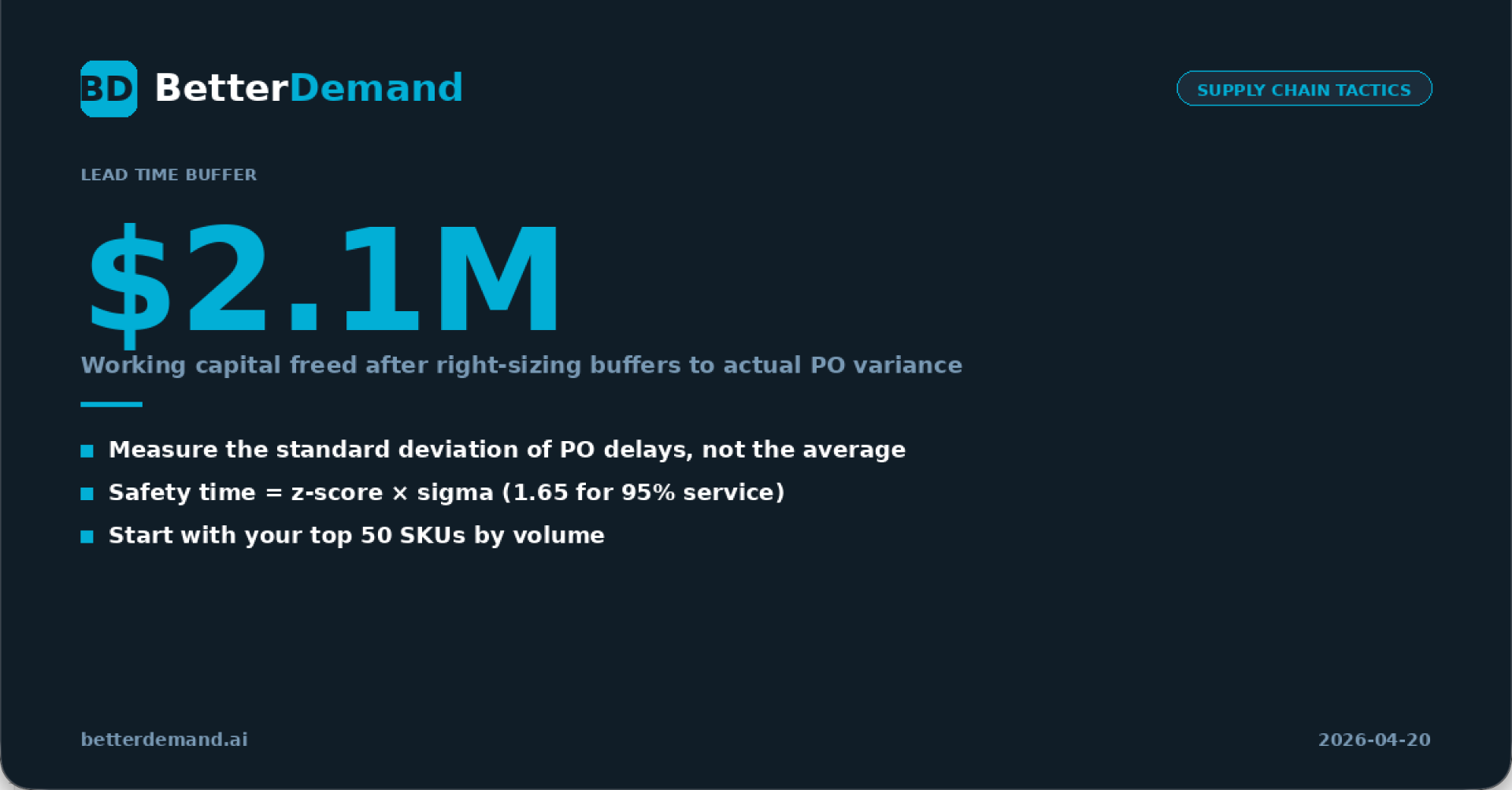
How to Size Lead Time Buffer Without Trapping Cash
Most importers buffer lead time with a gut number. The right math — standard deviation of actual PO delays — frees millions in working capital without hurting service.
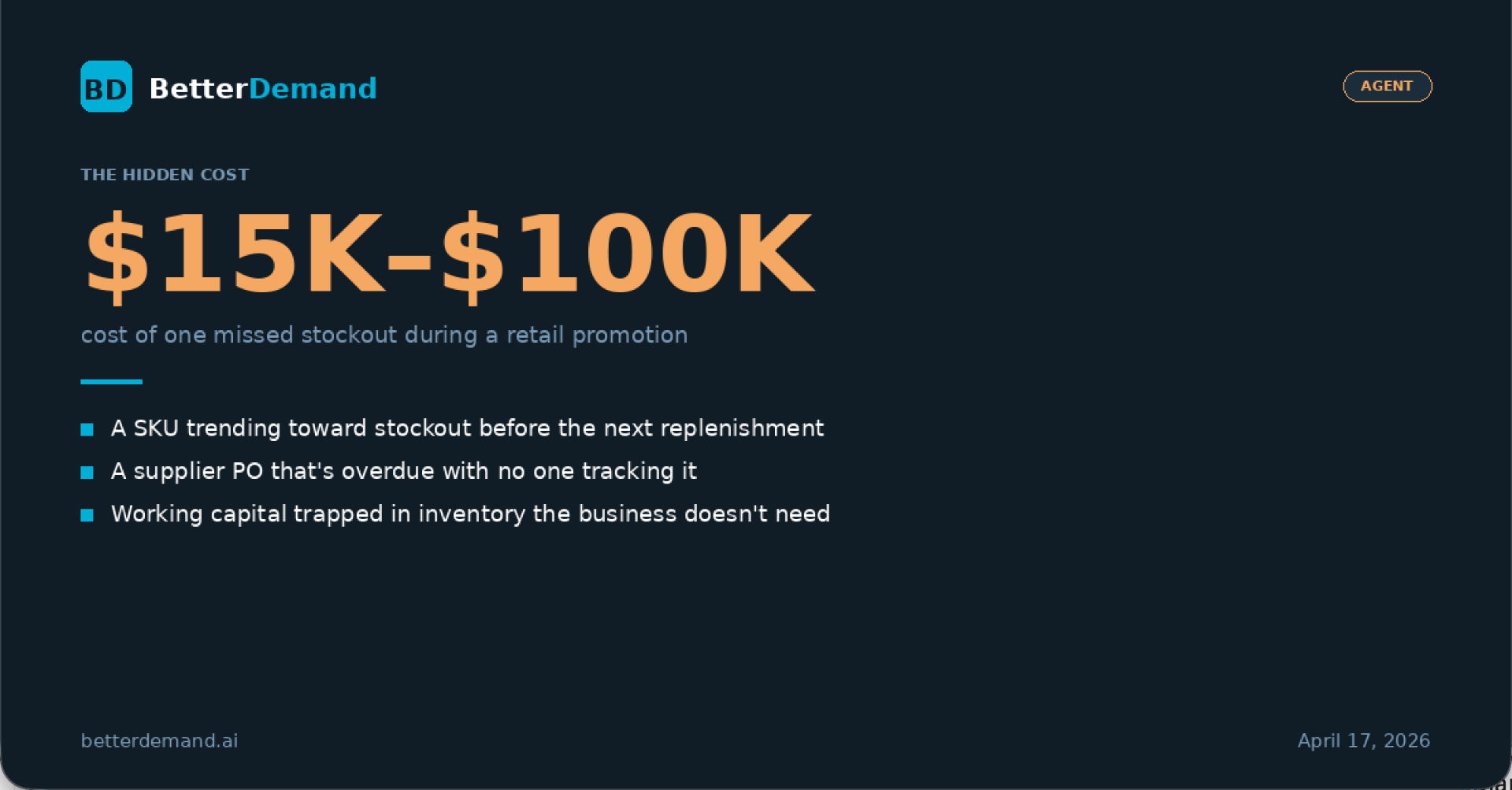
The Supply Chain Risk You Haven't Found Yet
Every $30M-$250M supply chain has at least one invisible risk costing real money. Here's how to find it before it finds you.
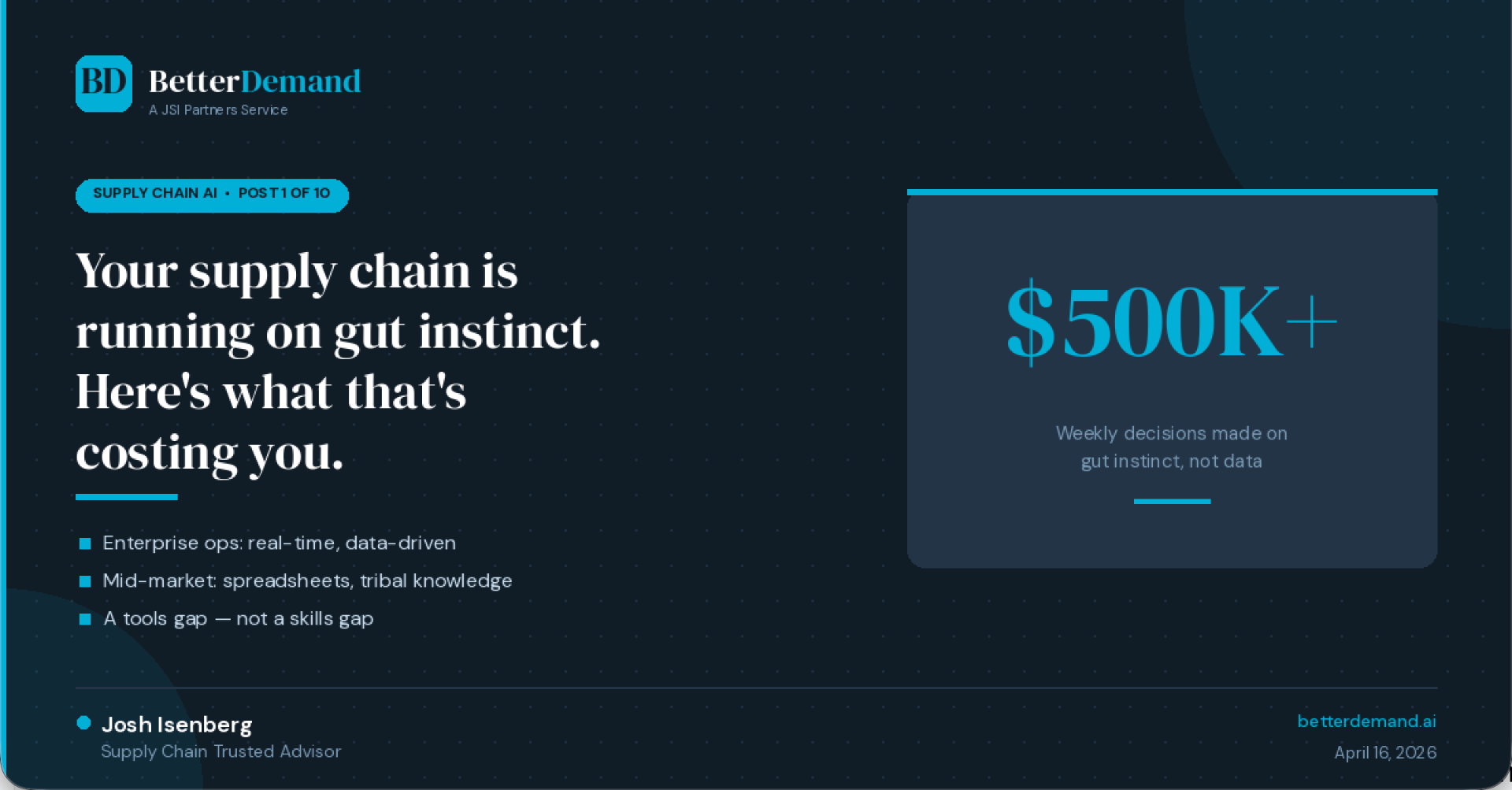
The Hidden Cost of Running Supply Chains on Gut Instinct
Mid-market supply chain teams make $500K decisions every week using spreadsheets and experience. Here's what that tools gap is really costing you.
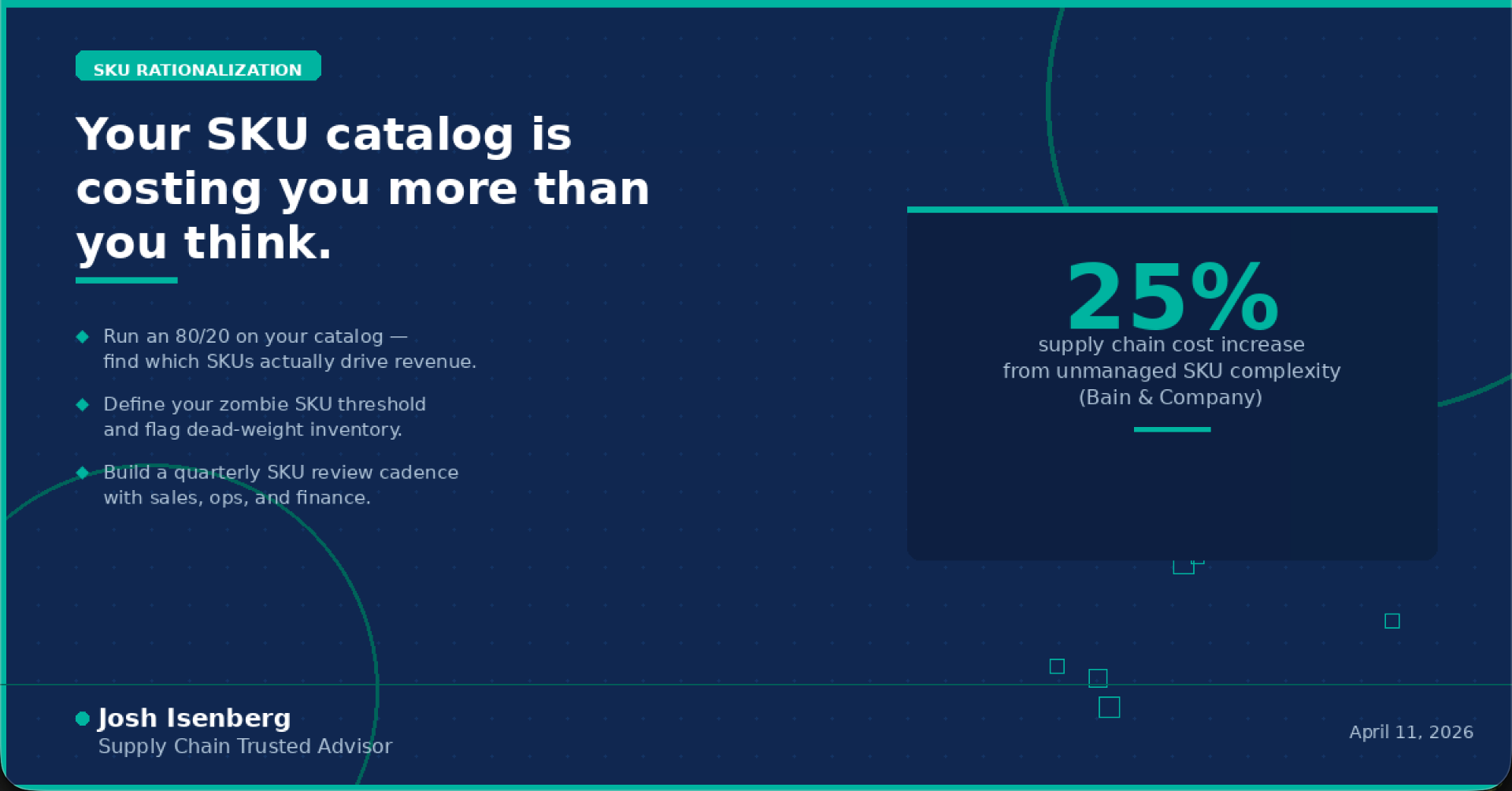
SKU Rationalization: The Silent Supply Chain Cost Driver
SKU proliferation quietly inflates supply chain costs by up to 25%. Learn how mid-market distributors can rationalize their catalog and reclaim margin.
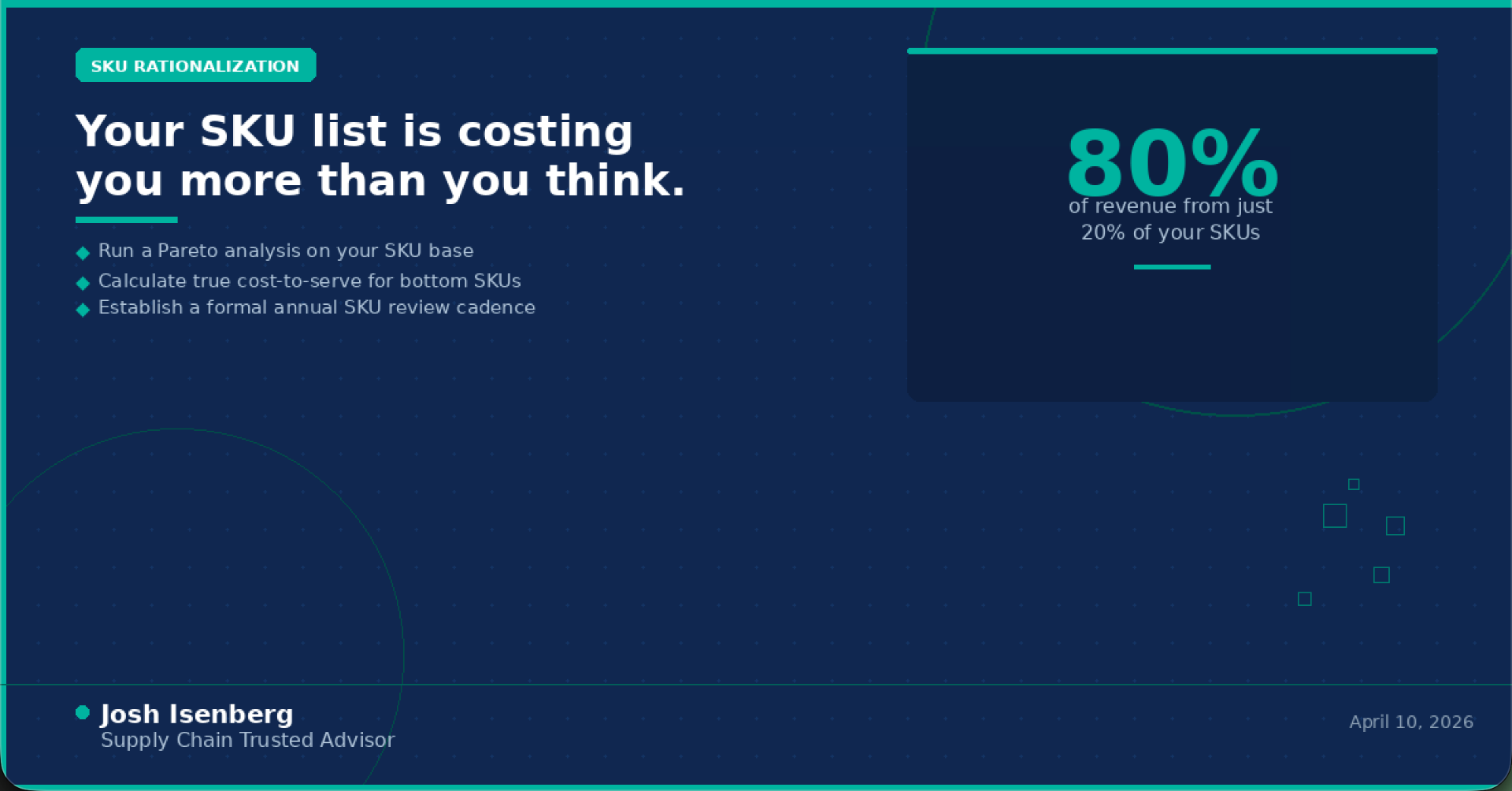
SKU Proliferation: The Hidden Drain on Your Supply Chain
Unchecked SKU growth silently drains planning, warehouse, and service capacity in mid-market distribution. Here's how to spot and stop the bleed.
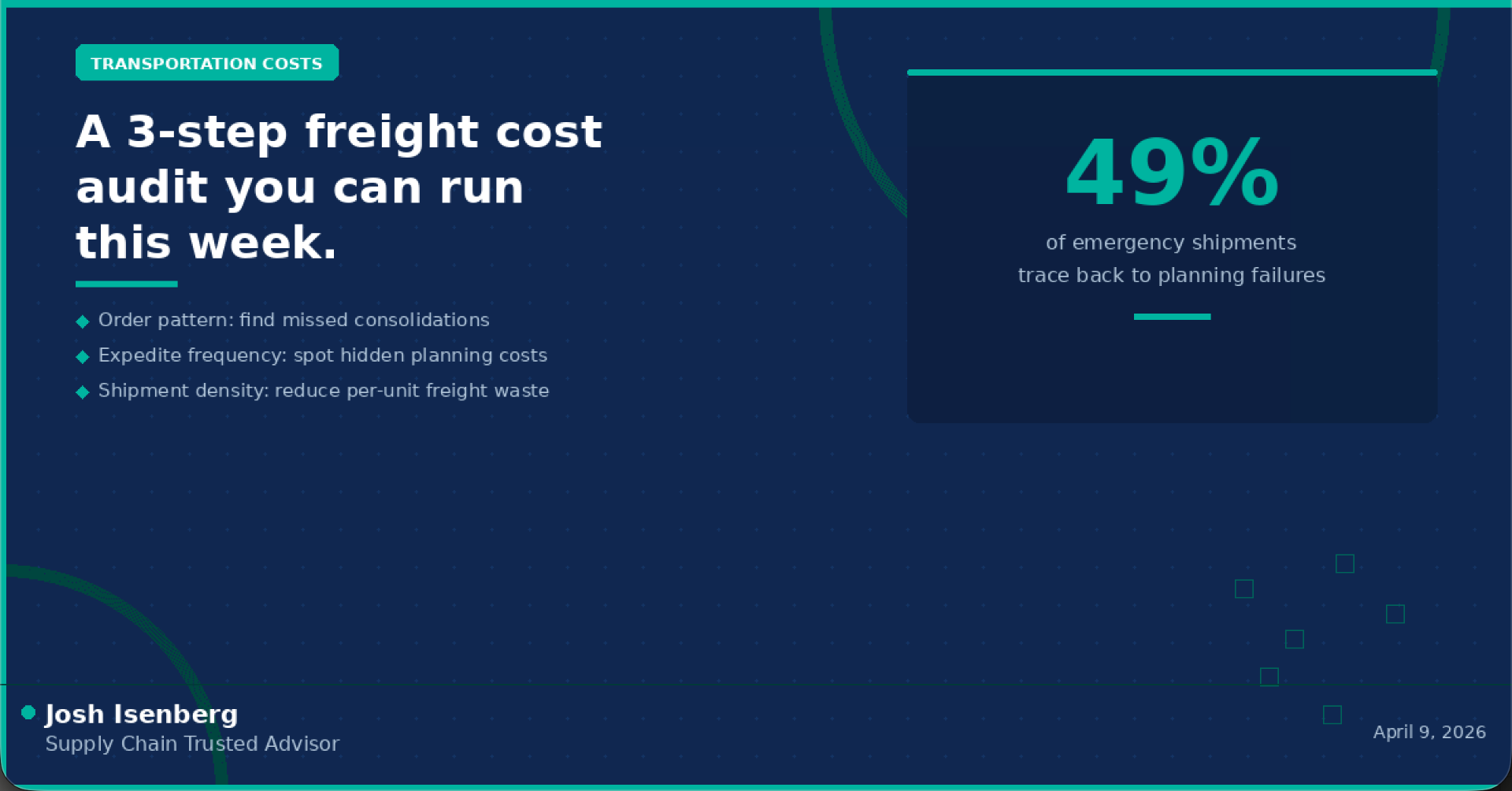
A 3-Step Freight Cost Audit You Can Run This Week
Find your biggest transportation cost leaks with a 3-step freight audit: order pattern analysis, expedite frequency, and shipment density. Run it this week.
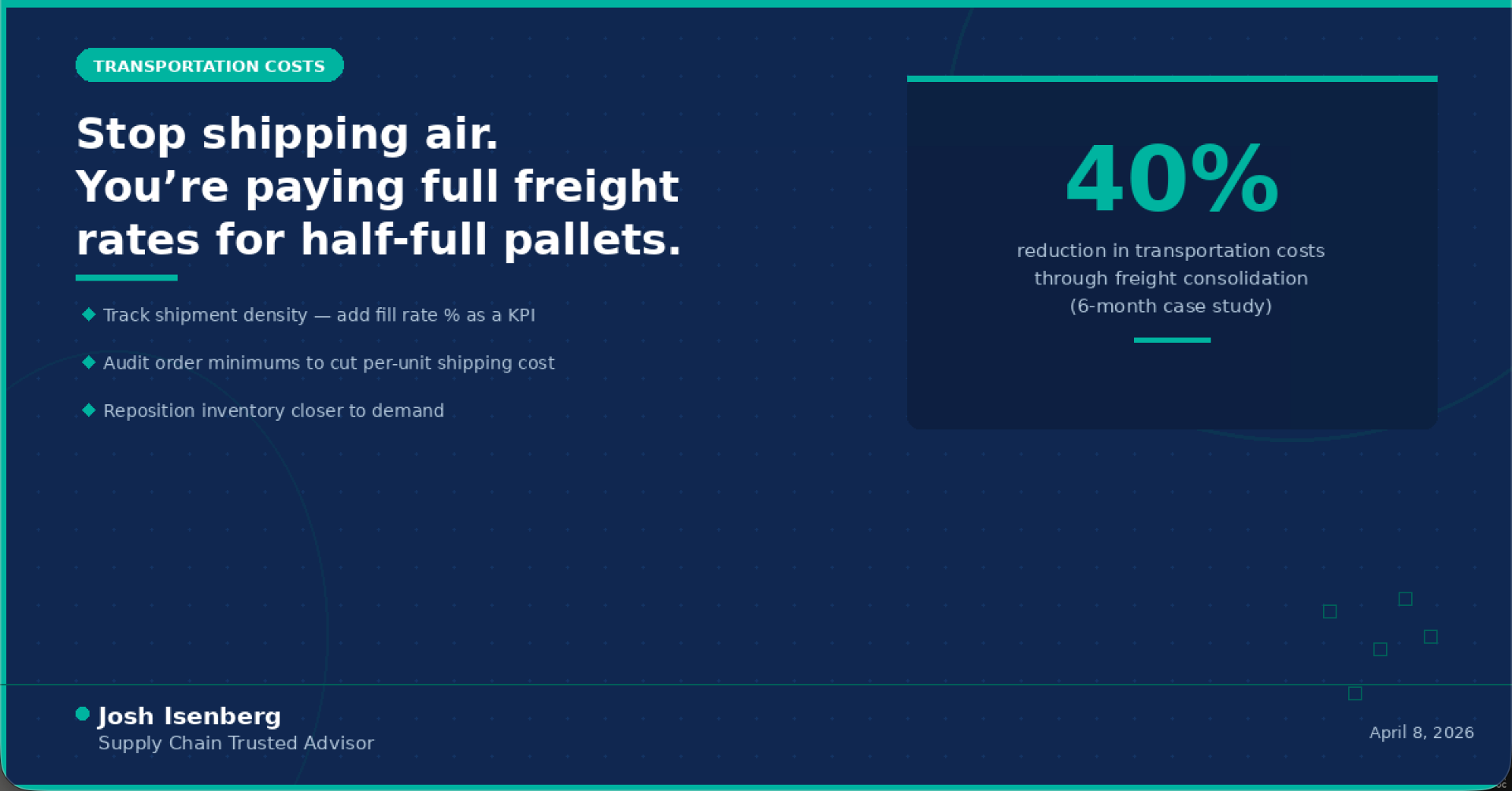
Stop Shipping Air: The Hidden Freight Cost Draining Margin
Rising LTL rates aren't your only freight problem. Shipment density and fill rates quietly destroy per-unit margin. Here's how to fix it in 90 days.
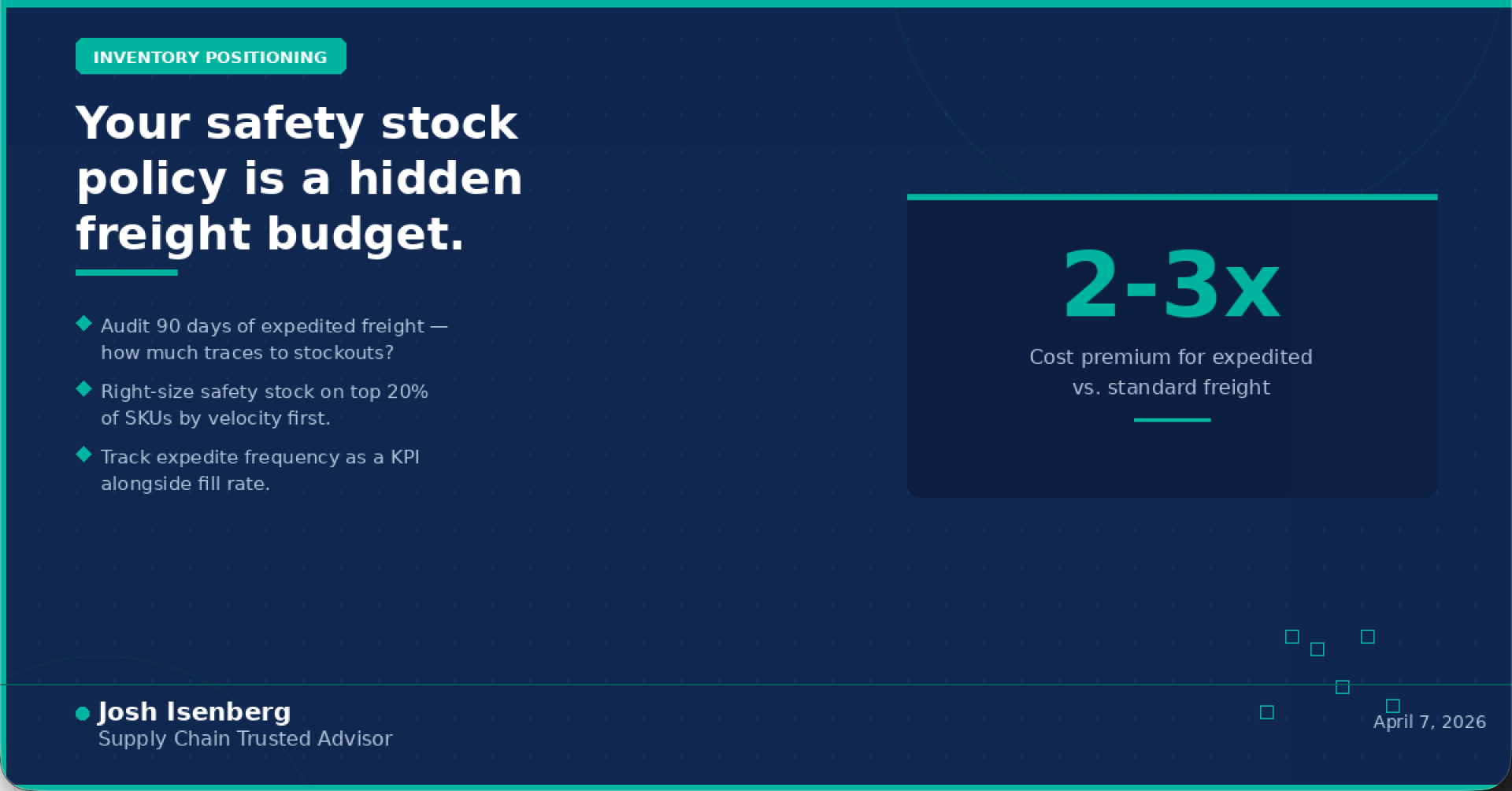
Your Safety Stock Policy Is a Hidden Freight Budget
Discover how poor safety stock calibration silently inflates your freight costs — and three steps to start fixing it this week.
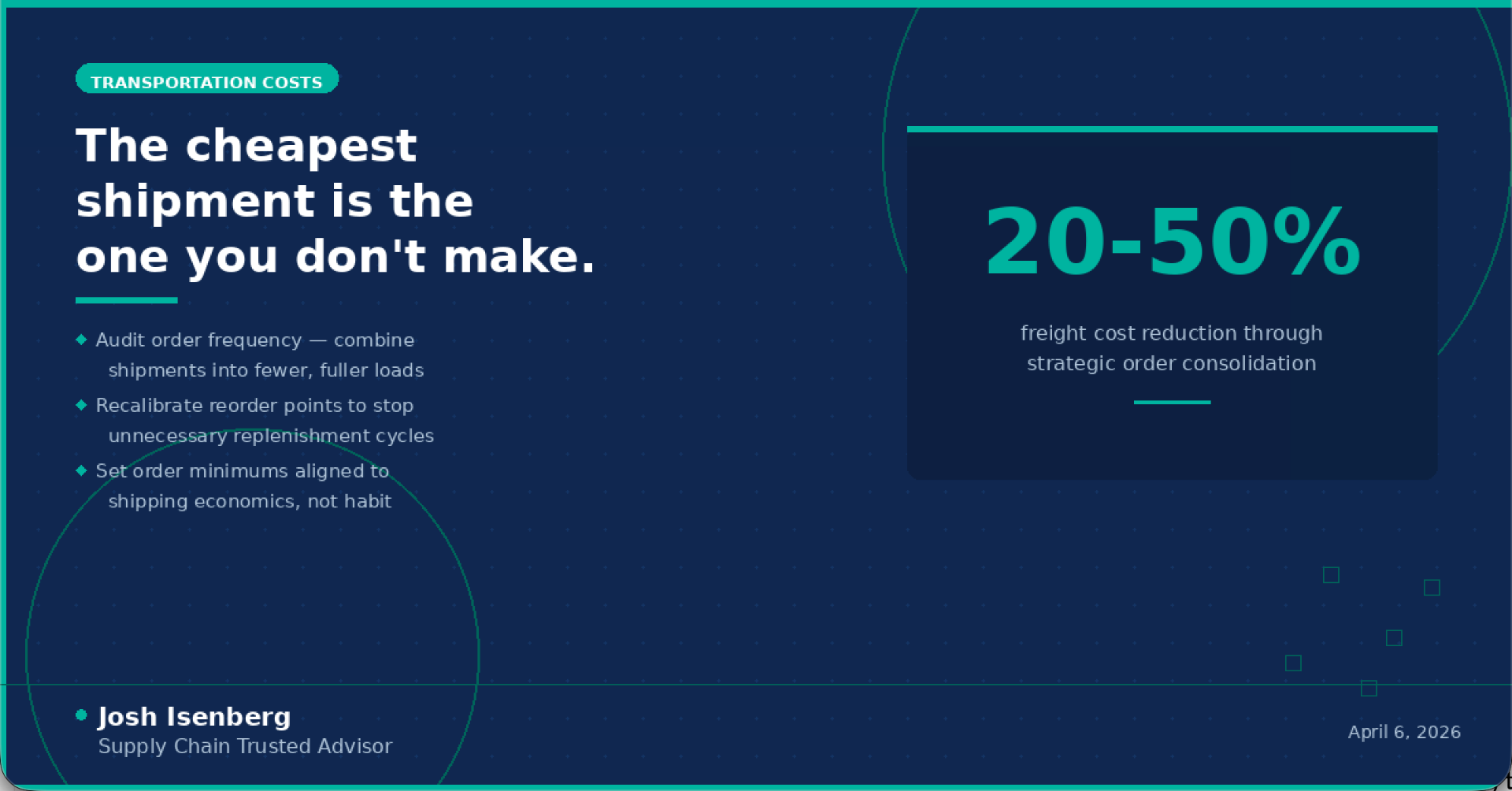
Why Eliminating Shipments Beats Negotiating Freight Rates
Most teams fight rising freight costs by negotiating rates. The bigger lever: eliminate shipments through smarter order consolidation and replenishment.
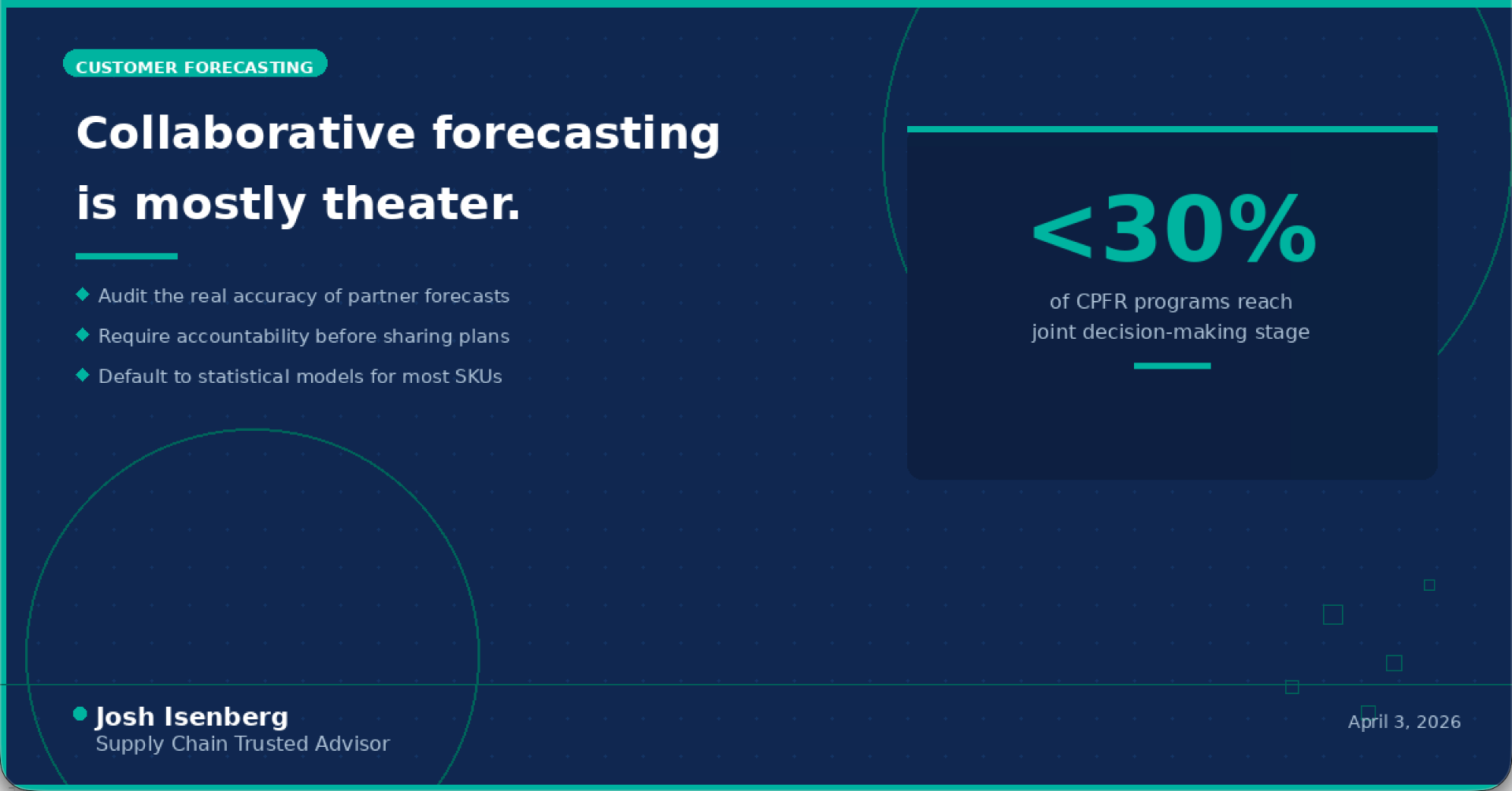
Why Collaborative Forecasting Mostly Fails to Deliver
Despite decades of CPFR evangelism, collaborative forecasting rarely improves accuracy. Learn when it works, when it doesn't, and what to do instead.
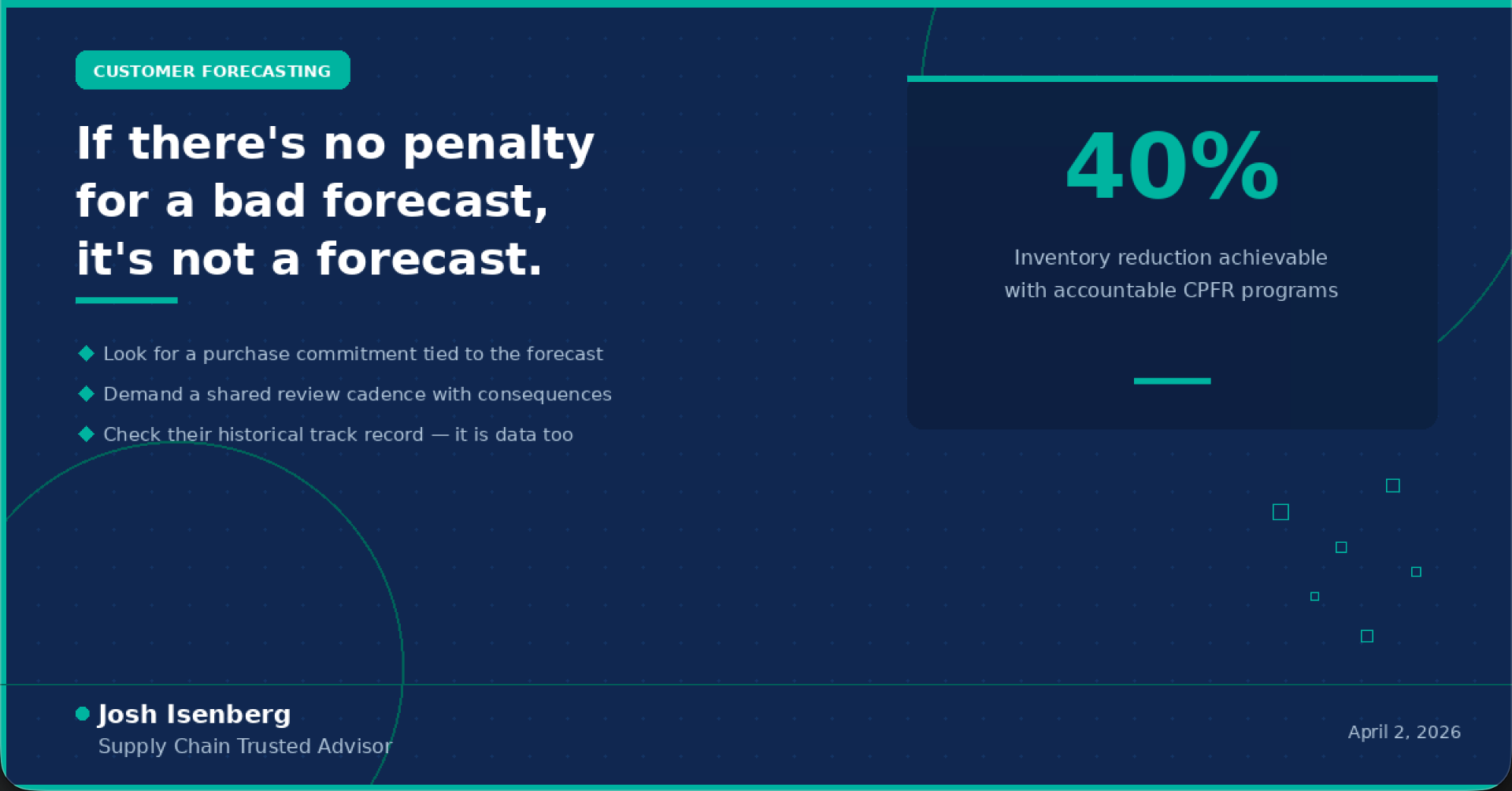
If There's No Penalty for a Bad Forecast, It's Not a Forecast
Most customer forecast sharing is risk transfer, not collaboration. Learn why accountability is the missing ingredient in effective supply chain planning.
5 Forecasting Mistakes That Cost Mid-Market Companies Millions
Avoid the five demand forecasting pitfalls that quietly drain profit and erode supply chain performance at $30M–$250M manufacturers and distributors.
Your Demand Forecast Isn't Wrong Because of Bad Software
Sales, Finance, and Operations don't share the same forecast — and that's why your numbers miss. Here's the alignment fix that actually works.
Your Safety Stock Formula Is Probably Lying to You
Set once during an ERP implementation and never touched again — that buffer inventory has quietly become either a cash trap or a stockout waiting to happen.