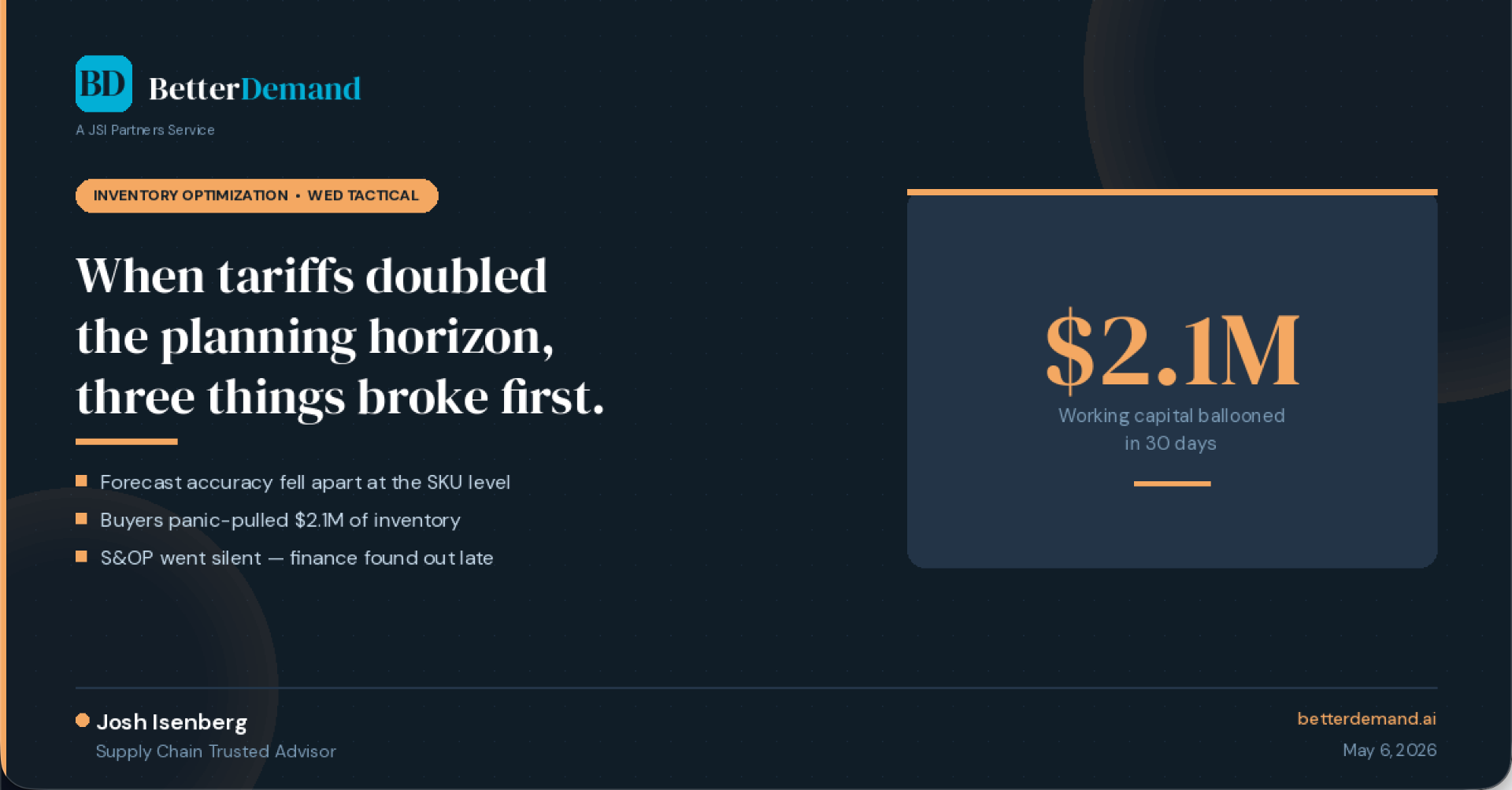
When Tariffs Doubled the Horizon, Three Things Broke
Tariff volatility forced a $60M food distributor to double its planning horizon overnight. Same model, twice the window. Three things broke in week one — and the fix wasn't software.
This is the pattern we keep seeing across mid-market product companies in 2026. Tariff uncertainty pushes leadership to extend planning horizons — eight weeks becomes sixteen, twelve becomes twenty-four — without changing how the underlying forecasting and S&OP processes actually work. Roughly three-quarters of small and mid-sized businesses have stretched their planning horizons in response to tariff volatility this year. Most are about to find out, the expensive way, that doing the same thing for longer is not the same thing as doing it well.
What Actually Broke
For this distributor, the assumption was that the existing spreadsheet model would scale. It didn't. Three things broke almost immediately.
Forecast accuracy collapsed at the SKU level. The aggregate number looked fine — total volume was within 4% of plan. But the top 50 SKUs swung 30%+ off baseline. The model wasn't decomposing seasonality, trend, and event-driven demand properly past the eight-week mark. At a longer horizon, those errors compounded. Sales saw the aggregate green light. Ops saw the SKU-level red lights. Nobody reconciled.
Working capital ballooned $2.1M in the first 30 days. The buyer, reasonably worried about tariff timing, pulled orders forward to get ahead. Nobody modeled the cash impact. Inventory turns dropped from 9.2 to 7.4 in a single month. The CFO found out when the line of credit hit a covenant threshold.
S&OP went silent. The monthly cadence couldn't keep up with the noise. Sales kept selling off the old forecast. Ops kept buying off panic. Finance was running blind for three weeks at a stretch. By the time the team caught it, the working capital damage was already done.
What Actually Fixed It
The fix was three changes — none of them software.
First, a two-hour weekly cross-functional huddle replaced the monthly S&OP. Demand planner, ops lead, sales lead, finance. One agenda. One forecast version. One question per SKU class: are we still right about this?
Second, a clean SKU-level decomposition. Separate the trend from the seasonality from the event-driven demand. At the longer horizon, those layers behave differently and need to be modeled differently. The aggregate number is the last thing you should trust, not the first.
Third, a written governance rule: any pull-forward order over $250K required CFO sign-off. Not approval theater — a forced 24-hour pause to model the cash impact before placing the order. Most pull-forwards didn't survive the pause.
Working capital normalized within 60 days. Forecast MAPE dropped 14 points. S&OP cadence stuck at weekly.
The Mid-Market Lesson
If you're extending your planning horizon in 2026 because of tariff or sourcing uncertainty, ask one question before anything else: does our current process actually work at the new horizon, or are we just running the old playbook longer? In most cases the answer is the second one, and the gap shows up in working capital before it shows up in the forecast report.
Doubling the horizon means doubling the discipline. Different decomposition, different cadence, different governance. Same model, longer window — that's how you balloon $2.1M before anyone notices.
Ready to Forecast Smarter?
BetterDemand combines AI-powered forecasting with real supply chain expertise. Visit betterdemand.ai to learn how we help distributors and manufacturers plan with confidence.