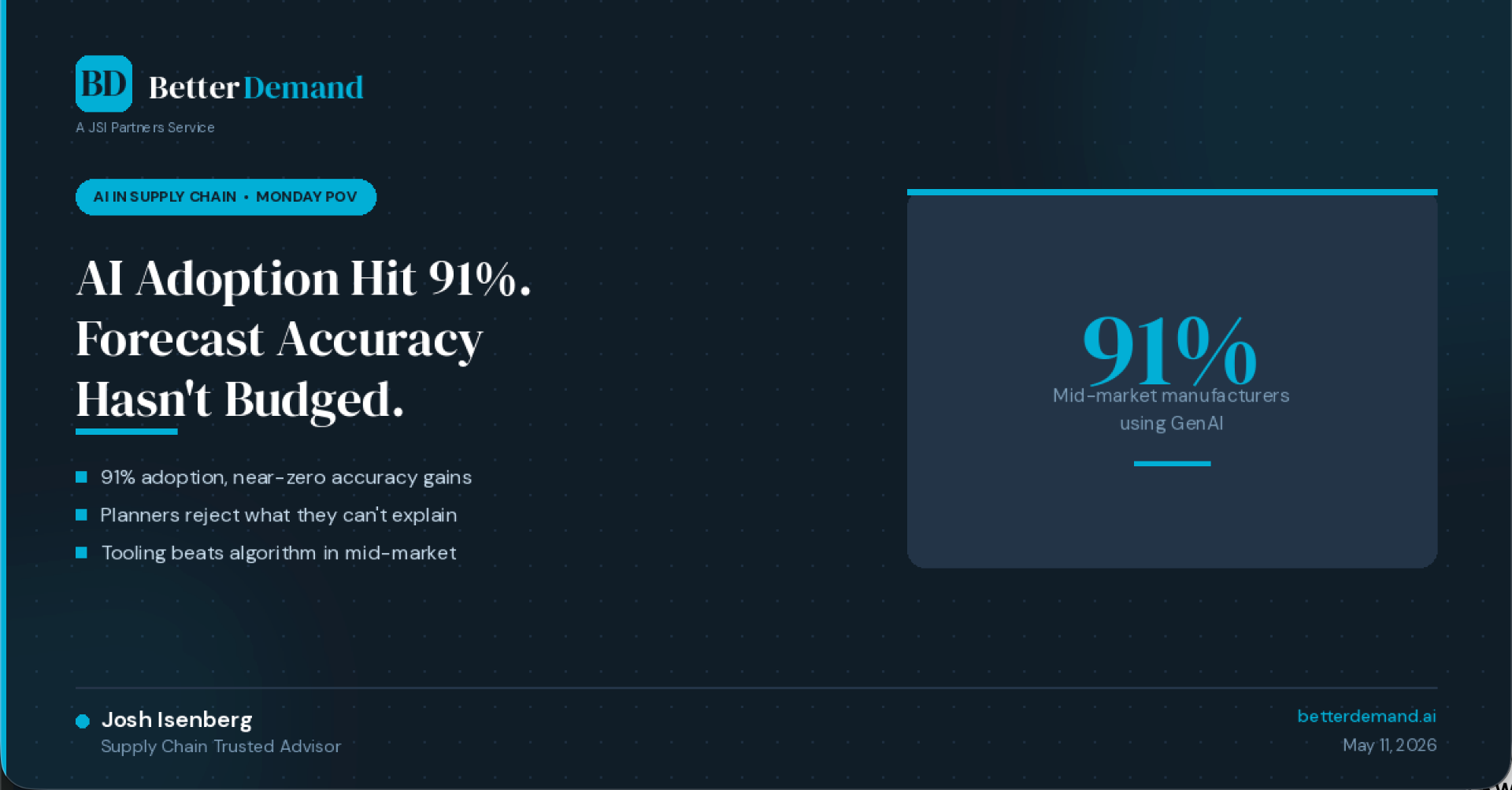
91% AI Adoption, Zero Forecast Change: Pilot Purgatory
A new round of mid-market manufacturing reports landed this month, and one number keeps showing up: 91% of mid-market manufacturers say they are using generative AI in some part of their operation. That sounds like a quiet revolution. It isn't. Walk into the S&OP meeting at almost any company between $40M and $250M in revenue, and the forecast on the screen looks exactly like it did two years ago — built in a spreadsheet, edited by hand, and barely connected to whatever AI tool the company bought last fiscal year.
I've spent the last six months in those rooms. The pattern is almost identical every time. Someone bought an AI tool. IT ran a pilot. The exec team got a demo. Then everyone returned to their day jobs, and the tool quietly slid into the same drawer as the last three planning platforms.
The Real Problem Isn't the Model
Most coverage of AI in supply chain frames the problem as technical. Better models. More data. Bigger pipelines. But that framing misses what's actually happening on the ground.
The planner — the person who owns the forecast number that the CFO and COO are going to argue about — does not trust a forecast they can't explain to their boss. And almost every AI forecast handed to a mid-market planner today comes with no story. Just a number, a confidence band, and a button. When the CEO asks why the number is what it is, "the model said so" is not a survivable answer.
So the planner does what any rational operator does. They open their spreadsheet, layer in what they actually know about the next promotion, the customer that's about to lose a major account, and the supplier whose lead time is creeping up. Then they go to S&OP with the spreadsheet number, not the AI number. The AI sits on a different tab, used as a sanity check at best.
That's not a failure of the model. That's a failure of how AI was introduced into the planning workflow.
What Mid-Market Actually Needs to Get Out of Pilot
The companies that are going to actually move forecast accuracy in the next 18 months will do three unglamorous things.
First, they will stop asking the planner to validate AI output and start asking the planner what they need from a forecast to use it. The planner is the customer of the AI, not the auditor of it. Most mid-market deployments have this backwards.
Second, they will pick tools where the AI forecast and the human override live in the same view, not in different systems. As long as the AI lives in a separate tab, it is a science project with a budget.
Third, they will give one person on the leadership team — not IT, not the data team — explicit ownership of whether AI is actually changing the decisions the company makes. If no one is measured on that, no one moves it.
None of this requires a model breakthrough. It requires admitting that the bottleneck in mid-market AI adoption is not the technology. It's the org chart and the workflow around it.
The Honest Read on the 91% Number
The 91% adoption stat will get cited in slide decks for the next year. It will make boards feel current. It will reassure investors. But if the same question gets asked again in 2027 — "what did your AI change in your forecast?" — and the answer is still "we ran a pilot," the gap between the headline and the reality is going to start hurting valuations, not just feelings.
Mid-market doesn't need more AI. It needs less AI ambition and more execution discipline around the AI it already bought.
Ready to Forecast Smarter?
BetterDemand combines AI-powered forecasting with real supply chain expertise. Visit betterdemand.ai to learn how we help distributors and manufacturers plan with confidence.