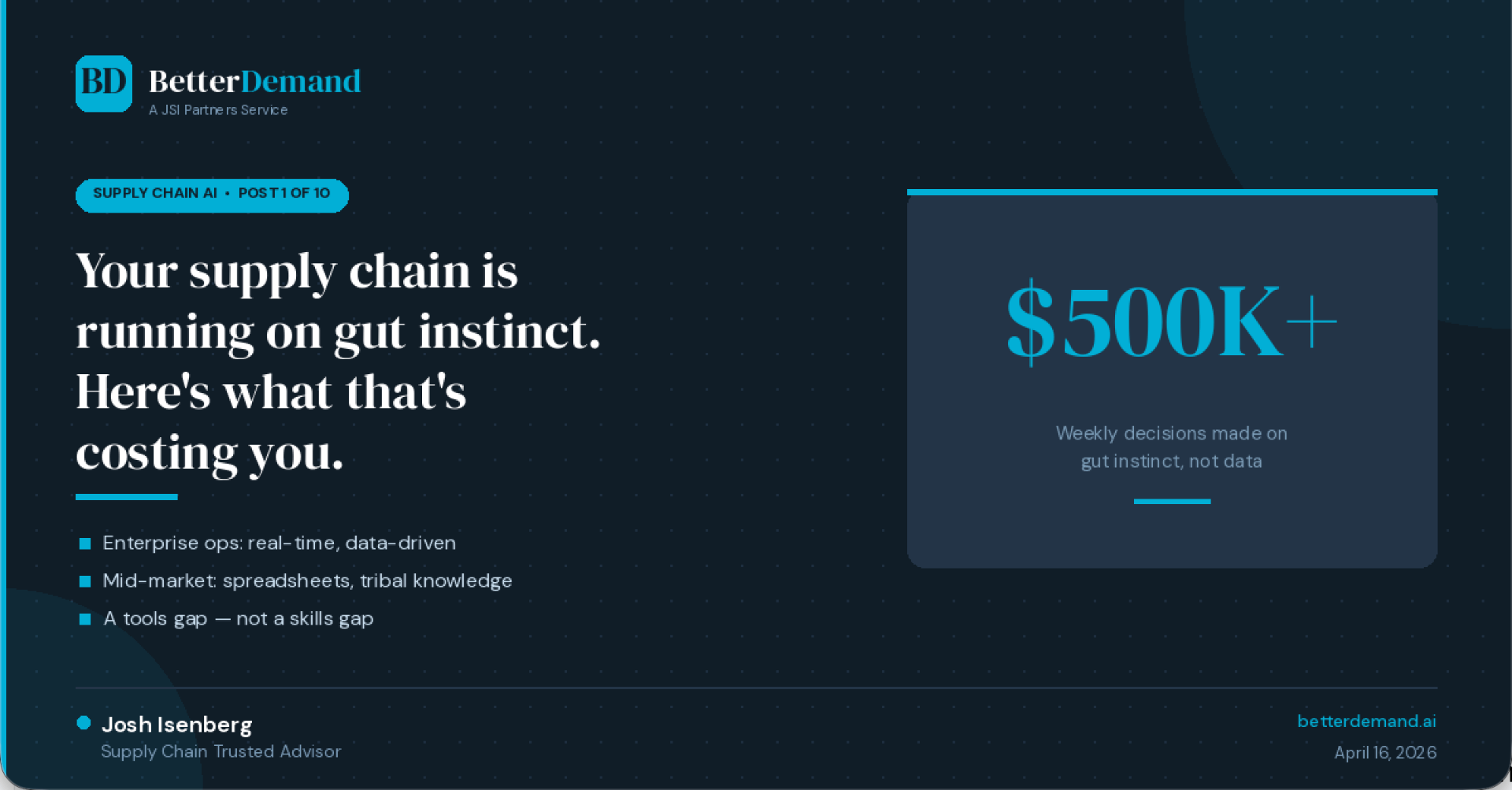
The Hidden Cost of Running Supply Chains on Gut Instinct
Walk into a typical mid-market supply chain office and the picture is remarkably consistent. A senior planner at the center of it all. Twelve open spreadsheets. A phone that rings constantly with supplier updates, customer escalations, and internal questions. And in that planner's head, a quiet fluency with every SKU's quirks and every supplier's tendencies that nobody else in the company fully understands.
This person is making decisions worth $500,000 or more every week. Sometimes every day. How much to order. When to expedite. Which customer to prioritize when allocation gets tight. These aren't small calls, and they're being made with tools built in the 1990s and intuition built over decades.
The Real Gap Is a Tools Gap
It's tempting to look at this and assume mid-market companies are simply behind the curve. They're not. The planners at $50M distributors and $150M manufacturers are often more resourceful, more cross-functional, and more accountable than their enterprise counterparts. They have to be. There is no dedicated forecasting analyst, no full-time S&OP coordinator, no bench of specialists to hand work off to.
What they lack is the instrumentation. Enterprise supply chain teams operate with real-time inventory visibility, automated replenishment recommendations, scenario modeling, and dedicated planning software that costs several hundred thousand dollars a year and takes nine months to implement. The $80M manufacturer down the road gets Excel, an ERP module that was state-of-the-art fifteen years ago, and a group text with their top three suppliers.
That isn't a fair fight. And it's been the status quo for so long that most ops leaders have stopped seeing it as a problem to solve.
Where the Money Actually Goes
The costs of the tools gap are everywhere once you know where to look. Excess inventory parked in a corner of the warehouse, bought on a hunch about a season that never materialized. A stockout that cost a key account's trust because nobody spotted the lead time shift in time. Another week of expedite freight charges that quietly eat margin. A customer commitment that slipped by two weeks because one supplier's portal wasn't checked on Thursday.
These costs rarely get attributed to the tools gap. They get attributed to the people doing their best inside it — and that's precisely the problem. When a planner can't keep up, the company adds headcount, or blames execution, or accepts the losses as the cost of doing business. None of those responses fix the underlying issue.
Why This Is Changing Now
For the first time, mid-market companies have a credible path to enterprise-grade supply chain intelligence without enterprise-grade cost or complexity. AI-driven planning doesn't require a 20-person team to operate or a twelve-month implementation to deliver value. It can start small, watch inventory overnight, and flag problems before they become fires.
The question isn't whether the tools gap will close. It's whether your company will close it first, or wait until your competitors already have.
Ready to Forecast Smarter?
BetterDemand combines AI-powered forecasting with real supply chain expertise. Visit betterdemand.ai to learn how we help distributors and manufacturers plan with confidence.