A Frozen Window the Floor Can Trust
It is 6:40 on a Tuesday morning and the line lead on Line 2 is holding two schedules. One is the printout from Friday, the one her crew staged film and labels against last night. The other is the email the planner sent at 9:50 p.m., which moves a 4,000-case run of a promotional item ahead of everything else. She looks at both, shrugs, and runs what is already staged.
That shrug is the whole problem. The plan lost the floor, and the floor is right.
A plan that changes daily is not a plan
Every mid-market food plant we have worked with has a version of this. The planner is not careless. A customer PO changed inside lead time, a truck did not show, a retailer moved a ship date, and the ERP regenerated the plan overnight the way it is built to do. Every one of those changes was reasonable on its own.
The floor does not see reasons. It sees that Monday's schedule was wrong by Tuesday, Tuesday's was wrong by Wednesday, and the only safe thing to do is run whatever is staged and physically in front of you. Once a crew learns that lesson, the plan is a suggestion. Changeovers get skipped because the next run might change anyway. Materials get staged for the run the lead expects, not the run the plan says. Adherence reports show 70 percent and nobody can say which 30 percent was the plan's fault and which was the floor's.
The fix is not a better plan. It is a plan with a part that does not move.
Three zones
The schedule gets cut into three windows by time from now.
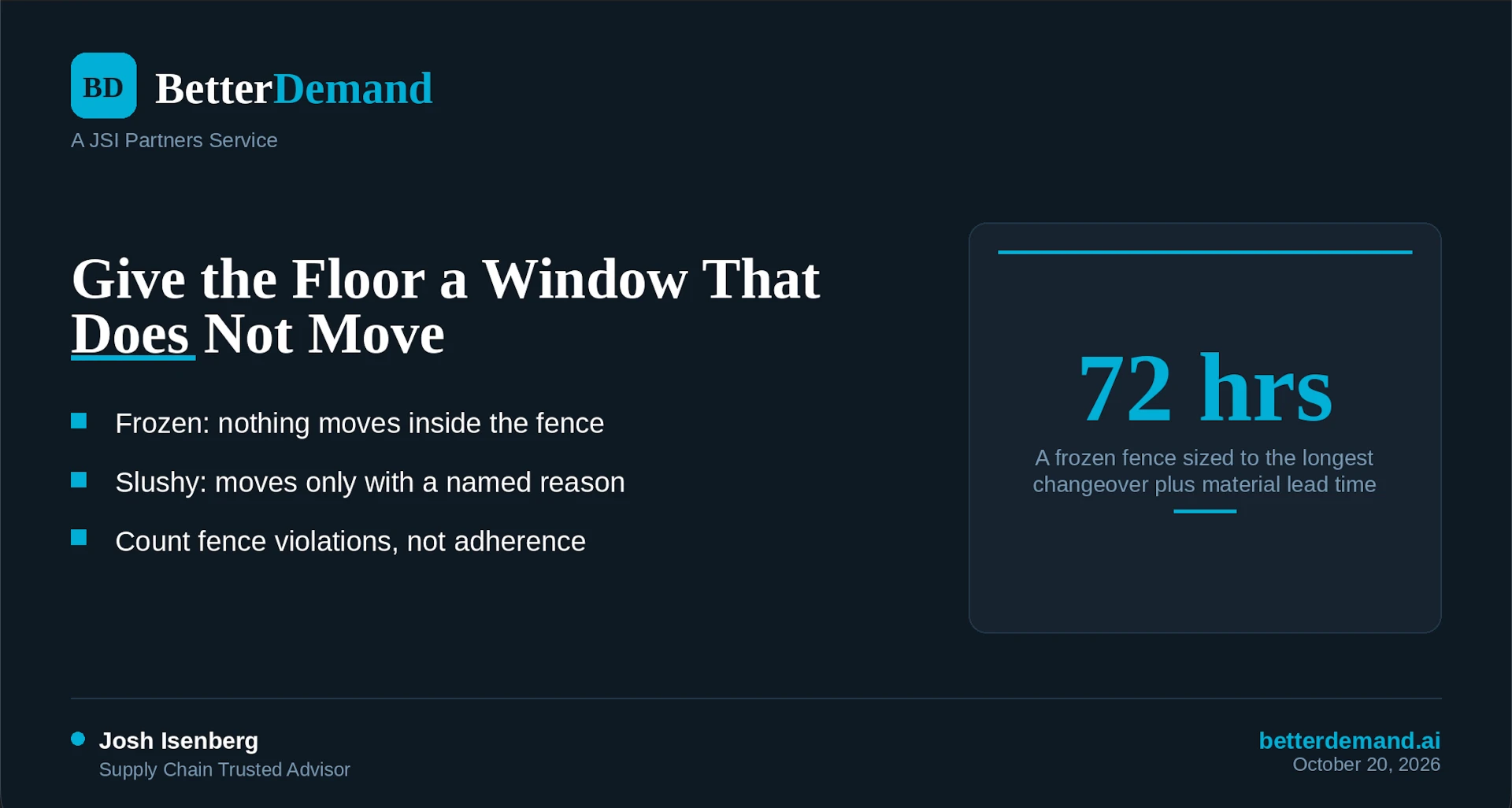
The frozen zone is the next stretch of hours or days where nothing moves. No resequencing, no inserted runs, no quantity changes. If a customer calls inside the frozen zone, the answer is the next slot outside it. The planner protects this zone from everyone, including sales, including the owner.
The slushy zone sits beyond the frozen zone. Runs can move here, but only with a named reason written next to the change: which order, which customer, who asked. A move with no reason attached is treated as a violation, not a judgment call.
The free zone is everything beyond that. The planner reshuffles it as often as the demand picture changes, and nobody on the floor is expected to look at it.
Most of the mid-market plants we see are running with a frozen zone of zero. The plan is slushy all the way to the current shift, and nobody wrote the reasons down.
How long should the fence be
The fence has to be long enough that the floor can act on it. Two numbers set the floor for that.
The first is the longest changeover on the line. If an allergen washdown on Line 2 takes six hours, the crew needs to know at least six hours ahead that it is coming, with the next item's materials already pulled.
The second is the material lead time inside the plant: the time between a run being named on the schedule and its film, labels, cases, and ingredients being staged at the line. At a refrigerated specialty foods producer JSI Partners worked with, that was two days, because the warehouse pulled packaging once a day and the kitchen batched sauces the day before.
Add them and round up to a shift boundary. Six hours plus two days becomes a frozen fence of 72 hours. In practice most mid-market food plants land between 48 and 72 hours frozen, with the slushy zone running out to the end of the following week. A plant with a four-hour changeover and same-day material pulls can run a shorter fence. A plant that cooks day one and packs day three cannot.
Do not set the fence by what sales will tolerate. Set it by what the floor needs to hit the plan, then negotiate down from there if you must. A fence that is set short to keep peace is just the old daily plan with a new name.
Count the violations, not the adherence
Schedule adherence as most plants compute it (cases produced divided by cases planned) hides the problem, because the plan it compares against was rewritten three times during the week. A 92 percent adherence number against a plan that changed Wednesday night tells you nothing about Monday's plan.
The number that matters is the fence violation count: how many times something moved inside the frozen zone this week, and how many times something moved inside the slushy zone without a named reason. Keep it in a column on the schedule itself. Every move gets a line: date, what moved, who asked, which zone it was in.
This number does two things. It gives the plant manager a short list to review every Monday, with names attached. And it separates the plan's failures from the floor's failures. If the violation count is zero and adherence is still 80 percent, the problem is on the floor: rates, staffing, downtime. If the violation count is 11 and adherence is 80 percent, the problem is upstream, and the floor was never given a plan it could hit.
What the first week looks like
The first week a fence is enforced is uncomfortable, and it is supposed to be.
A customer service manager will ask for an exception on day two, usually for a customer who is used to getting one. Someone in sales will go around the planner to the plant manager. A run will get moved inside the frozen zone anyway, by someone who did not know the rule or did not believe it. The violation count for week one is higher than anyone expected and it includes people's names.
What decides whether the fence holds is what the plant manager does with that list on Monday. If the exceptions are waved through, the fence is gone by week two. If the plant manager backs the planner and the customer gets the next slot outside the fence, the asks start arriving earlier. By week three, sales is calling on Wednesday about next week instead of calling Monday night about tomorrow, because that is the only call that still works.
That shift, from last-minute moves to early asks, is the real result. The floor notices within days. Crews stage materials against the plan again because the plan stopped lying to them.
What to do this week
Print the next seven days of the schedule and mark every change you make to it before Friday, with the reason. Count them. That is your baseline violation count, and it will be higher than you think.
Pick the fence. Take the longest changeover on your busiest line, add the time it takes to stage materials for a run once it is named, and round up to a shift boundary. Write that number down and tell the floor what it means: inside that window, nothing moves.
Put the violation count on Monday's production meeting agenda, above adherence. Review every line on the list with the person who asked for the move, and decide out loud whether it should have happened.
BetterDemand Capacity holds the frozen and slushy fences on the schedule itself. Runs inside the frozen fence cannot be resequenced without a logged override, moves inside the slushy fence require a reason, and the violation count rolls up by week, by line, and by who asked. The schedule is built from the production orders, routings, and open sales orders the ERP already exports, so the fence sits on top of Business Central, NetSuite, or Aptean without touching them, and the Agent can answer "what moved inside the fence last week and why" with the log as its source. Plants are usually live in a few weeks.
betterdemand.ai
Two free playbooks: Cost of Forecast Error and the S&OP Playbook