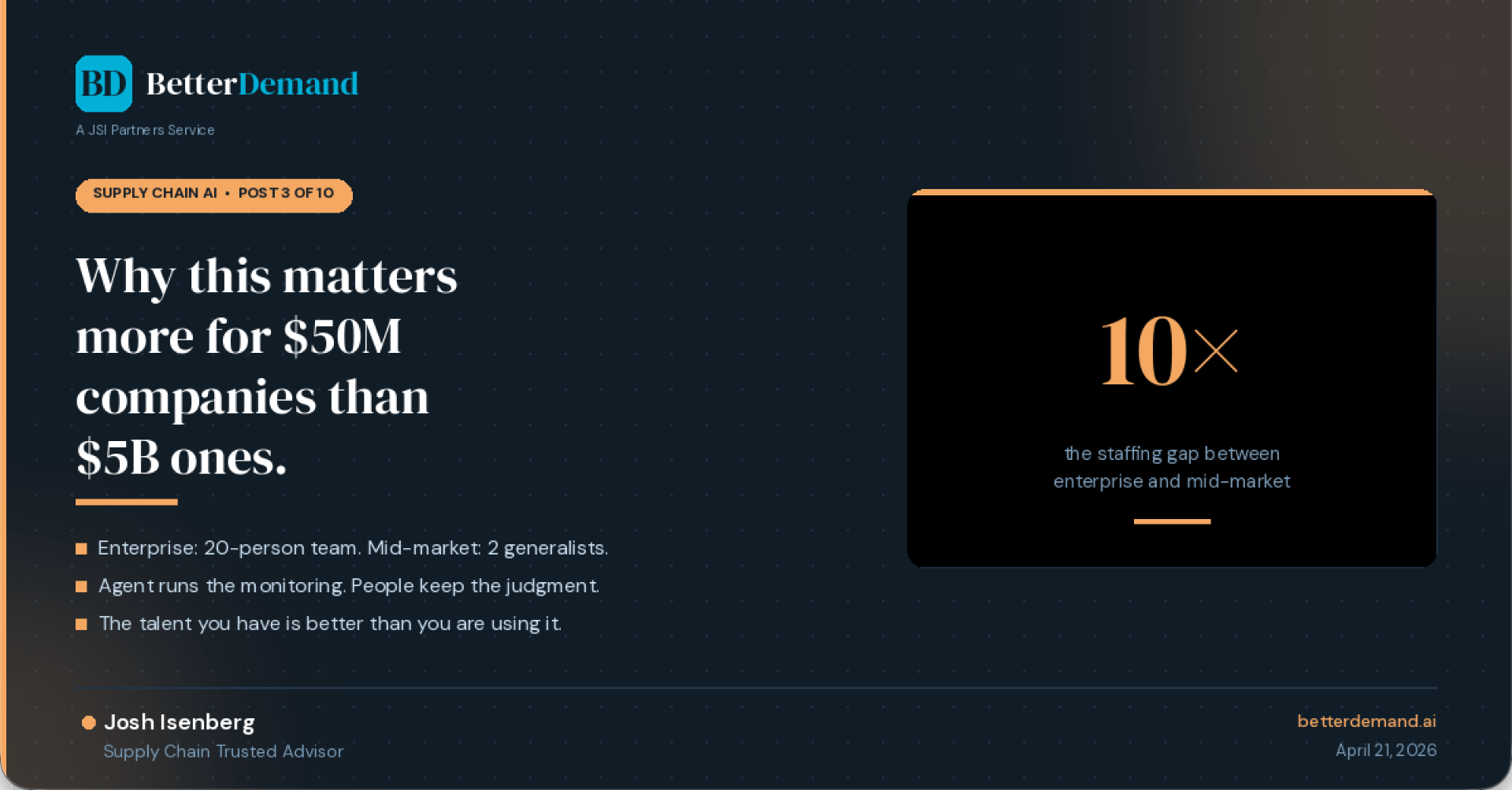
Why Supply Chain AI Matters More for $50M Companies Than $5B Ones
If you only read the headlines, you would think supply chain AI is primarily an enterprise story. The logos in the case studies are $5B and up. The implementation budgets are eye-watering. The team photos show rooms of analysts in front of dashboards. It looks like a conversation for someone else.
The math actually points the other way. The company that benefits most from a supply chain agent is not the one with a twenty-person planning team. It is the one with two.
Same complexity, a fraction of the people
A $50M distributor runs, in most dimensions, the same kind of operation as a $5B distributor. Same supplier lead times. Same customer expectations. Same SKU proliferation. Same seasonal swings. Same need to forecast, buy, allocate, and adjust every week of the year.
What is different is the number of people carrying that load.
The enterprise has a demand planner, a supply planner, a procurement specialist, a logistics lead, an inventory analyst, and someone owning master data. Each of those people is a specialist. Each has tools designed for their slice of the job. Each shows up Monday morning to work that someone else — or some system — has already queued up for them.
The mid-market has two generalists. They are responsible for every one of those functions. They also answer customer questions, manage supplier escalations, and sit in the weekly commercial meeting.
The Monday-morning difference
Picture the enterprise planner on a typical Monday. The overnight inventory sweep ran at 3 a.m. The supplier lead time updates were pulled before anyone got in. The exceptions are queued in a workflow. The planner's day is spent on judgment calls — deciding which exceptions matter, approving which POs to send, escalating which customer conversations.
Now picture the mid-market planner on the same Monday. The first two hours are spent exporting data from three systems and pasting it into spreadsheets. The next hour is pivot tables. By noon, they are finally ready to think. By 3 p.m., the CFO asks for a mid-month inventory update and the whole cycle starts again.
An agent closes this gap — not by replacing anyone, but by taking the monitoring, the drafting, and the exception surfacing off the planner's plate. Two people get their afternoons back for the work only they can do.
This is talent arbitrage, not technology spend
The smartest lens for a mid-market COO to put on this is not a software evaluation. It is a talent one. Your best operator is already doing excellent work. You are just using them for the wrong half of their day.
Every hour an agent absorbs is an hour your planner spends on supplier relationships, strategic tradeoffs, and the kind of unusual situations that are always the ones that actually move the business. That is compounding value. A twenty-person enterprise team already captures most of that value through sheer staffing. You can capture it too — without the headcount.
Ready to Forecast Smarter?
BetterDemand combines AI-powered forecasting with real supply chain expertise. Visit betterdemand.ai to learn how we help distributors and manufacturers plan with confidence.