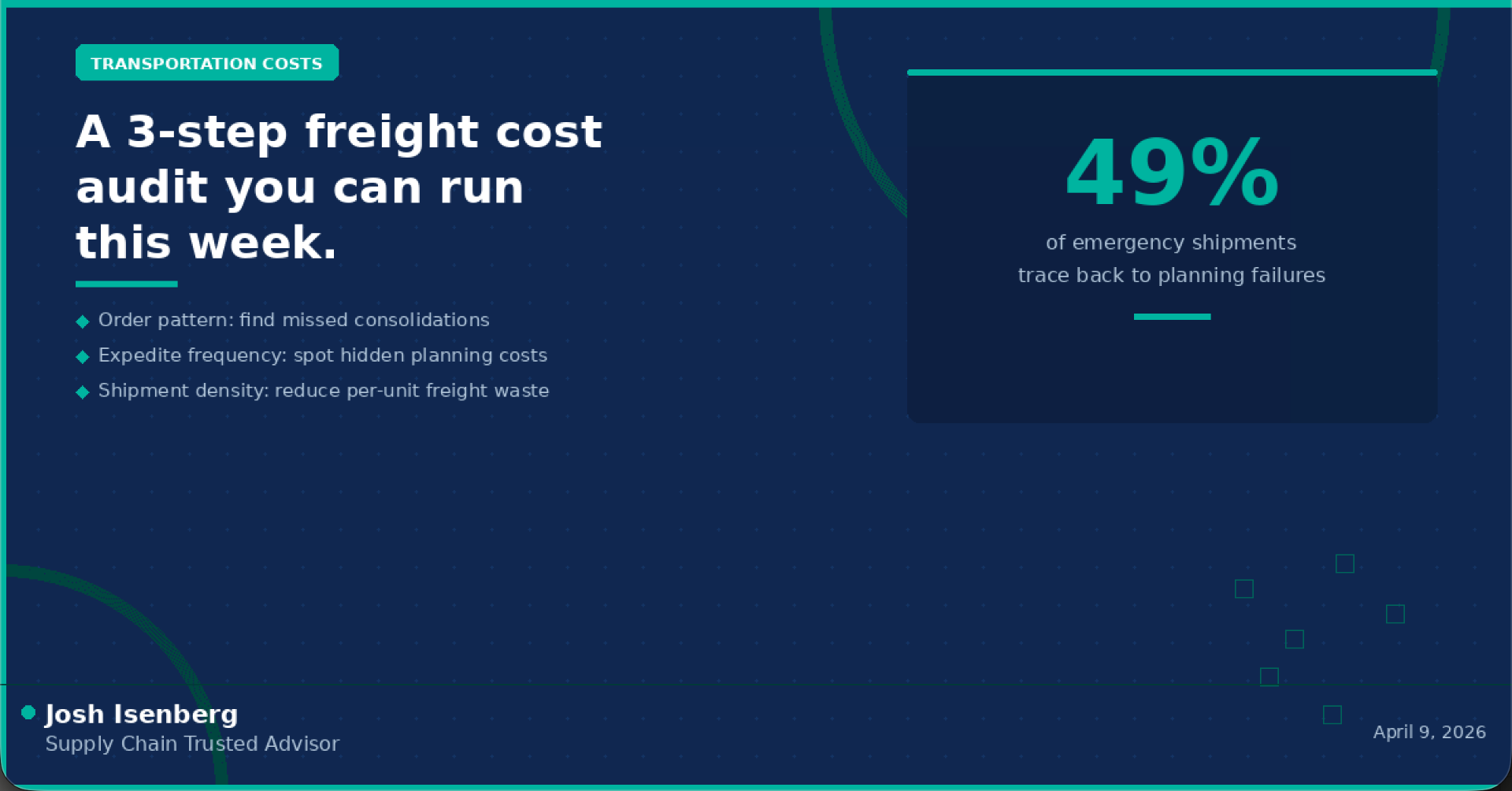
A 3-Step Freight Cost Audit You Can Run This Week
Your Freight Bill Is a Mirror — Not a Mystery
When freight costs spike, the instinct is to call a carrier rep and start negotiating. And sure, rate negotiations matter. But here's the uncomfortable truth: the biggest leverage most mid-market companies have over their freight spend has nothing to do with the rate card.
It has to do with how — and why — they're shipping.
According to APQC benchmarking data, 49% of all emergency and expedited shipments trace back to demand forecasting failures. Not supplier delays. Not carrier capacity crunches. Planning failures. That means nearly half of every premium freight dollar you spend is a tax on your own internal processes.
The good news? That's fixable. And you don't need a new TMS, a logistics consultant, or a six-month improvement project to start finding the leaks. You just need to look at three things.
Step 1: Order Pattern Analysis — Find the Consolidation Opportunities You're Missing
Pull your last 90 days of shipments. Then ask one question: how many shipments went to the same customer, distribution center, or region within 72 hours of each other?
Every pair you find is a consolidation opportunity you paid LTL rates for instead of truckload rates. It means your reorder triggers fired independently when they could have aligned. It means someone approved two separate purchase orders when one would have done the job.
This isn't a carrier problem. It's a replenishment cadence problem. And the fix is usually a policy change, not a contract change. When you can consolidate two LTL moves into one, you can cut per-unit freight cost dramatically — and research consistently shows that organizations optimizing shipment consolidation see 15–30% reductions in total transportation spend.
Step 2: Expedite Frequency — Translate Rush Orders Back into Root Causes
Pull your freight invoices from the last quarter and sort them by service type: standard, expedited, air, next-day. Calculate what percentage of your freight spend is in the premium categories.
Now comes the important part: for every expedited shipment, ask why it was expedited. You're looking for the upstream failure that caused it. In most mid-market operations, the answers cluster into a few categories: a stock-out that wasn't forecasted, a reorder point that was set too low, a lead time assumption that was never updated, or a supplier miss that wasn't caught early enough to avoid emergency shipping.
Top-performing companies keep expedited freight costs to around 3% of total freight spend. Bottom performers spend three times that — not because they have worse carriers, but because they have more planning gaps. Expedited freight is the symptom. Audit the causes.
Step 3: Shipment Density — Find Out If You're Shipping Air
This one requires a conversation with your carrier or a data pull from your TMS: what is your average shipment weight per load, and how does it compare to your freight class weight breaks?
LTL pricing is built around weight breaks. The rate per hundredweight (CWT) drops significantly as you move up in shipment weight. A shipper consistently sending 400-pound LTL moves is paying a dramatically higher per-unit rate than one consolidating to 800 or 1,200 pounds. If your order minimums are set based on customer preference or historical habit rather than freight economics, you're almost certainly leaving money on the table.
Low fill rates and undersized shipments are often a symptom of order minimum policies that were never designed with freight costs in mind. A small adjustment to your minimum order quantity or order frequency can have an outsized impact on your per-unit transportation cost — without requiring any carrier negotiation at all.
What This Means for You
These three steps — order pattern analysis, expedite frequency review, and shipment density assessment — form a practical freight cost audit that most companies can complete in a week with existing data. No new tools required.
What you'll typically find: 10–20% of your freight spend is avoidable without any changes to your carrier relationships, rates, or network footprint. The leaks are in the planning process, the replenishment logic, and the order policies — not in the rate cards.
The companies that consistently outperform on logistics costs don't just negotiate better. They plan better. And planning better starts with knowing where the money is actually going.
Run this audit. Then work backwards to the root causes. That's where the real savings are.
Ready to Forecast Smarter?
BetterDemand combines AI-powered forecasting with real supply chain expertise. Visit betterdemand.ai to learn how we help distributors and manufacturers plan with confidence.