The Just-in-Case Inventory Trap Mid-Market Firms Hit
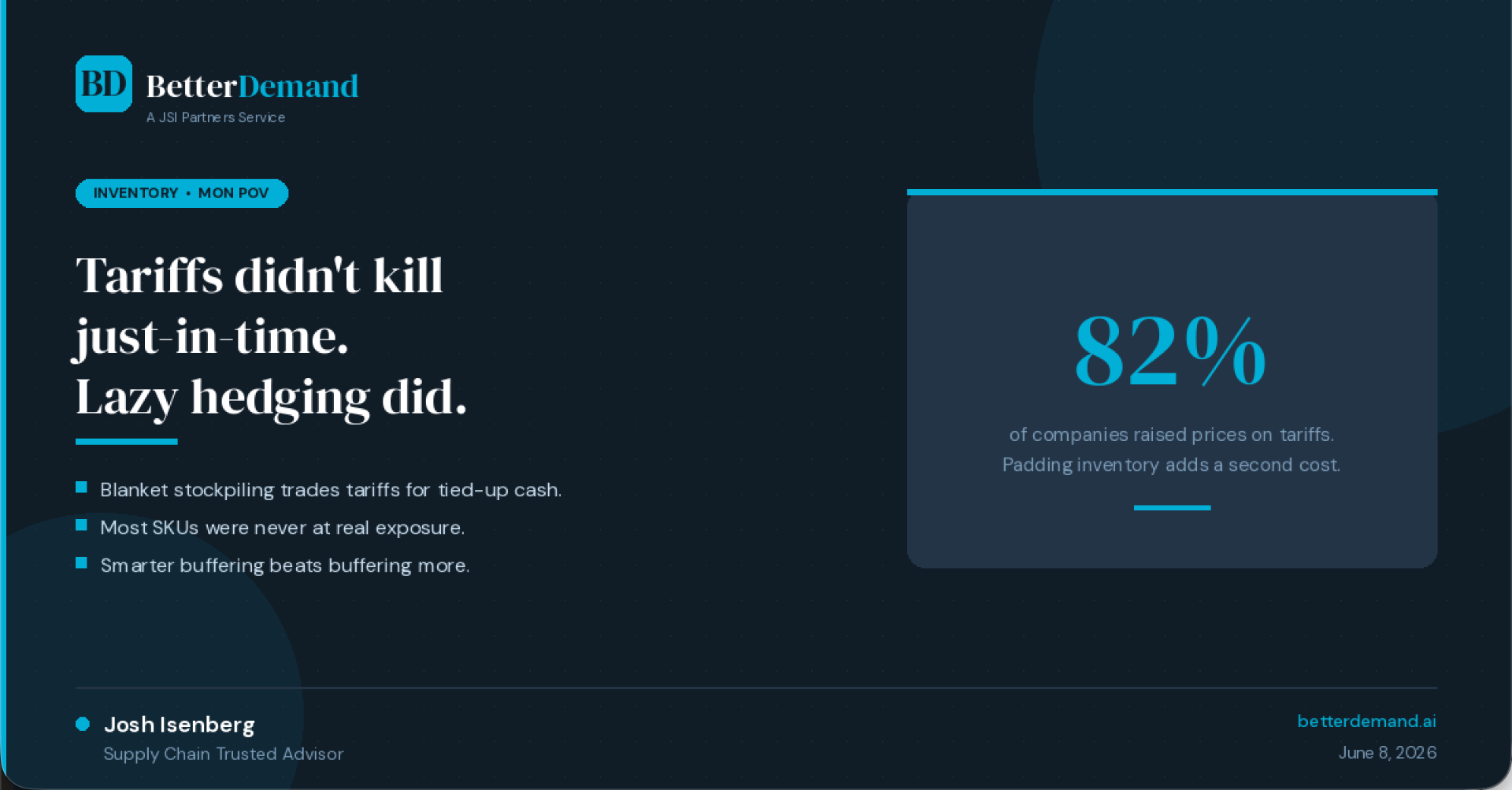
Tariffs didn't kill just-in-time. Lazy hedging did.
Walk into almost any mid-market product company right now and you'll hear a version of the same plan: hold more of everything, just in case. Roughly 82% of companies have already raised prices to cover tariffs, and a large share are quietly padding inventory on top of that. It feels like control. Mostly, it's fear with a purchase-order number attached.
Blanket Buffering Solves the Wrong Problem
Here's the issue. Stocking up across the board doesn't make a tariff problem go away — it converts it into a working-capital problem. Cash gets frozen in SKUs that were never at risk, sitting in a warehouse instead of funding payroll, equipment, or growth.
Meanwhile, the three or four items that actually carry real tariff exposure get the exact same flat treatment as everything else. You've spread your hedge so thin that the SKUs that needed protection don't get any more of it than the ones that didn't. That's not risk management. That's anxiety, applied evenly.
The Operators Getting This Right Buffer Selectively
The mid-market companies handling this period well aren't buffering more. They're buffering smarter. They've done the work to know which SKUs carry genuine tariff and supplier exposure, which inputs have real lead-time risk, and which products can comfortably stay lean.
That distinction is a forecasting and segmentation question, not a warehouse-space question. It starts with demand signal and exposure mapping at the SKU and supplier level, not with a blanket directive to "build safety stock." When you can see where the real risk concentrates, you can put your cash and your shelf space exactly where they earn their keep — and leave the rest alone.
Uncertainty Is a Reason to Know Your Numbers
It's tempting to treat an uncertain trade environment as license to stock everything. The opposite is true. Uncertainty is precisely the condition that rewards companies who know their numbers cold — their demand patterns, their exposure, their lead times — and punishes the ones reaching for a uniform hedge because looking closely feels like too much work.
The next 12 months of tariff policy will stay messy. The companies that come through with their balance sheets intact won't be the ones who stocked the most. They'll be the ones who knew exactly what to stock, and why.
Ready to Forecast Smarter?
BetterDemand combines AI-powered forecasting with real supply chain expertise. Visit betterdemand.ai to learn how we help distributors and manufacturers plan with confidence.