SKU Rationalization: The Silent Supply Chain Cost Driver
The Problem Nobody's Tracking
Ask a supply chain leader about their biggest cost challenges and you'll hear a familiar list: freight rates, supplier lead times, demand variability, labor. Rarely does anyone say "our SKU count."
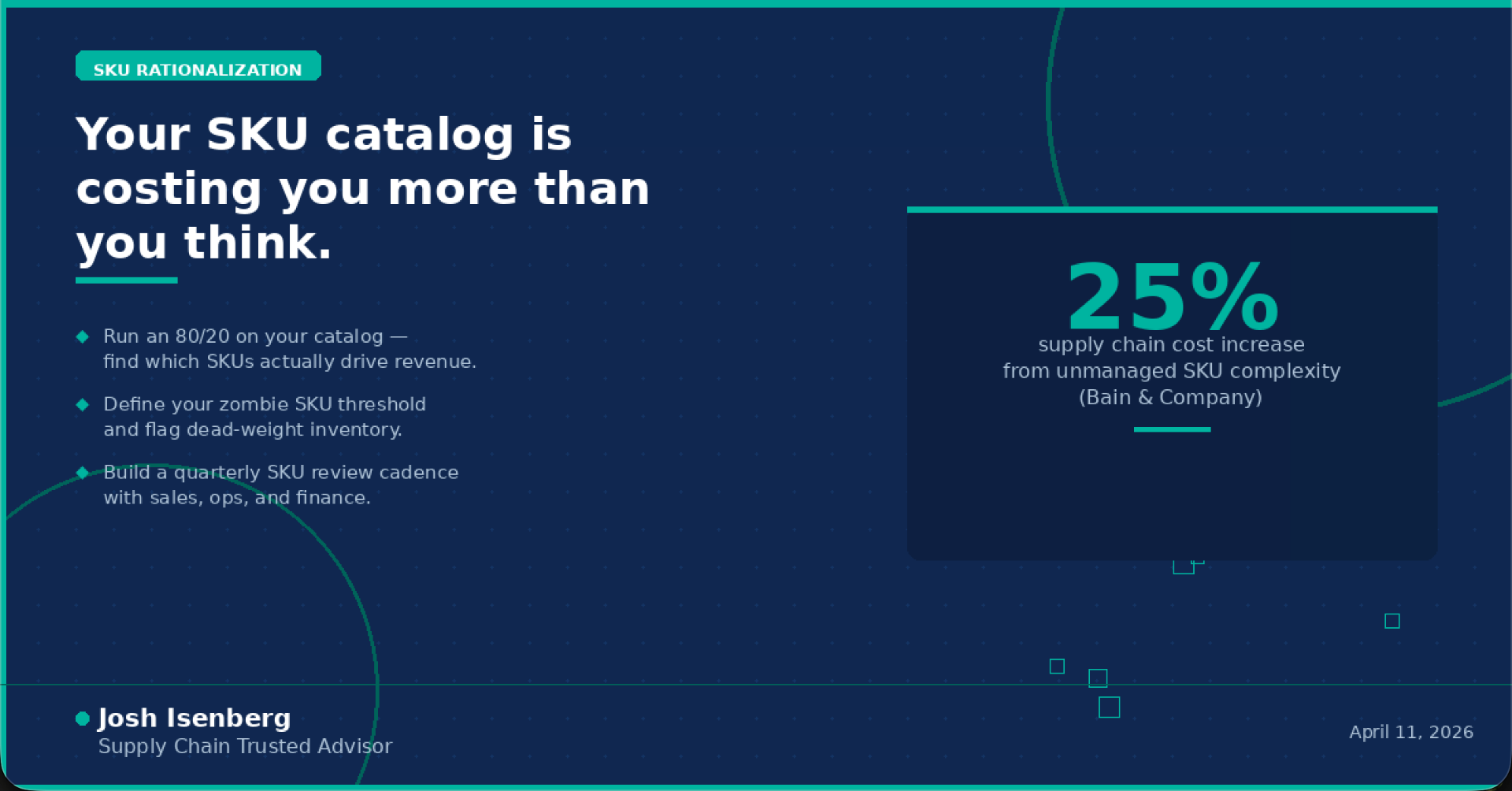
But according to Bain & Company, unmanaged SKU complexity can inflate supply chain costs by up to 25%. Not as a one-time hit — as a persistent, compounding drag on everything from forecast accuracy to warehouse efficiency to purchasing leverage. And in most mid-market distribution and manufacturing environments, the problem is hiding in plain sight.
Here's the pattern: A sales team adds a new product variant to win an account. A product manager launches a regional SKU that never scales. An acquisition brings in a catalog nobody rationalized. Over time, the product list grows — and nobody's job is to cut it back.
The result is a supply chain that's quietly subsidizing hundreds of underperforming items while your planning team struggles to make sense of the noise.
What SKU Proliferation Actually Costs You
The 80/20 rule is well-documented across industries: roughly 20% of SKUs generate 80% of revenue. That means in a typical mid-market catalog of 2,000 items, about 1,600 of them are contributing modestly — but consuming forecasting bandwidth, warehouse slots, procurement cycles, and working capital at full cost.
The specific costs compound across your operation. Every low-velocity SKU increases forecast error, because demand signals are sparse and noisy. Every additional item means another bin location, another replenishment rule to maintain, another item that can generate a stockout or an overstock. Your purchasing team fragments their volume across more line items, eroding negotiation leverage. Your 3PL or DC charges you for complexity even when the items barely move.
Survey data from mid-market distributors shows that 39% experience moderate to high inventory leakage — meaning dead stock and discounted sell-through are already visibly eroding margins. And 21% of companies don't know their leakage rate at all. That's not a data problem. That's a catalog governance problem.
Three Steps to Start Rationalizing
The goal of SKU rationalization isn't to shrink your catalog for the sake of it. It's to make deliberate, defensible decisions instead of letting complexity accumulate by default. Here's how to get started.
Step 1: Run an 80/20 on your current catalog. Pull trailing 12-month sales data and sort by revenue contribution. Identify what percentage of SKUs generate 80% of your revenue. Most teams find the answer is around 20% — sometimes less. That gap is your rationalization opportunity. You don't need to act on it immediately, but you need to see it clearly.
Step 2: Define your "zombie SKU" threshold. A zombie SKU is one that's still on your books and being forecasted and replenished, but contributing almost nothing. Set a rule: any SKU with fewer than X units sold in the trailing 12 months AND below Y% gross margin contribution gets flagged for review. The exact thresholds depend on your business, but the key is having a rule — not an ongoing debate.
Step 3: Build a regular rationalization cadence. SKU reviews shouldn't be a one-time project. Schedule a quarterly or biannual working session that brings together sales, operations, and finance. Sales needs to defend continued stocking. Operations needs to quantify the carrying cost. Finance needs to see the margin math. When those three perspectives are in the same room with the same data, the right decisions tend to make themselves.
What This Means for Your Planning Team
The downstream benefits of a leaner, more deliberate catalog go beyond cost reduction. Fewer SKUs means a higher proportion of your items have enough historical demand signal to forecast statistically. Safety stock calculations become more reliable. Replenishment rules can be tuned. Your planning team spends less time managing exceptions on items that barely matter and more time optimizing the ones that do.
Companies that undertake comprehensive SKU optimization can cut supply chain expenditures by up to 50% and improve margins by 3 to 5 percentage points, according to Bain research. Those aren't trivial numbers — and they don't require a new ERP, a new 3PL, or a major transformation initiative. They require a disciplined, cross-functional commitment to catalog governance.
Simplification is a supply chain strategy. And in most mid-market companies, it's the most underutilized one.
Ready to Forecast Smarter?
BetterDemand combines AI-powered forecasting with real supply chain expertise. Visit betterdemand.ai to learn how we help distributors and manufacturers plan with confidence.