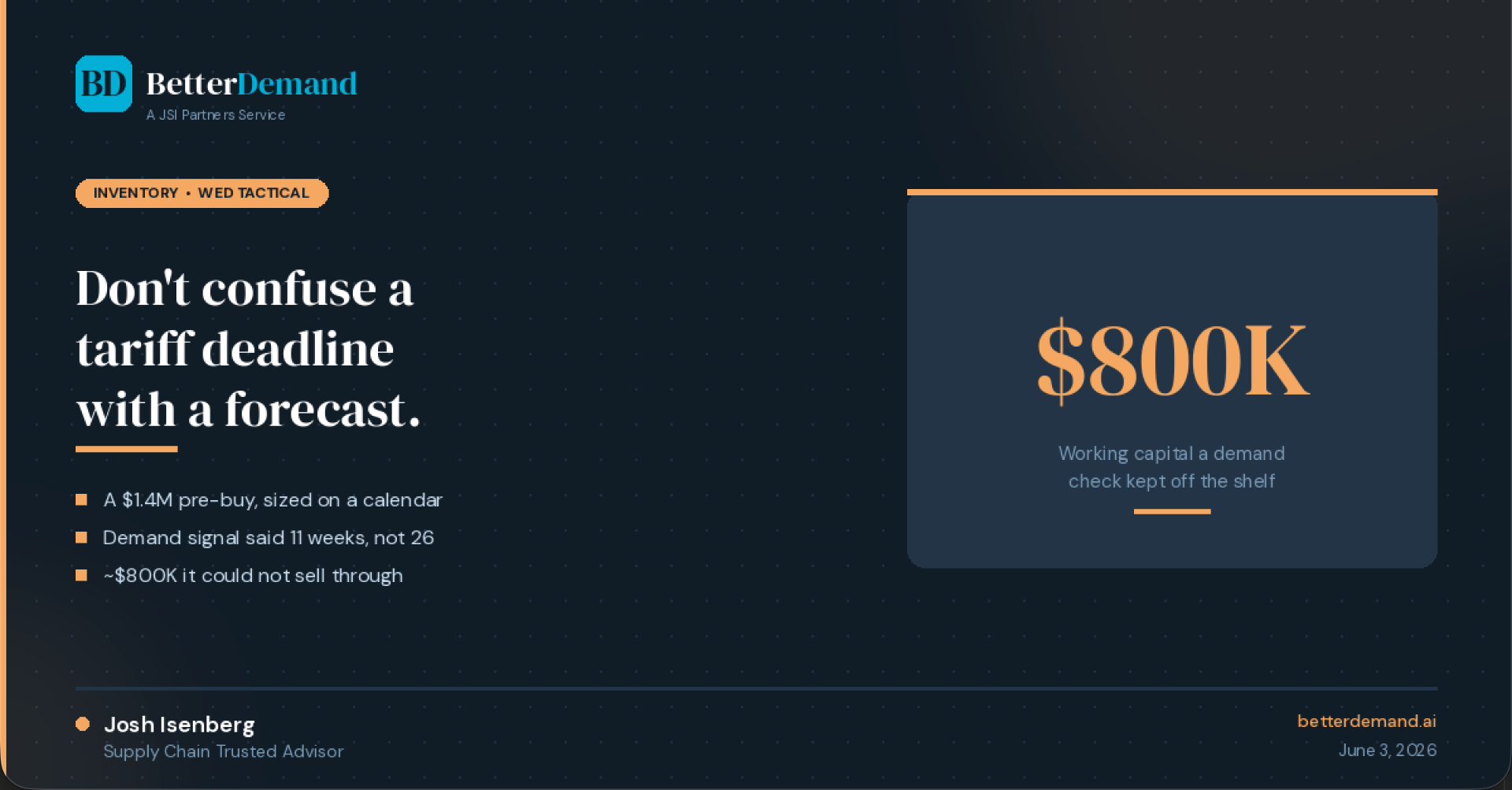
A Tariff Deadline Is Not a Forecast
A mid-market food distributor was about to sink $1.4M into a tariff pre-buy. Roughly $800K of it had no demand behind it. The deadline felt urgent, the logic felt obvious, and the check was nearly written. Then we ran the math.
This is the question landing on desks across the mid-market right now. Section 122 tariffs are set to expire mid-July, and the natural instinct is to load up on imported inputs before rates potentially move. Buy ahead, or wait it out? For most operators, it's being decided on gut.
Three Numbers Before the Check
A pre-buy is a bet, and like any bet it has a price. Before this client committed, we pressured three numbers.
First, velocity: how fast does this SKU actually turn? Second, carrying cost: what does parking that inventory cost at the company's real borrowing rate? Third, confidence: how sure is anyone, honestly, that prices spike after the deadline?
The forecast answered the first question cleanly. At normal velocity, they'd move about eleven weeks of that ingredient, not the twenty-six weeks the six-month pre-buy assumed. The gap between those two numbers was the whole problem.
What the Math Exposed
The full pre-buy would have parked roughly $800K in inventory the business couldn't sell through, at a 9% cost of capital, to hedge a price move nobody could actually size. That's not risk management. That's converting a credit line into a warehouse full of slow-moving stock.
So we split the decision. They bought the eleven weeks they could defend on demand. They kept the credit line open for the rest. And they built a trigger: if the July rate landed above a set threshold, they'd execute the back half within 48 hours. Discipline now, optionality later.
The Principle Underneath
The lesson isn't "never pre-buy." Sometimes the math says go, and you go. The lesson is that a tariff deadline is not a forecast. The deadline tells you when a price might move. Your demand signal tells you how much you can actually carry. Confuse the two and your working capital quietly disappears into inventory you'll be discounting six months from now.
Most mid-market teams are making this call on instinct this summer because instinct is all they have wired up. The ones with a real demand signal are making the same call on math, and they'll keep their cash where it belongs.
Ready to Forecast Smarter?
BetterDemand combines AI-powered forecasting with real supply chain expertise. Visit betterdemand.ai to learn how we help distributors and manufacturers plan with confidence.