Stop Shipping Air: The Hidden Freight Cost Draining Margin
You're Not Just Shipping Product — You're Shipping Air
LTL freight rates have climbed 63.8% above their January 2018 baseline. Supply chain teams are scrambling to renegotiate contracts, shift modes, and squeeze carrier relationships. All of that work matters. But most of it is attacking the wrong problem.
The rate on your freight invoice is only half the equation. The other half — the half that rarely shows up in a planning meeting — is how full your shipments actually are. A 40% full pallet costs almost the same to move as a 90% full pallet. But the per-unit freight cost is more than double. That gap quietly erodes margin, and almost no one is tracking it.
This is what it means to ship air. And until you measure it, you can't fix it.
Why Planning Teams Miss This
The standard freight KPI is cost per shipment, not cost per unit. When a planner hits "send" on a replenishment order, they're thinking about service levels and on-time delivery — not pallet density. The result: thousands of half-empty LTL shipments that each look individually reasonable but collectively represent a massive, invisible overhead cost.
Order minimums are often the culprit. When customers — or internal replenishment logic — can trigger a shipment for a small quantity, the planning team absorbs the freight premium. If there's no minimum order quantity tied to freight economics, every undersized order is a hidden subsidy that shows up nowhere on a standard P&L.
The same dynamic plays out in replenishment cycles. Outdated reorder points that were set when freight was cheaper often trigger more frequent, smaller shipments than the economics justify today. Nobody updated the math when rates went up.
Three Levers to Stop Shipping Air
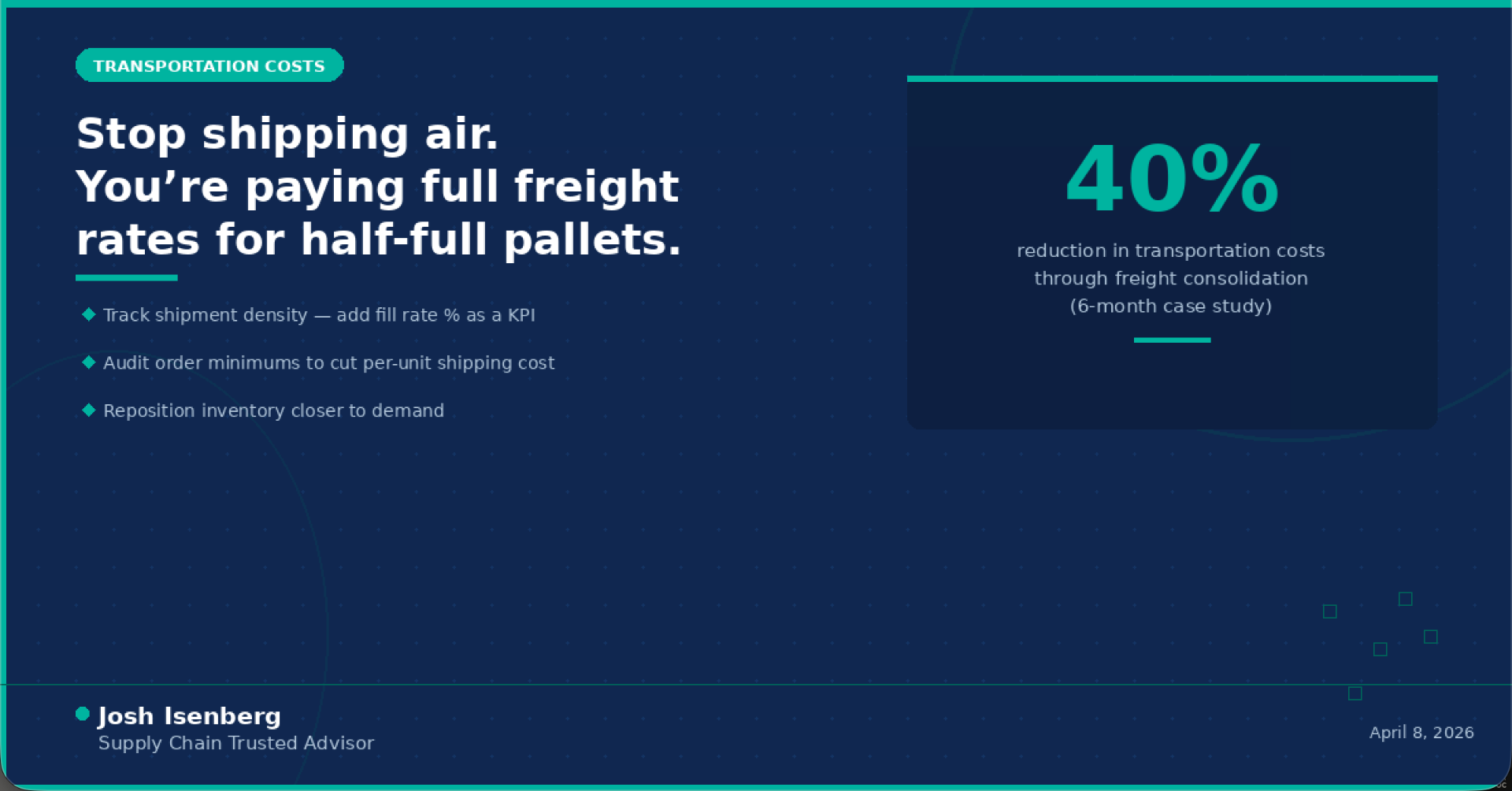
Track shipment density as a KPI. Add fill rate percentage to your transportation reporting — not just shipment count or total freight spend. If your average LTL shipment is running at 40% capacity, you now have a number to improve. You can't optimize what you can't see.
Audit your order minimums. Minimum order quantities should be set with freight economics in mind, not just warehouse convenience. A quick analysis of your last 90 days of LTL shipments will reveal which customers, SKUs, or replenishment triggers are consistently generating underweight loads. Raising minimums — even selectively — on high-frequency, low-density shipments is one of the fastest ROI moves in freight optimization.
Reposition inventory closer to demand. When you hold safety stock regionally rather than shipping small, frequent replenishments from a central distribution center, consolidation opportunities multiply naturally. Inventory positioning and freight cost are not separate problems — they are the same problem. Companies that recognize this connection and align their replenishment cycles to it see compounding benefits: lower freight cost, higher fill rates, and fewer stockout-driven emergency shipments.
The results are striking when these levers are pulled together. One manufacturer reduced transportation costs by 40% in six months through freight consolidation — not by changing carriers, but by changing how they shipped. Another cut LTL cost per unit from $0.46 to $0.39 while capturing $430,000 in chargeback savings.
What This Means for Your Operation
Here is a quick audit you can run this week: pull your LTL shipment data for the last 90 days and calculate the percentage of shipments that were under 50% of maximum pallet capacity. For most mid-market distributors and manufacturers, that number is higher than expected — often 30 to 50 percent of all LTL shipments.
That percentage is not a freight problem. It is a planning problem that shows up in your freight invoice.
The fix does not require a new carrier contract or a technology overhaul. It starts with visibility — knowing your average shipment density — and then working backward through your order minimums, replenishment cycles, and inventory positioning strategy to fill the gaps.
Rising freight rates are real. But the fastest wins in transportation cost are not in your carrier negotiations. They are in how full your trucks are when they leave your dock.
Ready to Forecast Smarter?
BetterDemand combines AI-powered forecasting with real supply chain expertise. Visit betterdemand.ai to learn how we help distributors and manufacturers plan with confidence.