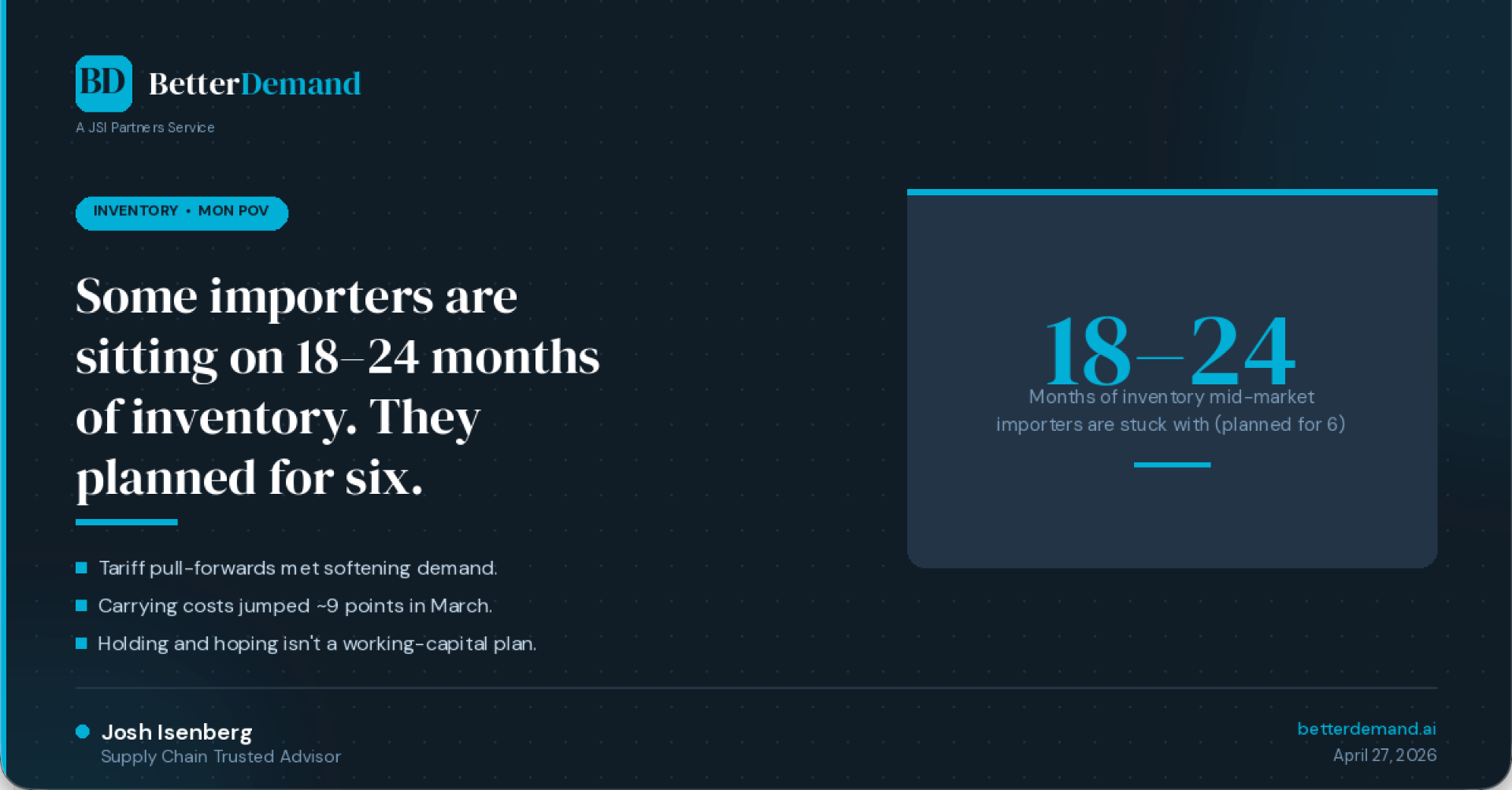
18 Months of Inventory When You Planned for Six
Mid-market importers across F&B, CPG, and distribution are quietly drowning in tariff-driven inventory. Hope is not a working-capital strategy — but neither is another year of waiting for demand to reappear. Here's what the operators who survived the 2022 glut are doing differently this time.
Some mid-market importers right now are sitting on 18 to 24 months of inventory. They planned for six. That isn't a forecasting failure. It's tariff whiplash, compounded by panic ordering, compounded by a forecasting model nobody updated when the rules of the game changed.
And it's quietly choking working capital across F&B, CPG, distribution, and a long list of mid-market product companies that don't have a deep treasury function to absorb the hit.
How the trap got set
The pattern is consistent across the operators I've talked with this spring. Late last year, the tariff calendar started moving. Buyers — reasonably — pulled forward Q3 and Q4 purchases to land product before the next round of duties hit. The math made sense in isolation: pay today's price, hold the inventory, sell into demand that was still forecasting strong.
Then two things happened at the same time.
Demand softened. Some of it was real consumer pullback. Some of it was channel partners doing the same pull-forward, which inflated reported sell-in and masked weakening sell-through for a quarter. Either way, the order book in March 2026 was not the order book the buy plan was built on.
And carrying costs climbed. The inventory cost index jumped almost 9 points in a single month — capital costs, warehousing, insurance, all moving the wrong direction at the same time. The spreadsheet model that justified the pull-forward never accounted for any of this.
Hope wearing a strategy costume
The mid-market move I'd push back on right now: another round of "let's just hold it and wait for demand to come back."
That isn't a plan. That's hope wearing a strategy costume. Every month you sit on stuck SKUs, the carrying cost compounds against you, the obsolescence clock ticks louder, and the cash you need to actually run the business stays tied up in a warehouse.
The harder, less satisfying answer is the one most CFOs already know in their gut. Mark down the stuck SKUs. Free up the cash. Then rebuild the forecast from current sell-through — not from the world you bought into in January.
The companies that survived the 2022 inventory glut did exactly this. They didn't do it cleanly. They didn't do it with perfect data. They did it about six months earlier than their competitors did, and that single bit of timing was the difference between protecting margin and watching it bleed out for another fiscal year.
What actually works in a moving target environment
You can't out-forecast a policy environment that changes monthly. Stop trying.
What you can do is run a much tighter loop between buying decisions and what's actually moving off the shelf. That's smaller order quantities. Shorter forecast horizons. Faster signal from sales channels into supply planning. And a S&OP cadence that can actually act on a 30-day data shift, not just admire it in a slide deck.
This is mid-market reality. You don't have the procurement bench of a Fortune 500. You don't need it. You need a forecasting system that can absorb a tariff change, a soft month, or a channel inventory correction without the buy plan going sideways for two quarters.
Ready to Forecast Smarter?
BetterDemand combines AI-powered forecasting with real supply chain expertise. Visit betterdemand.ai to learn how we help distributors and manufacturers plan with confidence.