Service-Level Lifts Don't Require More Safety Stock
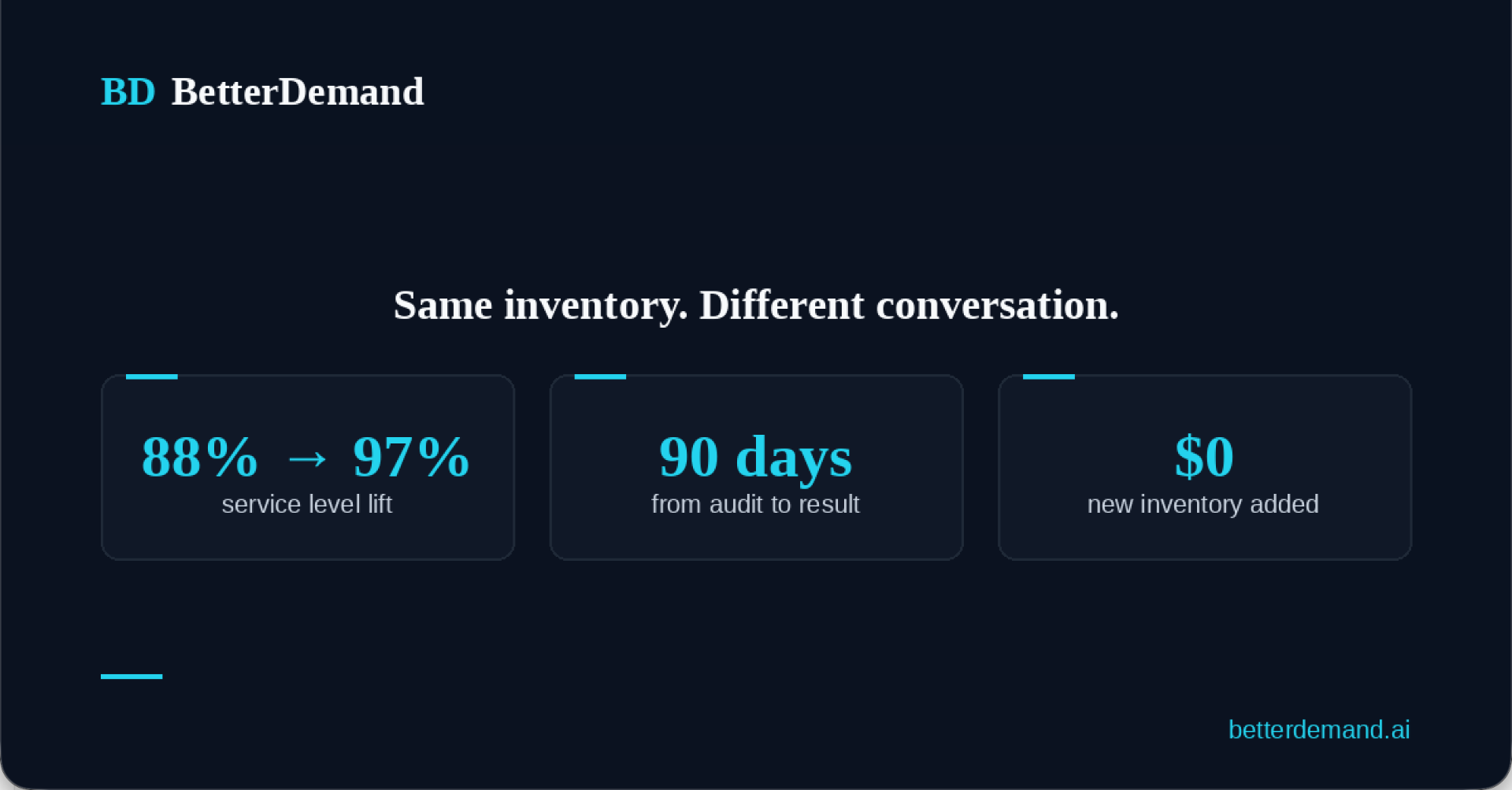
A manufacturer I worked with last year lifted service levels 9 points without adding a dollar of inventory. The ops director told me it was the most boring win of his career. He meant it as a compliment.
The setup
Four-site industrial manufacturer, $180M revenue. Service level had been stuck at 88% for three quarters. The CFO wanted 95% by year-end, and the annual operating plan had been built around hitting it. Every internal conversation started the same way: "we need more safety stock."
That's usually how these stories begin. Service level is below target, someone in finance wants a number, and the safety-stock conversation becomes a proxy for every frustration the ops team has been carrying around for a year.
We had one request before we opened a spreadsheet: don't assume it's a demand problem yet.
What the data actually showed
We spent a week looking at stockouts the way nobody had looked at them. By SKU, by site, by week, by root cause. The root-cause pass is the one most teams skip — it takes time, it requires someone to actually call the warehouse and ask what happened — and it's almost always where the answer lives.
The pattern was boring and obvious in hindsight. Seventy percent of the misses came from twelve SKUs, across the same four sites, driven by one thing: late replenishment between their own warehouses. Inter-site transfers were consistently arriving one to two weeks after the receiving site had already stocked out.
This is not what a demand problem looks like. Demand problems are noisy. They show up as forecast bias across a broad SKU base, as occasional promotion-induced spikes, as channel-mix shifts. They don't cluster on twelve SKUs at the same four sites every month.
They had a network problem. The inventory existed. It was just in the wrong place.
The fix
The fix was a 20-minute weekly inter-site transfer review. Three people — a warehouse operations lead, a distribution planner, and a replenishment coordinator. One spreadsheet showing projected stockout risk by SKU-site for the next two weeks, rank-ordered. Every Tuesday morning, they walked the list, made transfer decisions, and logged them.
Owned by distribution, not by planning. That detail mattered. Planning had been getting blamed for a problem they couldn't solve, and distribution had been waiting for someone to tell them what to move. Once we put the decision in the hands of the people who actually controlled the trucks, the whole thing unclogged.
Nine points of service lift in 90 days. No new inventory. No software change. No consultant report. A standing meeting and a spreadsheet.
The broader lesson
Most "we need more inventory" conversations at mid-market companies are actually "we don't know where our inventory is going" conversations. The working capital looks like a stock problem on the P&L because that's the number the CFO sees. It's usually a process problem in the warehouse, and process problems don't show up on the balance sheet until you look for them.
This is not a case against safety stock. There are plenty of situations where you genuinely need more buffer — variable lead times, demand that's spiking, a new product without a curve yet. But "we should carry more inventory" should be the last option you land on, not the first. It's expensive, it's slow to unwind, and it hides the underlying dysfunction for another quarter.
Before anyone at a mid-market product company signs off on a safety-stock increase, someone should be able to show them a clean root-cause analysis on the last ninety days of stockouts. If that analysis hasn't been done, the inventory conversation is premature.
Ready to Forecast Smarter?
BetterDemand combines AI-powered forecasting with real supply chain expertise. Visit betterdemand.ai to learn how we help distributors and manufacturers plan with confidence.