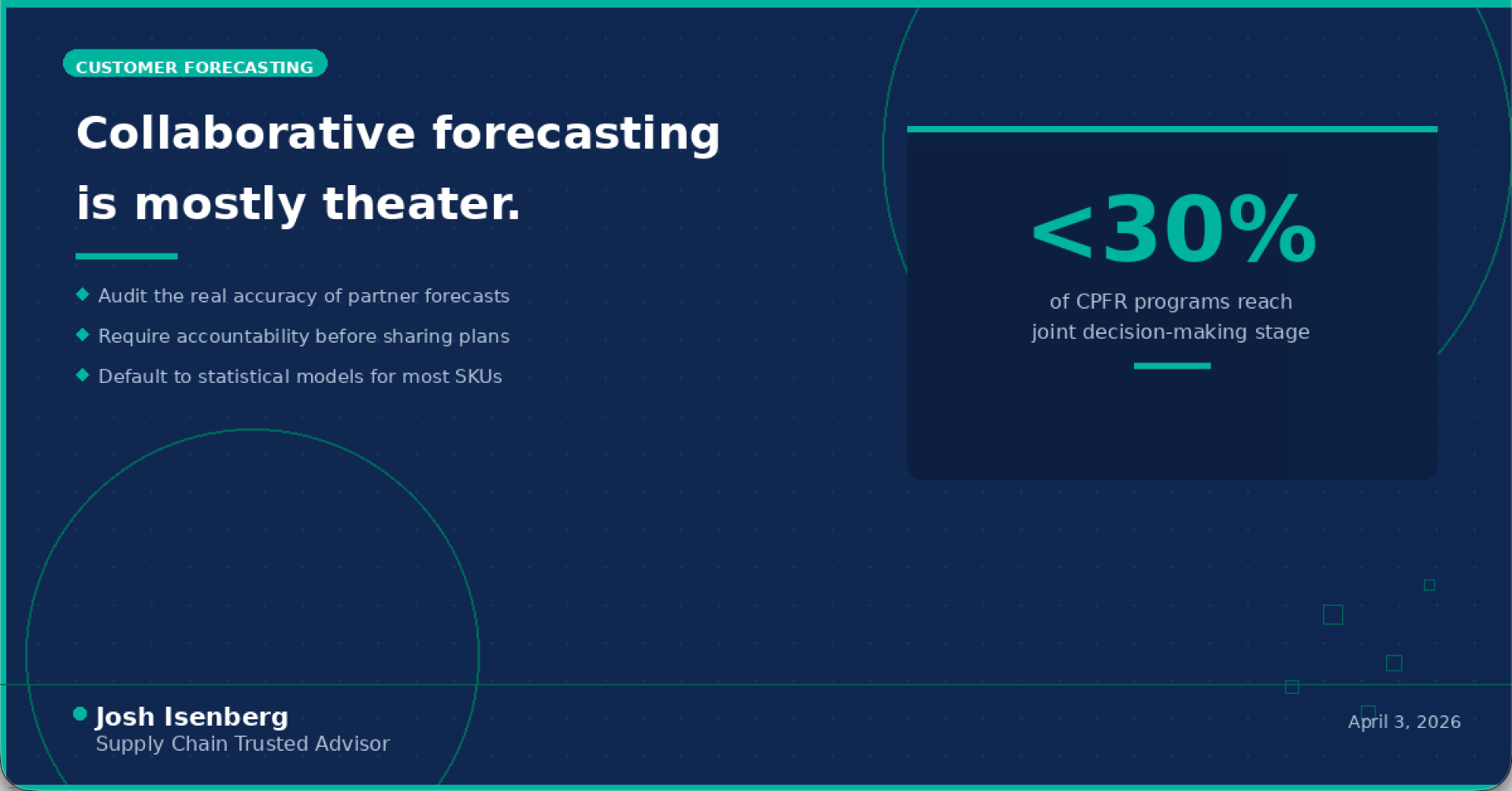
Why Collaborative Forecasting Mostly Fails to Deliver
The Industry's Favorite Sacred Cow
Collaborative Planning, Forecasting, and Replenishment — CPFR — has been supply chain gospel since the mid-1990s. The premise is intuitive: if trading partners share demand signals, forecasts should improve, inventory should drop, and everyone wins.
Thirty years later, the promise has largely gone unfulfilled. Research published in Operations Research Letters by Galbreth, Kurtulus, and Shor found that collaborative forecasting can actually reduce forecast accuracy across a wide range of cost and demand parameters. That is not a typo. The very act of incorporating partner forecasts can make your predictions worse.
Yet the industry keeps evangelizing the framework. CPFR pilot programs continue to launch. Planning teams continue to spend hours in joint forecasting calls. And leadership continues to wonder why accuracy numbers have barely moved.
Why Collaboration Sounds Better Than It Performs
The core issue is that most collaborative forecasting programs lack structure and accountability. When a customer shares a forecast, there is typically zero consequence for inaccuracy. No penalty for over-projecting demand. No financial stake in the numbers they provide. The supplier absorbs all the risk.
The numbers bear this out. While showcase implementations at companies like Walmart and P&G produced impressive pilot results — 25% reductions in out-of-stocks, 30% inventory reductions — these represent the top fraction of a percent of trading relationships. The vast majority of CPFR programs produce marginal improvements of 2-8 percentage points at best, often consumed entirely by the operational overhead of running the program.
Industry adoption tells the real story. Despite three decades of promotion by VICS (now GS1 US) and countless consulting engagements, broad-based CPFR adoption remains low. Most companies that attempt it stall at the early stages — sharing data without ever reaching the joint decision-making that drives real value.
The Overhead Problem Nobody Talks About
Even when collaborative forecasting produces a modest accuracy gain, organizations rarely account for the true cost. Joint forecasting calls consume senior planner time — often your best people. Data reconciliation between partner systems is manual and error-prone. Exception management for forecast disagreements creates meeting after meeting.
For a mid-market distributor or manufacturer, that overhead might mean one or two full-time planners dedicated to managing collaborative relationships that produce single-digit accuracy improvements. The math often does not work.
When Collaboration Actually Pays Off
This is not an argument against all collaboration. There are specific conditions where incorporating customer forecasts genuinely improves outcomes: when the customer has demonstrated forecast accuracy over time, when there is a contractual or financial mechanism that creates accountability for forecast misses, when the SKU has long lead times that make statistical forecasting alone insufficient, and when the customer has visibility into demand signals you simply cannot access — like a major promotion or product launch.
Outside those conditions, your planning team's time is almost certainly better spent improving your own statistical forecasting, cleaning your demand data, and building better safety stock models.
Ready to Forecast Smarter?
BetterDemand combines AI-powered forecasting with real supply chain expertise. Visit betterdemand.ai to learn how we help distributors and manufacturers plan with confidence.