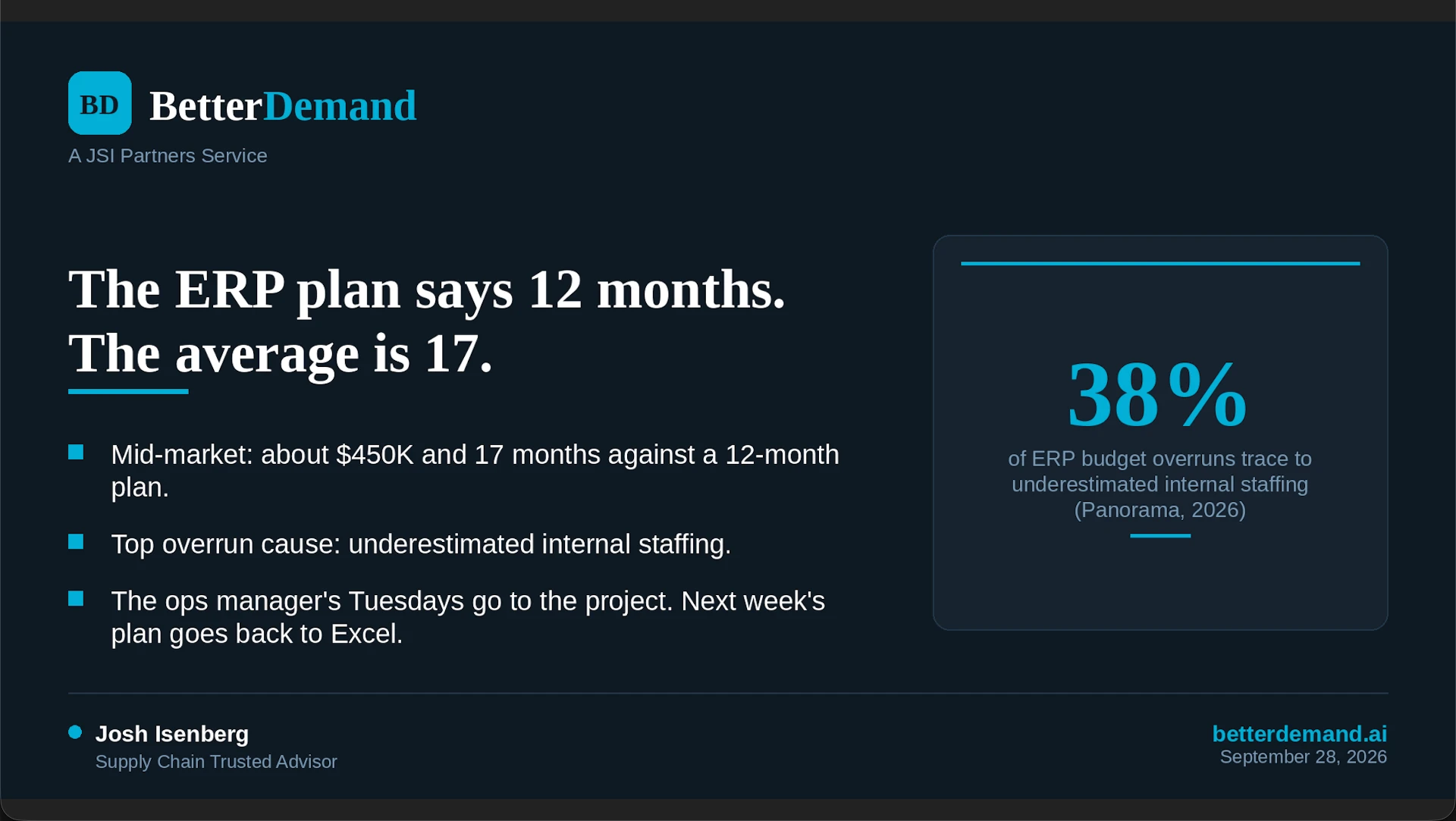
The ERP Plan Says 12 Months. The Average Is 17.
A mid-market manufacturer signs an ERP project in Q4. The plan says twelve months. The go-live slide says next October. The operations manager is assigned as the business lead, because she knows the plant better than anyone.
Seventeen months later the system goes live. Orders, inventory and financials work. Demand planning, capacity and S&OP are "phase two." Phase two is a spreadsheet.
That is not a horror story. It is the average. And the part of it that costs the most never appears in the budget.
What the numbers say
Panorama Consulting's 2026 ERP Report puts the average implementation at about 17 months, against the 12 most project plans assume. Mid-market cost runs around $450,000. Fewer than a third of companies report that the project met its objectives, and manufacturing is the industry where overruns are most common.
The leading cause of budget overruns is not the software and not the integrator. It is underestimated internal staffing, cited by 38 percent of companies, ahead of scope expansion at 35 percent and data issues at 34 percent.
Read that again. The thing most likely to break the project is the thing the company controls, and the thing it has the least of.
The third cost
Every ERP budget has two lines everyone sees: license and implementation. There is a third line nobody writes down.
It is the operations manager's Tuesdays. For a year and a half, the person who was going to build a real planning process for the plant is in configuration workshops, data-cleansing sessions and user-acceptance testing. Her best work goes into making the system of record correct. Her second-best work goes into keeping the plant running while she does that.
Next week's plan, the one that decides which line is overloaded and which customer gets the call, goes back to Excel. Not because anyone decided that. Because Excel is what there was time for.
I ran planning at Walmart and Campbell's, and I have led planning transformations at companies with far more headcount than a $100M manufacturer has. The pattern is the same at every size. The ERP project consumes the operations capacity that planning needed. By the time the project ends, the planning problem is older, larger, and still unsolved.
Why phase two never starts on time
An ERP project is scoped around the system of record, because that is what the vendor sells and what the auditor needs. Orders, inventory, costing, financials. Those go live.
The forward-looking half, what the plant will make next week, whether it fits, what it costs to fix when it does not, is listed as a later phase. Later phase means after the budget has been spent and the team has been exhausted. In the companies I work with, I have never met a phase two that started on the date in the original plan. Most start a year late. Some never start.
That is what "half-baked ERP" means in practice. Not a bad system. A finished system of record with an unfinished plan sitting beside it.
The case for not waiting
None of this is an argument against the ERP project. The system of record matters, and most mid-market companies do eventually need to replace the one they outgrew.
It is an argument against waiting for it.
The plan for next week exists whether or not the project is on schedule. The retailer's scorecard arrives on its date. The line goes down on a Monday. Those are weekly events, and the ERP project is a seventeen-month one. The two run on different clocks, and only one of them can be moved.
A planning layer that runs beside the ERP, whichever ERP it is, loads from the exports the ERP already produces. It does not touch the system of record, so it does not compete with the project for scope or for the integrator's time. It can be live in days and measured inside a quarter, which is what a mid-market operator can afford to wait for. The operations manager gets her Tuesdays back, because the plan is built by the system and she spends her hour reviewing it instead of her day rebuilding it.
When the ERP project finishes, the planning layer is still there, now reading from a cleaner source. Nothing is thrown away.
What to do this quarter
If the ERP project is already running, ask one question in the next steering meeting: who is building next week's plan, and in what? If the answer is "the same person who is leading the project, in a spreadsheet," the third cost is already being paid.
If the ERP project is on the budget list for next year, ask a smaller question first: what is the specific gap that hurts every week? For most mid-market manufacturers it is three things: which line is overloaded next week, which order is going to miss its date, and what it costs to fix it. None of them requires a new ERP. All of them require a plan that exists before Monday.
The ERP industry's own research says go-live should be treated as the start of value realization, not the end of the project. Seventeen months is a long time to wait to start.
Source: Panorama Consulting Group, 2026 ERP Report.
See what the planning layer looks like on your own exports. Book a 20-minute walkthrough and bring one week of orders.