Walmart OTIF: How It Is Scored and What a Supplier Actually Controls
TL;DR: Walmart's on-time, in-full program scores every purchase order on two separate questions: did the cases arrive inside the must-arrive-by window, and did all the cases arrive. The two are measured independently, so a supplier can post near-perfect in-full and still fail on time. Fines run 3 percent of the cost of goods on non-compliant cases. Most on-time failures at mid-market suppliers trace to one of five causes, and three of them are fixable without touching the plant. This guide explains the scoring, the common failures, and what to ask your own team this week.
Why this matters now
A supplier gets the call from Walmart's supply chain team. The scorecard says on-time is in the 80s. The supplier's own numbers say fill rate is near 100 percent, trucks are leaving, product is arriving. The two pictures do not match, and the supplier does not know which one is wrong.
Both are right. They measure different things. Understanding why is the difference between fixing the score in a quarter and arguing about it for a year.
How Walmart scores a purchase order
Every PO is graded on two metrics, and each one has its own target.
On time. Walmart assigns each PO a must-arrive-by date, the MABD. The order is on time if it arrives at the receiving DC within the window Walmart specifies around that date. Early is a miss. Late is a miss. The window is measured against the MABD on the PO as Walmart holds it, not against the date the supplier wrote on the shipping paperwork.
How on-time is measured depends on who moves the freight. If the supplier delivers (prepaid), the clock runs to the DC door, so transit time and carrier appointment scheduling are the supplier's problem. If Walmart picks up (collect), the supplier is measured on having the order ready on the ship date, and the transit leg belongs to Walmart.
In full. The order is in full if the cases received match the cases ordered. This is measured at the case level per PO, not as a percentage across the week. Short one case and the PO is not in full. Over-ship and it is not in full either.
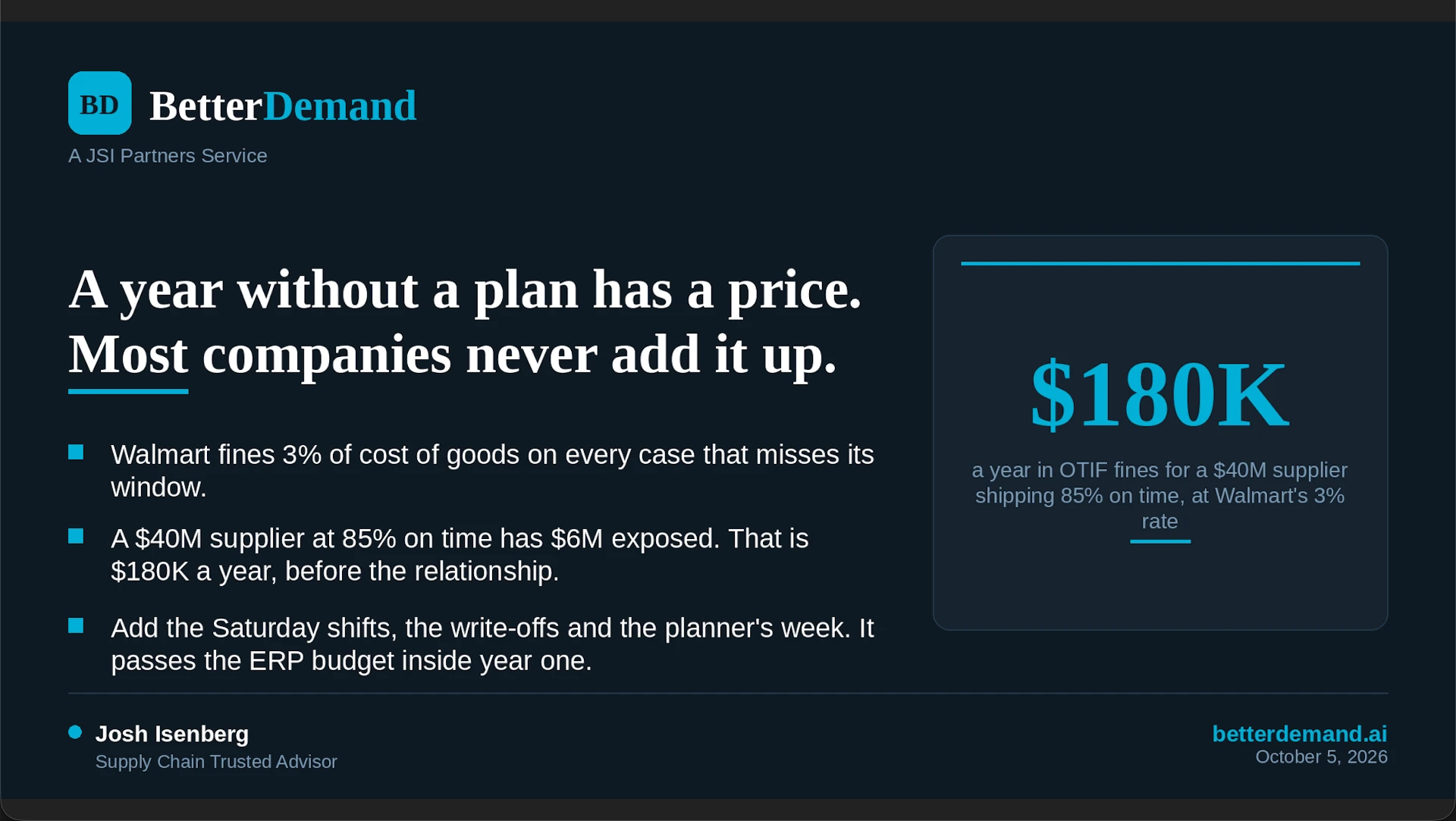
The targets and the fine. Walmart publishes compliance thresholds for both metrics, and they have moved several times since the program began in 2017; the current program sets the bar near 98 percent for both. Cases that fall outside the window or short of the order are charged at 3 percent of the cost of goods. On a $40M supplier shipping 85 percent on time, that is roughly $6M of product exposed and about $180,000 a year in fines, before any conversation about the relationship.
The exact thresholds and windows are in the Supplier Agreement and on Retail Link, and they change. Check the current version before planning against it.
Why in-full can be perfect while on-time fails
This is the pattern most mid-market suppliers call about, and it has a simple cause: the two metrics answer different questions, and the plant is built to answer the first one.
Fill rate is a production question. Did we make the cases and ship them? A plant that runs seven days and ships everything eventually will score near 100 percent in full, because every case does leave.
On time is a scheduling question. Did the cases leave on the day that put them in the window? A plant that takes a breakdown on Monday, ships four of ten orders that week, and pushes six to the following week has not shorted anyone. It has made six orders late. Fill rate stays perfect; on-time drops with every push.
So a plant can be excellent at making product and still fail the program, because the program is not measuring whether product gets made. It is measuring whether the plan held.
The five causes, in the order to check them
Three of these are clerical or process and can be fixed in weeks. Two are planning problems and need a plan that exists before the week starts.
1. The MABD was changed, but not through Walmart. When an order cannot ship on time, some suppliers update the date in their own system and deliver against the new date. Walmart's scorecard still measures against the original MABD, so the delivery is late even though the supplier's records show it on time. Changing a date through Walmart's process before the original date passes is treated differently from delivering late against the original. Ask your order desk which one they do.
2. The ASN or appointment missed, not the truck. On prepaid freight the receiving DC needs an advance ship notice that matches the load and a delivery appointment inside the window. A truck that arrives on the right day without a matching ASN, or outside its appointment, can score as a miss. This is the "clerical" failure, and it shows up as on-time misses on orders that physically arrived on time. Pull a sample of ten misses and check whether the ASN matched and the appointment was kept.
3. Prepaid versus collect confusion. Suppliers sometimes plan to the ship date when they are measured to the arrival date, or the reverse. Three days of transit is the difference between on time and late. Confirm which terms each DC runs on, and plan to the date that is measured.
4. The week did not fit on Thursday. This is the planning cause. Orders arrive, the plant schedules them, and the week is over capacity before anything goes wrong. One order was always going to be late; the plant just did not know which one until Friday. The fix is a plan that shows the overload the day orders arrive, so the supplier chooses which order slips and tells the customer first, instead of finding out from the dock.
5. The breakdown, and the hole it leaves. A line loses twelve hours on Monday. The plant recovers by robbing one customer to pay another, and the hole carries for three or four weeks. Every push is an on-time miss. The fix is the same plan, re-run with the lost hours in it, showing what overtime buys back and which orders are protected on purpose. That turns a three-week recovery into a Tuesday decision.
Five questions to ask your transportation manager this week
- For our last ten on-time misses, did the truck arrive on the right day? If yes, the cause is the ASN, the appointment, or the MABD, not the plant.
- Are our Walmart orders prepaid or collect, by DC? Which date are we measured to?
- When we cannot make a date, do we change the MABD through Walmart before it passes, or deliver late against the original?
- On Thursday, when orders arrive, do we know which ones will not fit the week before we start it?
- When a line goes down, how do we decide which orders slip, and does Walmart ever hear it from us before the truck is late?
If the honest answers to 1 through 3 point at paperwork, the score can move inside a month. If 4 and 5 are "we find out Friday," the score will keep moving until the plan does.
What a supplier can control, and what it cannot
A supplier cannot control the MABD window, the fine rate, or whether a DC's appointment system is full. It can control three things: the accuracy of what it sends Walmart (dates, ASNs, appointments), the day each order ships, and which order gets protected when the week does not fit.
The first is a process fix. The second and third are a planning capability: knowing on Thursday which orders are at risk, by customer, and what each option to recover costs. Most mid-market suppliers do that math by hand, after the fact, in a spreadsheet. The ones that stop paying the fine do it before the week starts.
Frequently asked questions
Does Walmart fine on in-full and on-time separately? Yes. Each metric has its own target, and a case can be charged for missing either. A PO can be in full and still charged for on-time, which is the common mid-market pattern.
If we deliver a day early, are we on time? Not in the current program. The window has an early edge as well as a late edge. Early arrivals are counted as non-compliant.
We changed the date and Walmart agreed. Why is the order still a miss? Check whether the change was made through Walmart's process before the original MABD passed, and whether the PO Walmart holds reflects it. A date agreed by email with a buyer is not the same as a changed MABD on the PO.
Our on-time is fine but in-full dropped. Different problem? Yes. In-full failures are usually inventory or production: the case was not there to ship. On-time failures are scheduling and paperwork. Fixing one does not fix the other.
How fast can on-time move? If the causes are clerical, inside a month. If the cause is a plant that is over capacity on Thursday, as fast as a plan can be put beside the ERP, which is weeks, not the year an ERP project takes.
Related terms
- MABD (must-arrive-by date): the date Walmart assigns to a PO; on-time is measured against the window around it.
- ASN (advance ship notice): the electronic notice of what is on the truck; a mismatch can score a physically on-time delivery as a miss.
- Prepaid versus collect: who moves the freight, and therefore which date the supplier is measured to.
- Fill rate: cases shipped over cases ordered, the supplier's internal measure; close to Walmart's in-full but not the same calculation.
- Frozen fence: the point after which the production schedule is not changed; the plan that holds between order arrival and the ship date.
Want to see your own orders scored before the week starts? Book a 20-minute walkthrough and bring one Thursday's order file.