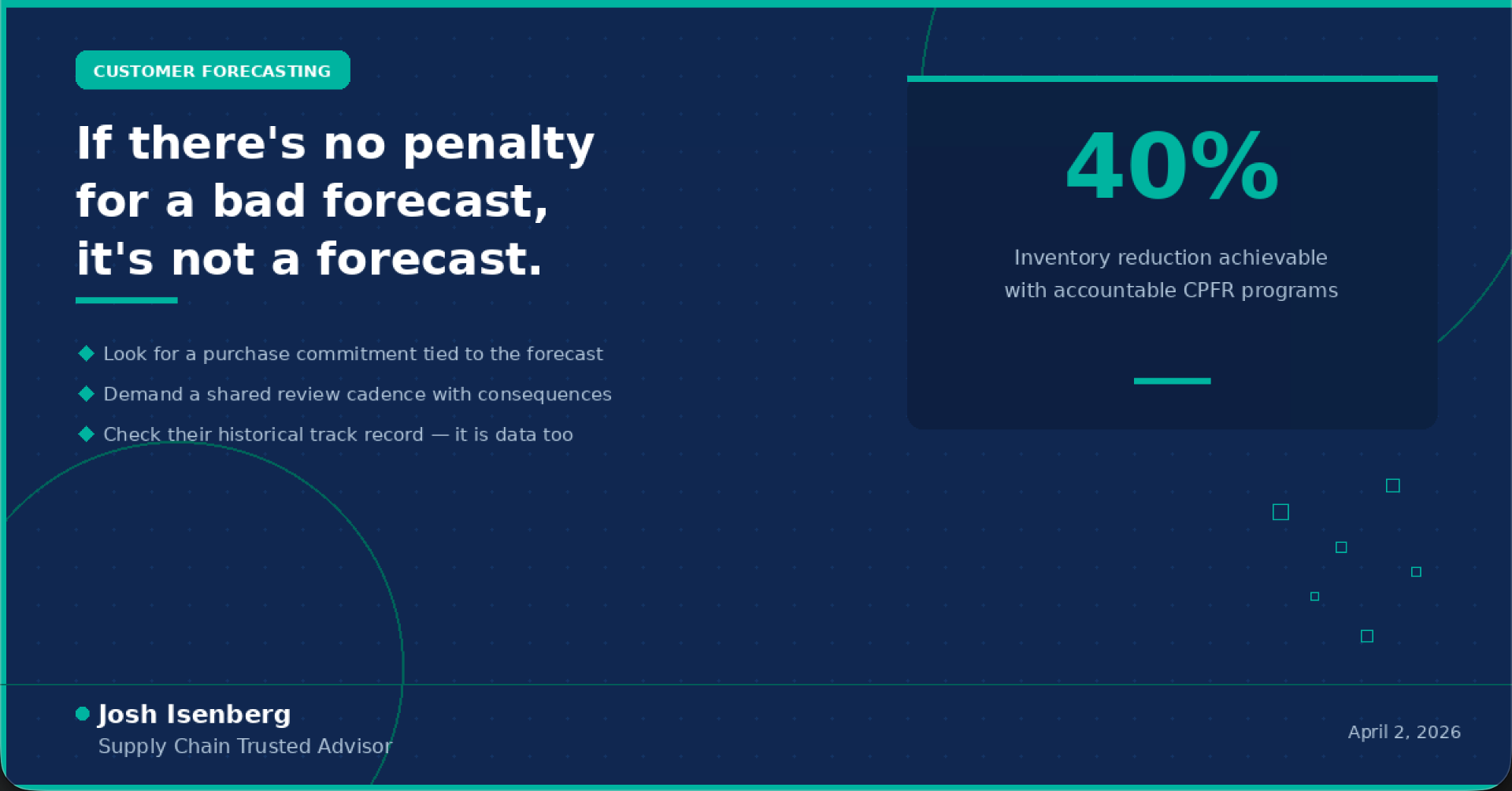
If There's No Penalty for a Bad Forecast, It's Not a Forecast
The Uncomfortable Reality of Customer Forecasts
You've been there. A key customer sends over their 12-month demand plan in January. Confident. Detailed. Color-coded by SKU. You take it seriously — you adjust your purchase orders, recalibrate safety stock, and align your production schedule accordingly.
By Q3, their actual orders are 40% below what they projected. They have no explanation. They face no consequence. And you're left managing the inventory overhang, the working capital hit, and the conversation with your finance team about why turns are down.
This scenario plays out thousands of times a day across supply chains. It's not a forecasting problem. It's an accountability problem.
The customer's forecast wasn't a real forecast. It was a wish list — and you funded it.
CPFR Promised a Solution — But Left Out the Key Ingredient
Collaborative Planning, Forecasting, and Replenishment (CPFR) has been a standard supply chain framework since the late 1990s. The premise is straightforward: if suppliers and customers share demand signals and align their planning processes, everyone benefits. Less variability. Lower inventory. Fewer stockouts.
And when it works, it really works. Case studies show that well-executed CPFR programs can reduce inventory levels by up to 40% and meaningfully improve forecast accuracy. These aren't fabricated numbers — they come from real retail and consumer goods programs where major partners committed to the process.
But here's what the success stories share that rarely gets mentioned: the programs that deliver results have teeth. There's a purchase commitment, a financial floor, a shared KPI, or a review cadence where both sides are accountable for the outcome. The customer has skin in the game.
In the programs that underdeliver — which is most of them — the accountability structure is one-sided. The supplier adjusts. The customer revises. No one is penalized for a bad number. And the forecast continues to be treated as an expression of optimism rather than a binding planning signal.
The Three Questions That Separate Real Forecasts from Risk Transfer
Before you build any supply plan around a customer's stated demand, ask three questions:
Does the forecast come with a purchase commitment? It doesn't need to be a firm PO for the full horizon, but some form of floor — even a partial commitment — is a meaningful signal. When a customer is willing to put money behind their forecast, the quality of that forecast tends to improve dramatically. When they're not, treat the number with appropriate skepticism.
Is there a review cadence with shared accountability? A forecast without a review process is a forecast that never gets corrected until it's too late. The best collaborative programs establish monthly or quarterly checkpoints where both sides review accuracy, discuss drivers of variance, and adjust together. If your customer isn't showing up to that conversation, the collaboration is theater.
What does their track record say? Historical forecast accuracy is the most underused input in supply planning. If a customer has consistently overforecast by 30–50% for the past two years, that's not bad luck — that's a systematic bias you should be adjusting for. Treat past accuracy as data, not as an awkward conversation to avoid.
What This Means for Your Planning Process
The goal isn't to distrust your customers — it's to build supply plans that reflect reality rather than optimism. That starts with being honest about which forecast inputs are grounded in accountability and which ones aren't.
For customers with strong track records and some form of financial commitment, collaborative forecasting can genuinely improve your planning accuracy and reduce inventory costs. Use their input — weight it appropriately.
For customers with poor track records and no accountability structure, their forecast should carry much less weight in your statistical baseline. Supplement it with your own historical demand analysis. Apply an accuracy adjustment. Build buffer where you need it.
The practical rule: the more accountability a customer has in the forecasting relationship, the more weight their input deserves. The less accountability, the more you should trust your own models.
Collaborative forecasting isn't bad. Collaborative forecasting without accountability is just an optimistic spreadsheet that someone else will pay for.
Ready to Forecast Smarter?
BetterDemand combines AI-powered forecasting with real supply chain expertise. Visit betterdemand.ai to learn how we help distributors and manufacturers plan with confidence.