Demand Planning Software for Food and Beverage Manufacturers
Demand Planning Software for Food and Beverage Manufacturers
TL;DR: Demand planning software for food and beverage has to understand shelf life, lots, changeovers and sanitation windows, not just units per week. A forecast that ignores those turns into a schedule the plant cannot run. Require a forecast that lands on a finite schedule, ask every vendor the demo questions below, and match the tool type to the size of the problem, not the size of the logo.
Most planning tools were built for products that sit in a warehouse for a year. Yours does not. A lot has a clock on it, a line has a washdown, and the retailer's DC orders on its own rhythm. Here is what that changes.
What is different about planning in food and beverage
Shelf life and FEFO. Finished goods and ingredients expire. Stock rotates first-expired, first-out, so the oldest lot ships first and the forecast has to account for how much sellable life a customer will accept on arrival. Building ahead to protect service is a bet against the date code.
Lot control. Every receipt, batch and shipment carries a lot. A lot sits in quality hold or positive release until it clears, and during that time it is on the shelf but not available. A plan that counts held lots as supply overstates what you can ship.
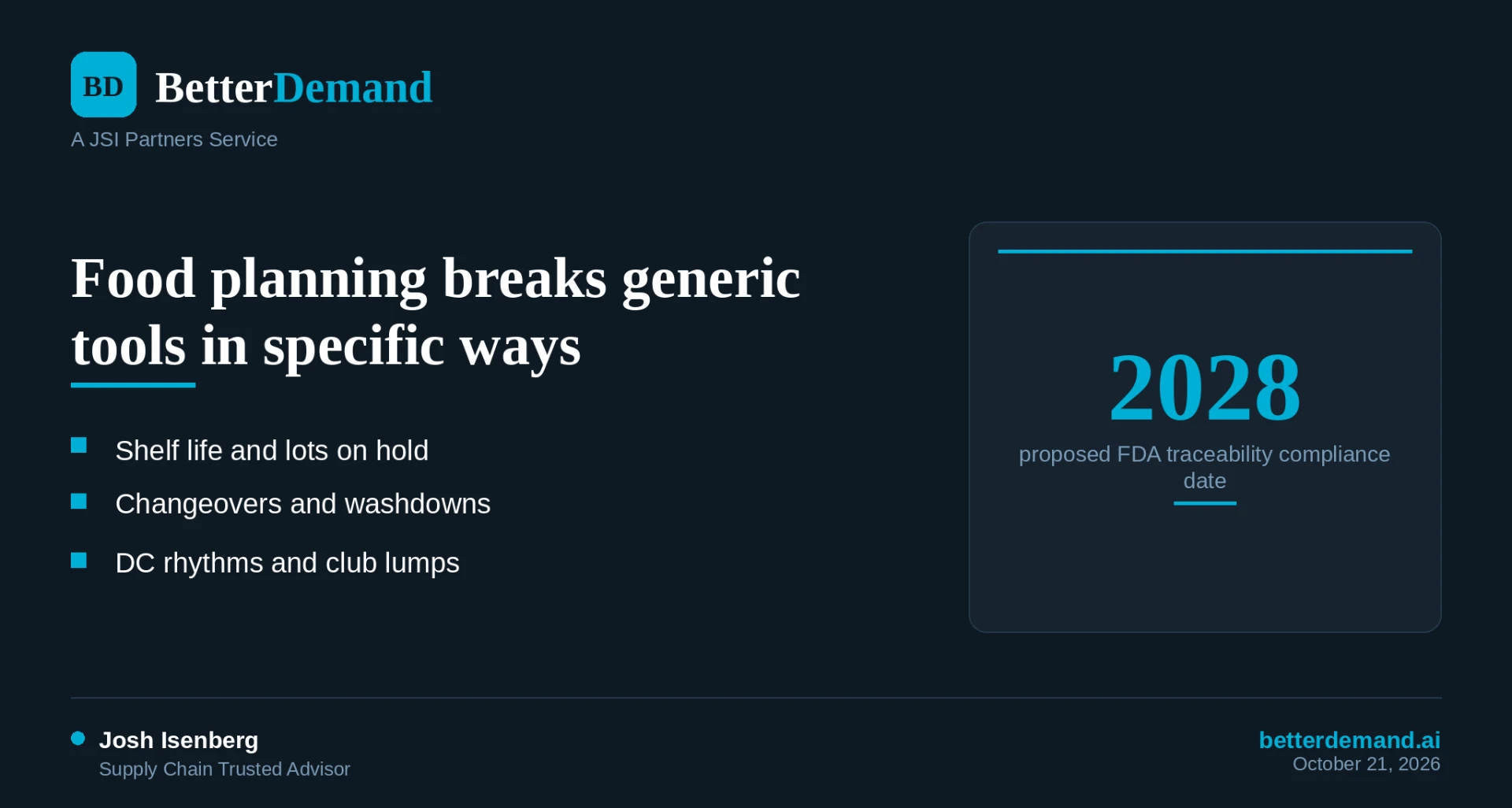
Traceability is also becoming a rule, not a preference. The FDA's Food Traceability Rule requires lot codes and key data elements at critical tracking events for foods on its Food Traceability List. NC State's Food Business program reports that the FDA has proposed moving the compliance date from January 20, 2026 to July 20, 2028.
Changeovers and sanitation windows. A line that runs an allergen product needs a cleanout before the next run. A changeover eats the shift. Sequence matters as much as quantity, which is why a forecast in cases means little until it is converted into runs in a workable order.
Seasonality and heat season. Beverages, ice cream, chocolate and grilling items swing with weather and holidays. Chocolate and confectionery also constrain shipping in summer, so the build and the ship date are two different decisions.
Retailer DC ordering rhythms. Demand reaches you as DC replenishment orders, not shelf sales. Each DC orders on its own cycle, so the pattern by item and DC looks different from the point-of-sale pattern behind it. Forecasting at the DC level matches what actually arrives on your order desk.
Promotions with no forecast behind them. A feature price or an end-cap display lands on the schedule as a PO, often with sales aware of it and planning not. The run slips or the plant runs overtime to cover it.
Club orders arriving as lumps. A club account may order a full truckload of one item once a month. Averaging that into a weekly number hides the spike and breaks the schedule the week it ships.
For more on why forecast accuracy comes down to process, read forecast accuracy is a process problem.
Capabilities to require
Treat these as pass or fail. Ultra Consultants, an ERP advisory firm, lists lot control with FEFO, shelf life and expiration tracking, quarantine and QA holds, and planning constraints for allergen segregation, changeovers and capacity among the core requirements for food and beverage processors. Add the demand side to that list.
- Forecasts by item and by retailer DC, not only by item total
- A way to enter promotions and known one-time orders as events, separate from baseline
- Shelf life and lot status read into the plan, including held lots
- Finite capacity, so the plan shows which line is over 100 percent next week
- Changeover and sanitation logic that sequences runs
- A frozen window, so the floor is not rewritten daily
- Seasonality that can be set per item, not one curve for everything
- A comparison to what your customers say they will order
- Plain-language explanations of why the number is what it is
Our Forecaster module produces forecasts at the item and retailer DC level and compares them to what your customers say they will order.
What to ask every vendor in a demo
- Show a lot on quality hold. Does the plan treat it as available?
- Show a promotion entered as an event. How does it move the run, and what happens when sales changes it inside lead time?
- Show a club-size order. Does it become a lump on the schedule, or get smoothed into the average?
- Show two products with a washdown between them. Does the system resequence the runs?
- Show a forecast at DC level for one retailer, then roll it up.
- What export or API do you read from my ERP, and how long does a live plant take?
- Who owns the forecast number after go-live: the tool, the planner or the consultant?
- What does it cost for my sites and SKU count, in writing?
If an answer starts with "that is configurable," ask to see it configured.
Which type of tool fits
ERP planning module. Microsoft states that Business Central's planning system proposes supply orders from reordering policies and item settings. It is built into the system you already run and carries your lots and items. The limit is capacity. A Microsoft partner, DMSI, writes that standard Business Central scheduling assumes infinite capacity and that sequencing is manual. Fit: simple, single-line plants with slack.
Inventory replenishment tools. Netstock publishes a food and beverage page describing seasonal, holiday and promotion planning, expiry and batch tracking, and lead-time monitoring, with connections to more than 60 ERPs including NetSuite, Dynamics and SAP Business One. It is strong where the problem is what to buy and when. Its published focus is inventory, not line capacity. Fit: distributors and plants whose pain is purchasing.
Enterprise suites. SAP describes Integrated Business Planning as a cloud solution covering S&OP, demand, supply, replenishment and inventory, with AI-powered forecasting and multi-location supply modeling. Suites like it cover the whole network. They also bring a larger implementation. Fit: multi-plant companies with a dedicated planning team.
Scheduling specialists. PlanetTogether publishes food and beverage scheduling features including allergen cleanout, sanitation windows, sequence-dependent setups and shelf-life tracking. It is strongest on the schedule itself. Fit: plants with complex sequencing and a scheduler to run it.
A planning layer beside the ERP. This is BetterDemand. It reads the exports your ERP already produces and adds finite capacity and the forecast on top, without replacing anything. It does not hold your lot records, so it is not a quality or traceability system. Fit: 20 to 300 people, one to a few plants. For a broader ranking, see supply chain forecasting tools ranked by fit.
What to do this week
- Pull the last 12 weeks of orders for your top retailer and look at them by DC. Mark every week where one DC ordered more than twice its average.
- List every promotion and club order in the next 8 weeks and check whether planning has it. Anything missing goes onto the schedule as an event.
- Count the changeovers and sanitation windows on your busiest line next week. Write the hours down and compare them to the hours your plan assumes.
What BetterDemand does about this
BetterDemand is planning software that runs beside your ERP for mid-market food, beverage and CPG manufacturers. Capacity is a finite scheduler that shows which line is over 100 percent next week and lets you test overtime, shifts and sequencing. Forecaster produces statistical forecasts by item and retailer DC and compares them to customer forecasts. Agent answers plain-English questions from the schedule math and shows its source. It works from Business Central, NetSuite, Aptean, Plex and SAP B1 exports, goes live in weeks, and carries a year-one money-back guarantee. See the pricing, which is set by sites and SKUs rather than revenue.
betterdemand.ai
Two free playbooks: Cost of Forecast Error and the S&OP Playbook