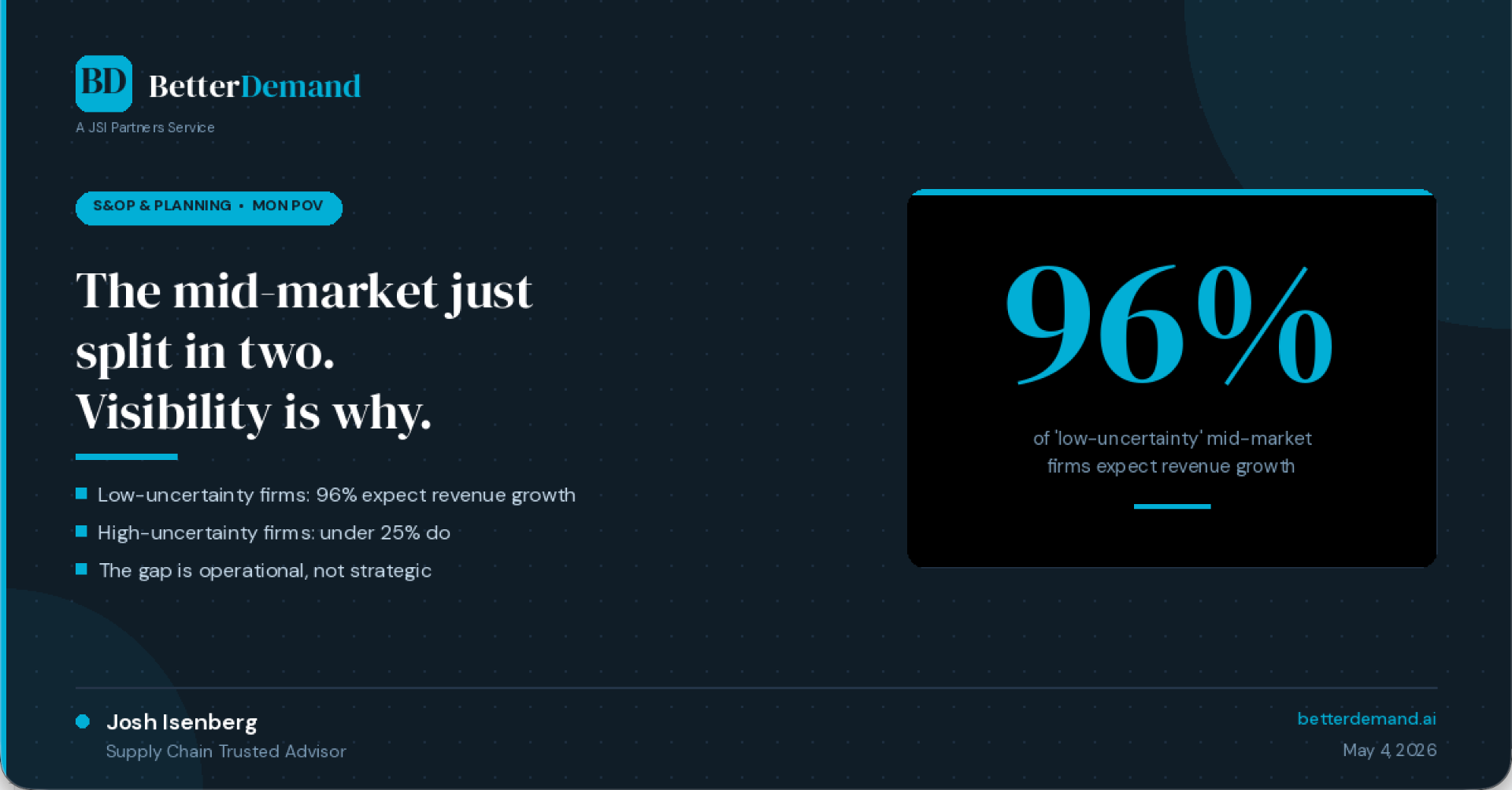
The Mid-Market Just Split in Two — Visibility Is Why
New mid-market confidence data shows a 73-point gap in revenue-growth expectations between two camps of mid-market product companies. The gap isn't really about tariffs. It's about what each company knew about its own supply chain on the morning the tariffs landed.
The mid-market isn't one market anymore.
According to recent middle-market confidence data, 96% of "low-uncertainty" mid-market firms expect revenue growth this year. At "high-uncertainty" firms, less than a quarter do. That's a 73-percentage-point split inside what most analysts still talk about as a single segment.
That gap isn't really about tariffs. Tariffs hit everyone. The duties on electronics, consumer goods, textiles, industrial components, furniture, and toys landed on every import-dependent product company in the country, regardless of how that company's planning team was set up.
The gap is what each company knew about its own supply chain on the morning the tariffs landed.
Visibility Was Always the Strategic Asset
The firms in the "low-uncertainty" bucket didn't get lucky and they aren't necessarily bigger or better-capitalized than the rest. Most of them spent the last two or three years doing unsexy work:
- Fixing inventory accuracy at the SKU and location level so they actually know what's on the shelf.
- Mapping tier-2 and tier-3 suppliers, not just the names on the purchase orders.
- Building an S&OP cadence the CFO actually trusts when the demand signal moves.
- Tightening the link between sales pipeline data and the production plan, so the next 90 days isn't just last year's plan with a 5% bump.
None of that work photographed well on LinkedIn while it was happening. There was no "transformation" announcement, no platform launch, no consultant-led offsite to celebrate. It was a string of quarterly project plans that the CFO probably tried to defer at least once.
The firms in the "high-uncertainty" bucket are mostly the ones that kept saying they'd get to it after the next quarter. After the next ERP project. After the next hire. After the next planning cycle.
What the Data Actually Means for Mid-Market Operators
Tariff cycles are now part of the operating environment, not a one-time disruption. The 2026 round of duties added new pressure on top of the 2025 cycle. Carrier on-time delivery rates hit historic lows in 2025. Excess inventory from earlier disruptions is still sitting on warehouse floors.
In that environment, "low uncertainty" doesn't mean a calmer market. It means the company has the visibility to know what's actually true about its own demand, inventory, and supplier situation week over week. That clarity is what lets a CFO commit to a number with confidence — and what lets a COO act on a tariff change in days instead of months.
Visibility was always the strategic asset. Tariffs just turned it into a binary outcome.
If you've been pushing demand planning down the priority list because nothing was on fire — that's the moment the fire finally finds you. The companies on the right side of this 73-point gap didn't wait. They built the muscle before they needed it.
Ready to Forecast Smarter?
BetterDemand combines AI-powered forecasting with real supply chain expertise. Visit betterdemand.ai to learn how we help distributors and manufacturers plan with confidence.