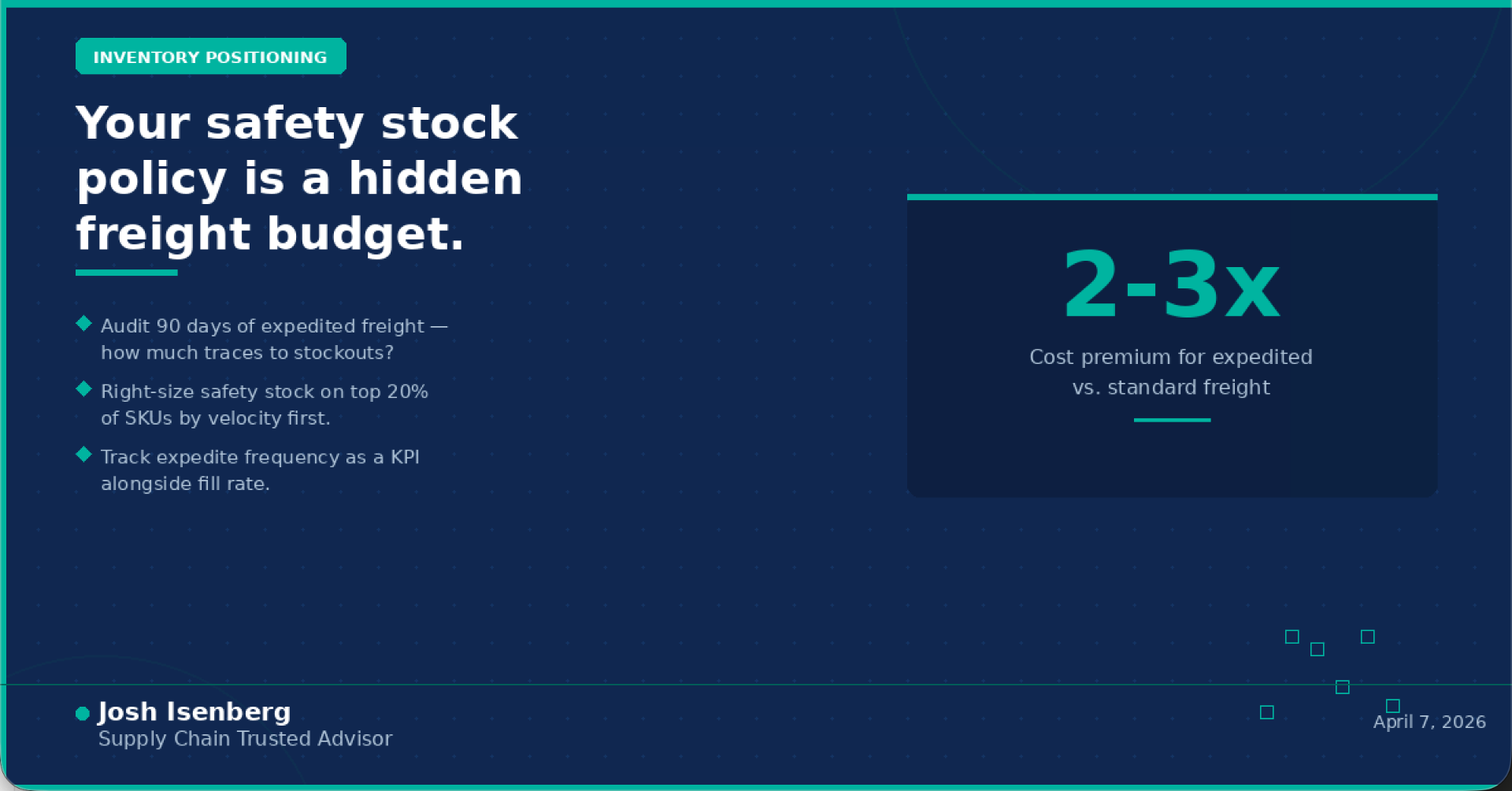
Your Safety Stock Policy Is a Hidden Freight Budget
The Freight Cost Problem You're Not Looking At
When freight costs spike, the default response is familiar: renegotiate carrier contracts, audit accessorial charges, consolidate lanes. These are reasonable moves. But in most mid-market supply chain operations, a significant portion of freight overspend has nothing to do with carrier pricing.
It traces back to safety stock.
Every time a key SKU stocks out, the operational response is almost automatic: expedite the replenishment, call in a rush order, pay the premium rate. Expedited freight costs 2–3x more than standard ground shipping — and when air freight is involved, the multiplier can reach 10–15x. Do that a few dozen times a quarter across a product catalog, and you've created a freight budget that no one planned for and no one owns.
The reason this problem persists is that the cost is rarely visible in one place. It shows up as "freight variances" in logistics, absorbed into cost of goods in finance, and quietly accepted by operations as the price of doing business. Without connecting the expedited shipment back to the stockout that caused it, the true cost of poor inventory planning stays invisible.
The Hidden Link Between Reorder Points and Freight Bills
Safety stock exists for a reason: to buffer against demand variability and lead time uncertainty. But many mid-market companies set their safety stock levels once — during an ERP implementation or at the beginning of a planning cycle — and rarely revisit them.
SKU velocity changes. Supplier lead times shift. Demand patterns evolve. When safety stock targets fall out of sync with current reality, stockouts become more frequent. And each stockout that triggers an emergency shipment is, in effect, a tax on your inventory planning.
The math is straightforward. If you're carrying $50,000 per year in expedited freight charges, and even half of that traces back to preventable stockouts, you could likely eliminate $25,000 in premium freight spend by recalibrating safety stock on your highest-velocity SKUs. The carrying cost increase on the additional inventory would almost certainly be less than the freight premium you're currently paying.
Studies consistently show that right-sizing safety stock reduces carrying costs by 10–20% while maintaining or improving service levels — because the goal isn't to hold more inventory across the board, but to hold the right inventory in the right places.
Three Steps to Start Fixing It This Week
You don't need a new system or a multi-month project to start recovering freight dollars from your safety stock policy. Here's a practical starting point:
Step 1: Run a 90-day expedited freight audit. Pull every expedited or premium shipment from the past 90 days. For each one, ask a simple question: was this triggered by a stockout, or by genuine unforecastable demand? If more than half trace back to stockouts, you have a safety stock problem masquerading as a freight problem.
Step 2: Right-size safety stock on your top 20% of SKUs by velocity. You don't need to overhaul your entire catalog. Start with the items that drive the most stockout-triggered freight spend. Even adding two to three days of additional cover on high-velocity SKUs can dramatically reduce emergency shipments without meaningfully increasing carrying costs.
Step 3: Add expedite frequency to your KPI dashboard. "Fill rate" is the standard inventory health metric — but it doesn't tell you whether you're achieving that fill rate through good planning or expensive emergency responses. Tracking how often you expedite, and why, creates accountability and surfaces the true cost of planning gaps.
What This Means for You
Freight cost reduction isn't just a logistics problem. It's a planning problem. And the companies that make the most sustainable progress on freight spend aren't always the ones with the best carrier relationships — they're the ones who engineer out the need for emergency shipments in the first place.
The next time freight costs come up in an ops review, push the conversation upstream. Ask not just what you're paying per shipment, but why those shipments are happening. The answer will tell you a great deal about whether your inventory policy is working for you — or costing you more than you realize.
Ready to Forecast Smarter?
BetterDemand combines AI-powered forecasting with real supply chain expertise. Visit betterdemand.ai to learn how we help distributors and manufacturers plan with confidence.