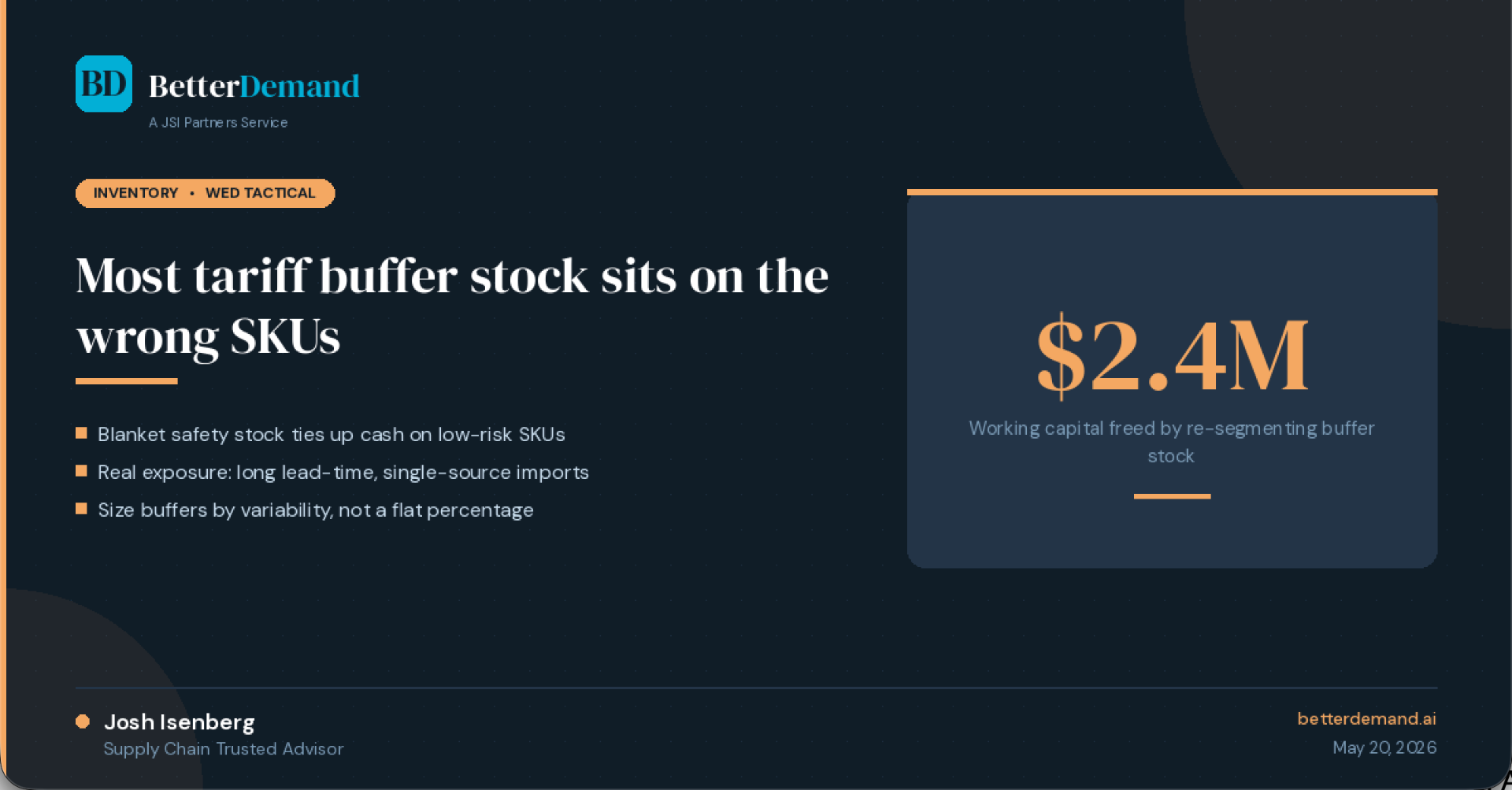
Tariff Buffer Stock: Why Most Teams Cushion Wrong
Eighty-seven percent of supply chain leaders added buffer inventory this year to hedge against tariffs. It is the responsible-sounding move, and it is the one most teams reached for first. The problem is that a large share of that buffer is sitting on the wrong stock.
The Blanket Buffer Trap
Here is a pattern I have seen play out more than once over the past year. The tariff headlines hit. The planning team gets nervous. Leadership asks for a cushion, and the fastest way to deliver one is to raise safety stock across the entire catalog by some flat percentage. Twenty percent on everything. It feels decisive, it is easy to approve, and it shows the board that the company is taking the risk seriously.
With one mid-market distributor, that single decision tied up roughly $2.4 million in working capital in a quarter. The uncomfortable part was where the cash landed. Most of it went to items that were never exposed to tariffs in the first place: domestically sourced products with steady, predictable demand. Those SKUs did not need a bigger cushion because something three categories over got hit with a duty.
Exposure Is Not Evenly Distributed
The core mistake in a blanket buffer is treating every SKU as if it carries the same risk. It does not. Tariff exposure concentrates in a narrow slice of the catalog, and that slice has three recognizable traits: long lead-time items, single-source imports from tariff-affected countries, and products with lumpy or hard-to-predict demand. Those are the SKUs where a disruption actually threatens your service level. Everything else is, at most, a secondary concern.
When you cannot see which SKUs carry the real exposure, the safe-feeling default is to protect all of them equally. That instinct quietly drains cash, and it does it without improving your protection on the items that matter.
Rebuild the Buffer the Boring Way
The fix is not exciting, and that is the point. Segment the catalog by demand variability and lead-time risk. Size safety stock to each segment's actual service-level need rather than applying one flat percentage to the whole book. Concentrate working capital where the tariff exposure genuinely sits, and pull it back everywhere else.
For the distributor above, that rework held service levels steady and kept full protection on the SKUs that mattered, while freeing about $2.4 million back into working capital within a single quarter. Same protection, far less cash locked up.
Buffer inventory is not the mistake. Buffering everything equally is. If you raised safety stock this year, the question worth asking is a simple one: do you actually know which SKUs that extra cash is sitting on?
Ready to Forecast Smarter?
BetterDemand combines AI-powered forecasting with real supply chain expertise. Visit betterdemand.ai to learn how we help distributors and manufacturers plan with confidence.