SKU Proliferation: The Hidden Drain on Your Supply Chain
The SKU Count Nobody Is Watching
There's a number hiding in most mid-market operations that rarely gets audited, almost never gets challenged, and quietly compounds into one of the biggest operational drains in the business: total SKU count.
Most companies grow their product lines with the best of intentions. A customer requests a custom pack size. Marketing launches a seasonal variant. A legacy product hangs around because "someone still orders it." Over time, the catalog expands — and the operational burden grows with it.
The problem isn't that companies have too many SKUs. The problem is that most companies have never honestly evaluated whether those SKUs are worth the cost of carrying them.
The 80/20 Reality Nobody Wants to Face
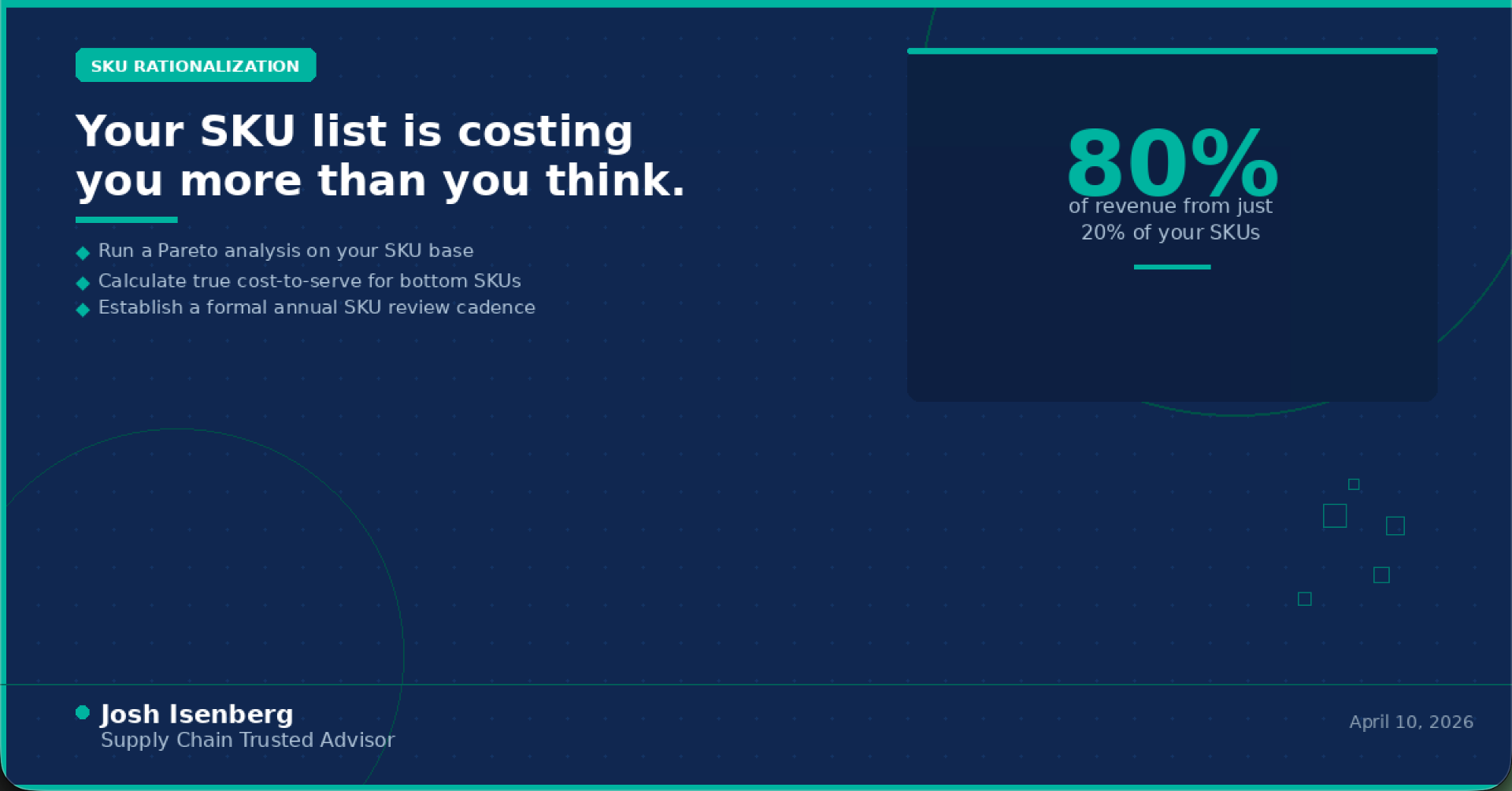
The Pareto Principle is not a theory in supply chain management — it's a consistent, empirical observation. Across industries and company sizes, roughly 80% of revenue is generated by just 20% of SKUs.
That means the remaining 80% of your product catalog — the vast majority of your SKUs — are collectively driving only about 20% of revenue. And when you look specifically at the bottom tier, the numbers get stark: C-class items, often the bottom 50% of SKUs by volume, may generate as little as 5% of total revenue.
One food company that conducted a formal SKU audit found that 25% of their active items generated just 0.5% of total revenue. An apparel company found that half of their products contributed only 1% to the top line. These aren't outliers — they're what the data consistently shows when companies finally look.
The revenue concentration is real. The question is whether your operational complexity reflects that reality.
What Excess SKUs Actually Cost You
The cost of a low-performing SKU isn't just the carrying cost of inventory. That's the number most teams see. The full cost-to-serve includes:
Planning overhead. Every SKU needs a forecast, a reorder point, and a safety stock calculation. Low-velocity items have erratic demand patterns that generate planning noise and phantom alerts in MRP systems. Planners end up spending time managing the long tail of the catalog instead of focusing on the SKUs that drive the business.
Warehouse complexity. Every active SKU needs a pick location, a bin, and a place in your putaway logic. The space consumed by slow-moving tail items is space that could be used for better slotting of your top performers — directly impacting pick efficiency and labor cost.
Service risk. Counterintuitively, having more SKUs can hurt service levels. Planning resources get diluted, forecast accuracy suffers across the board, and the operational complexity increases the chances of stock-outs on the SKUs that actually matter.
Forecast accuracy degradation. Low-volume SKUs introduce demand signal noise. When your forecasting system has to model items that sell 2 units a month alongside items that sell 2,000, accuracy suffers at both ends. Rationalizing the tail often has an outsized positive effect on overall forecast quality.
A Three-Step SKU Audit You Can Run This Quarter
SKU rationalization doesn't require a major initiative or a system implementation. It starts with three honest questions:
1. Run a Pareto analysis on your active SKU base. Sort your items by revenue contribution. Find the point where cumulative revenue crosses 80%. How many SKUs are in that group? How many are outside it? The ratio will tell you how concentrated — or diffuse — your revenue base actually is.
2. Calculate true cost-to-serve for your bottom performers. For the items in the bottom tier, estimate total cost including: direct carrying costs, planning time allocation, warehouse slots consumed, and historical stock-out frequency. In many cases, the cost-to-serve of a low-volume SKU exceeds its gross margin contribution. When that's true, the SKU is destroying value — not creating it.
3. Establish a formal SKU review cadence. Build a recurring process — at minimum annually — where every active SKU has to earn its place in the portfolio. Define the criteria in advance: revenue threshold, margin floor, strategic necessity, customer-specific requirements. Make rationalization a discipline, not a crisis response.
What This Means for Your Planning Team
SKU rationalization is ultimately a gift to your demand planners and supply chain team. Every SKU removed is one fewer forecast to maintain, one fewer reorder point to calibrate, and one fewer source of noise in your demand signal.
Companies that successfully trim their long tail consistently report improvements in forecast accuracy, reductions in planning cycle time, and better service levels on their core product lines — not because they got better at planning, but because they gave their planning systems a cleaner signal to work with.
The opportunity isn't complicated. It just requires the organizational will to ask an uncomfortable question: is every SKU in your catalog worth what it's actually costing you?
Ready to Forecast Smarter?
BetterDemand combines AI-powered forecasting with real supply chain expertise. Visit betterdemand.ai to learn how we help distributors and manufacturers plan with confidence.