Alternatives to Kinaxis, SAP IBP and o9 for Mid-Market Manufacturers
Alternatives to Kinaxis, SAP IBP and o9 for Mid-Market Manufacturers
TL;DR: Kinaxis, SAP IBP and o9 are strong platforms, built for large companies running planning across many sites, regions and functions, usually delivered with a systems integrator on a multi-year contract. A plant with 20 to 300 people needs something narrower: a finite capacity check, an item-level forecast from order history, a setup that runs on ERP exports, and one planner who owns the number. This guide lists the alternatives worth evaluating and ends with how to pick.
If you searched for kinaxis alternatives for mid-market plants, you probably already sat through a demo and felt the gap. The software was impressive. The project around it was not sized for a plant with one scheduler and a few lines.
That gap is not a flaw in the platforms. It is a question of fit.
Kinaxis alternatives for mid-market plants start with a size question
Each of the three vendors publishes enough to show who the product is built for. We use only what they say on their own sites and in their own filings.
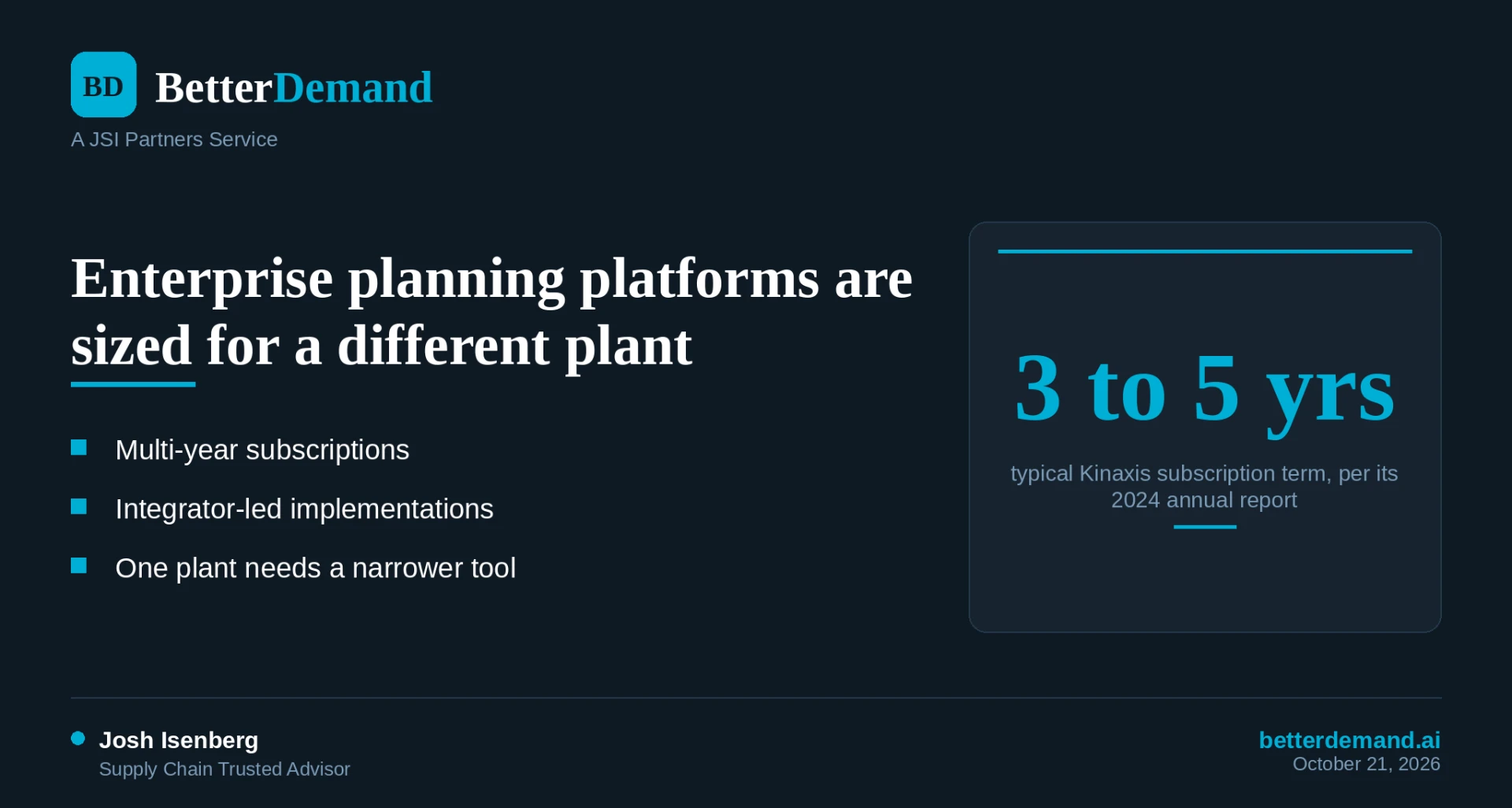
Kinaxis. Kinaxis calls Maestro an end-to-end supply chain platform, and it lists aerospace, automotive, chemical, consumer products, high-tech, industrial, life sciences and logistics as industries. What it does well is breadth: one platform across the supply chain, with a services group for implementation, professional services and training. Its 2024 annual report says customers sign multi-year subscription agreements, typically three to five years, and that implementation and configuration services are usually billed on a time-and-materials basis. Kinaxis also lists system integrators such as Accenture, Deloitte, EY, IBM and Infosys that "design, build, deploy and extend" Maestro for customers. The same report says its resellers focus on mid-market and smaller accounts, so a smaller buyer has a route in. It is worth asking that reseller what the scope looks like for one plant.
SAP IBP. SAP describes Integrated Business Planning as a cloud planning solution covering demand, response and supply, inventory, sales and operations planning, demand-driven replenishment and a supply chain control tower. SAP says more than 1,000 companies use it. One platform covers the planning processes from demand to inventory, and the page says it integrates with SAP and third-party systems. SAP does not publish a price for the full product on its product page. It does publish a starter edition, flat-fee and renewing every three months, but SAP marks it non-productive, with proof-of-concept tenants, up to 10 concurrent users and up to 5 planning areas. That is an evaluation sandbox, not a plant system.
o9. o9 describes its Digital Brain as a platform that links demand, supply, revenue, product and financial planning on an Enterprise Knowledge Graph. That connected view across commercial, operational and financial plans is what it does best. o9 lists global and regional consulting and systems integrator partners, and a 2023 o9 press release quotes its CEO on enterprises transforming "large and complex global supply chains." o9 does not publish pricing or customer size ranges on its site.
None of this makes the three wrong for a plant. It means the license, the integrator and the program around them are shaped for a company that plans across plants, countries and finance. A plant that schedules one to a few sites carries that weight without using most of it.
What a 20 to 300 person plant needs instead
Four things decide whether planning software gets used on a plant floor.
A finite capacity check. The daily question is which line is over 100 percent next week, with changeovers and fences counted. A run slips, a changeover eats the shift, and the Thursday order no longer fits. A rough-cut view that never says "line 2 is at 118 percent on Wednesday" does not help the scheduler. We cover the fence side in frozen window: the floor can trust.
An item-level forecast from order history. Mid-market plants rarely have clean statistical history above the item. The forecast has to start at the item and the retailer DC, from the orders already in the ERP, and show its own error each cycle.
Exports, not integrations. A plant with one IT person cannot run a six-month integration project. The tool should read the exports the ERP already produces (Business Central, NetSuite, Aptean, Plex, SAP B1) on a set cadence.
A planner who owns the number. The best system in the world fails if the plan belongs to a committee. One named planner owns the schedule and the forecast, and the tool serves that person rather than a steering group.
The same shape shows up in our earlier comparison of alternatives to Blue Yonder for mid-market forecasting. The vendor changes. The sizing question does not.
Alternatives a mid-market manufacturer can evaluate
Here is a fit-based list. Every row uses a vendor's own published statements.
| Option | What it does well | Where it fits | Published pricing |
|---|---|---|---|
| ERP-native planning (for example Business Central) | Planning Worksheet runs MPS and MRP and suggests purchase, transfer, assembly and production orders (Microsoft Learn) | Plants that want to stay inside the ERP and plan at rough-cut level | Ask your ERP partner |
| PlanetTogether | Finite capacity schedules, what-if scenarios and rescheduling; lists food and beverage as an industry; imports master data from the ERP and publishes the schedule back | Plants whose main problem is scheduling and that have a dedicated scheduler | None found |
| Netstock | Forecasting, inventory optimization, ordering and S&OP; lists NetSuite, Dynamics, SAP Business One and others; states "fully operational in 90 days or less" | Distributors and manufacturers whose main problem is buying and stock levels | None found |
| BetterDemand | Finite capacity scheduler plus item-level forecast, beside the ERP on exports | Food, beverage and CPG plants of 20 to 300 people | On the pricing page |
Two notes on the table. PlanetTogether is also a Kinaxis solution extension partner and lists Kinaxis among its integrations, so it can sit under a larger platform later. Netstock's published module list covers inventory, forecasting, ordering, supplier performance, demand planning and S&OP. Finite scheduling is not on that list, so ask directly if that is your pain.
For the wider forecasting field, see supply chain forecasting tools ranked by fit.
BetterDemand goes last because it is ours, so weigh it with that in mind. What it does is narrow: Capacity shows which line is over 100 percent next week, Forecaster builds item-level forecasts from order history, and Agent answers plain-English questions from the schedule math with the source on each answer. It runs beside the ERP and does not replace it. Pricing starts at $500 a month and is set by sites and SKUs, not revenue, with a year-one money-back guarantee.
How to choose
Match the tool to the pain you can name.
If the pain is the schedule, start with a finite scheduler (PlanetTogether or BetterDemand). If the pain is stock levels and purchasing, start with an inventory planning tool (Netstock). If your ERP already holds most of the logic and your pain is rough-cut, try its native planning first. If you run many plants across countries with a finance planning link, the three enterprise platforms are the right place to look, and a demo is worth your time.
Ask every vendor the same four questions: who delivers the implementation, how long until a planner uses it, what the contract term is, and what happens to the schedule when a run slips on a Tuesday.
What to do this week
Three things, none of which require buying anything.
- Write the four needs as a one-page scorecard. Finite capacity, item-level forecast, exports, named owner. Score your current setup from 0 to 2 on each. The lowest score is where to look first.
- Count the people the project would touch. List who would own the data, the schedule and the forecast. If the answer is more than three, you are shopping for a program, not a tool.
- Ask your ERP partner for the exports. Pull the open orders, item master and routings as they exist today. If you can get them in an afternoon, a tool that runs on exports will work for you.
BetterDemand is planning software that runs beside your ERP on the exports it already produces (Business Central, NetSuite, Aptean, Plex and SAP B1). Capacity checks every order against finite line capacity, with frozen and slushy fences and levers for overtime, shifts and sequencing. Forecaster adds item-level statistical forecasts and customer forecast comparison. Setup takes weeks, and the ERP stays in place. See pricing for the three tiers, which are set by sites and SKUs, not revenue.
betterdemand.ai
Two free playbooks: Cost of Forecast Error and the S&OP Playbook