10 Best AI-Powered Demand Forecasting Tools for Mid-Market (2026)
TL;DR
Most “best of” lists for AI demand forecasting tools are written for Fortune 500 budgets or Shopify stores. This guide is built for the mid-market: companies between $10M and $5B in revenue that need real pricing data, honest tradeoffs, and a clear picture of which tool actually fits. BetterDemand tops our list for mid-market manufacturers and CPG brands because it bundles senior supply chain advisory with AI forecasting at transparent pricing. Enterprise buyers with global, multi-tier supply chains should look at o9, Anaplan, or Blue Yonder, but need to budget for 6 to 24 month implementations and six-figure annual contracts.
Comparing tools? First see what your lines can really make: run the free Capacity Reality Check.
Run the Capacity Reality CheckQuick-Glance Comparison Table
| Tool | Starting Price | Best For | Rating | Implementation Time | Advisory Included? |
|---|---|---|---|---|---|
| BetterDemand | $1,000/mo ($12K/yr) | Mid-market manufacturing, CPG, F&B ($10M–$5B) | New to market | Weeks | ✅ Senior expert hours monthly |
| o9 Solutions | Custom (enterprise) | Large enterprise integrated planning | ~4.5/5 G2 | 6–12+ months | ❌ |
| Anaplan | ~$102K/yr median | Enterprise connected planning (finance + supply chain) | 4.2/5 G2 | 6–18 months | ❌ |
| Blue Yonder | $100K+/yr | Large retail, grocery, promotional modeling | 4.2/5 G2 | 12–24 months | ❌ |
| Netstock | Custom (mid-market) | SMB/mid-market ERP-connected replenishment | 4.6/5 G2 | Under 90 days | ❌ |
| RELEX Solutions | Six-figure+ | Retail, grocery, omnichannel | 93% satisfaction | Varies | ❌ |
| ToolsGroup | From $570/mo | Manufacturing/distribution, probabilistic forecasting | Gartner MQ 2026 | Varies | ❌ |
| Logility | Custom | Mid-market CPG and manufacturing | — | Longer than cloud-native | ❌ |
| Kinaxis | Custom (enterprise) | Global manufacturers, high-tech | — | Months | ❌ |
| Streamline (GMDH) | $30K–$80K+/yr | Mid-market manufacturers wanting fast deployment | 4.5/5 G2 | 9–12 weeks | ❌ |
Explore BetterDemand’s AI forecaster to see how advisory-plus-software works in practice.
What to Look For in an AI Demand Forecasting Tool
Before evaluating individual tools, get clear on what actually moves the needle. Too many buyers fixate on algorithm sophistication and miss the factors that determine whether a forecast ever changes a purchase order.
Forecast accuracy is a process problem, not just an algorithm problem. Research across supply chain organizations consistently shows that 60 to 70% of real-world accuracy variance comes from process and structural factors (SKU segmentation, overlay discipline, forecast value-add measurement, data quality) rather than the algorithm itself. A fancy ML model sitting on dirty data inside a broken S&OP process will underperform a simpler model inside a disciplined planning cadence. This is why forecast accuracy is a process problem worth understanding before you ever demo a tool.
ERP integration depth. Does the forecast actually drive purchasing and replenishment decisions inside your ERP, or does it stop at a dashboard? The gap between “nice chart” and “auto-generated PO recommendation” is where most mid-market implementations stall. If you need a tool that plugs into your ERP, ask vendors exactly how that handoff works.
Total cost of ownership. License fees are the tip of the iceberg. Enterprise tools routinely require systems integrator fees, dedicated internal model builders, and 6 to 18 months of implementation labor. Cloud-based planning solutions for small to mid-sized businesses typically start around $15,000 to $20,000 annually, while enterprise solutions can exceed $100,000 per year. The 3-year TCO gap between Anaplan and mid-market alternatives has been estimated at $400K to $2M or more.
Time to value. Can your team see measurable improvement in weeks, or are you looking at a year-long deployment before the first forecast runs? Mid-market companies usually can’t afford to wait 12 months. Practitioners on Reddit frequently cite implementation timelines as the deciding factor when choosing between tools in the $10M to $500M revenue range.
Promotional and NPI handling. This is the real stress test. Experienced buyers recommend always asking vendors two questions during evaluation: “Show me how you handle promotional forecasting” and “How does your system handle new product introductions with zero history?” These are the scenarios where generic statistical models break down and where embedded expert guidance or specialized AI features earn their keep.
For a broader look at common forecasting mistakes that trip up mid-market teams, that resource covers the five most expensive ones.
The 10 Best AI Demand Forecasting Tools in 2026
1. BetterDemand
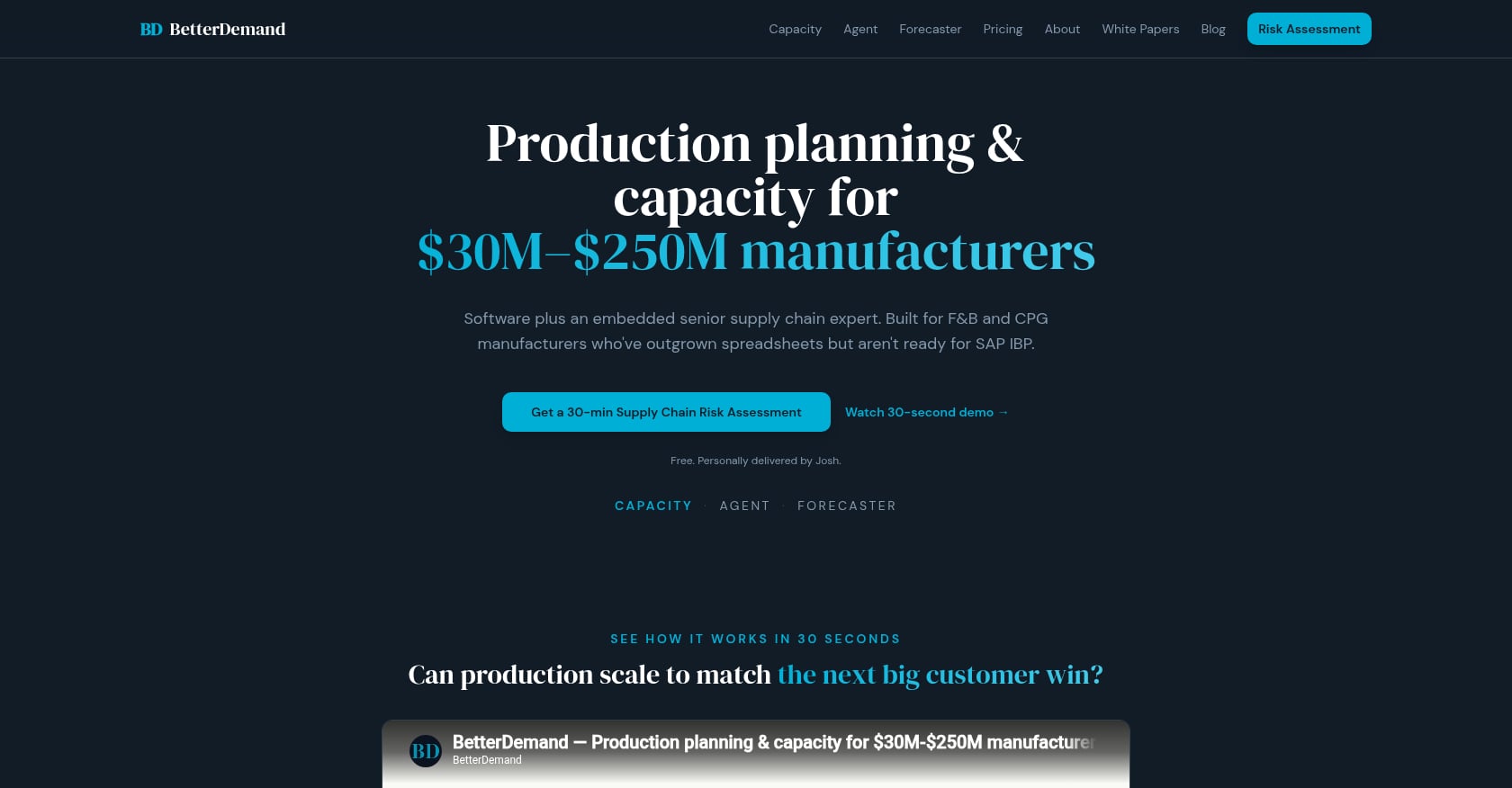
Best for: Mid-market product companies ($10M–$5B revenue) in manufacturing, CPG, food and beverage, and distribution that need forecasting and S&OP operationalization in one subscription.
Pricing:
- Starter: $1,000/mo ($12,000/yr)
- Professional: $1,667/mo ($20,000/yr)
- Enterprise: $3,333/mo ($40,000/yr)
All pricing is published. No hidden fees, no “contact us” games.
Key features:
- Live multi-horizon demand forecast built on your actual sales and inventory data
- Senior supply chain expert hours bundled into every subscription tier
- S&OP/IBP process design and facilitation
- Inventory optimization analysis across the full SKU portfolio
- Scenario planning for promotions, new product introductions, and seasonality
- ERP integration support on the Enterprise tier to drive purchasing and replenishment directly
Why it’s our top pick: Most AI demand forecasting tools sell software and assume you have the internal talent to operationalize it. BetterDemand is built on the opposite premise: the software is necessary but not sufficient. Every plan includes dedicated senior supply chain expert hours each month to run the S&OP cadence, handle exceptions, and ensure the forecast actually changes purchasing behavior. This directly addresses the reality that the mid-market staffing gap is the primary reason forecasting projects stall.
Value guarantee: 90-day measurable improvement guarantees tied to time, efficiency, and inventory outcomes ($24K on Starter, $40K on Professional, $80K on Enterprise), with free months of service if not achieved.
Tradeoffs:
- Newer market presence with limited public reviews compared to established enterprise platforms
- Not an end-to-end mega-suite (no TMS, WMS, or factory scheduling); focused on planning, S&OP enablement, and ERP handoff
- Success depends on baseline data quality, though expert hours help with data hygiene and process setup
See BetterDemand pricing and tiers
2. o9 Solutions
Best for: Large enterprises in consumer goods, retail, and manufacturing that need integrated planning across demand, supply, and finance on a single platform.
Pricing: Custom enterprise pricing, available on request. Expect six-figure annual contracts.
Key features:
- Integrated planning model connecting demand, supply, and financial planning through a common data model
- AI/ML-powered demand sensing and scenario planning
- Digital twin capabilities for supply chain modeling
- Broad industry coverage across CPG, retail, and industrial manufacturing
Tradeoffs:
- Steep initial configuration and change management. G2 reviewers consistently note that the platform’s flexibility and depth require significant upfront time to configure
- Data integration is a recurring pain point. Users report that integrating o9 with existing data sources is “really difficult”
- Multiple reviewers mention bugs and regression issues during the build phase
- Enterprise pricing puts it out of reach for most mid-market budgets
User sentiment: One G2 reviewer noted that “one of the main strengths of o9 is its ability to support integrated planning across multiple domains in a single platform,” but cautioned that the implementation journey is not for the faint of heart.
3. Anaplan
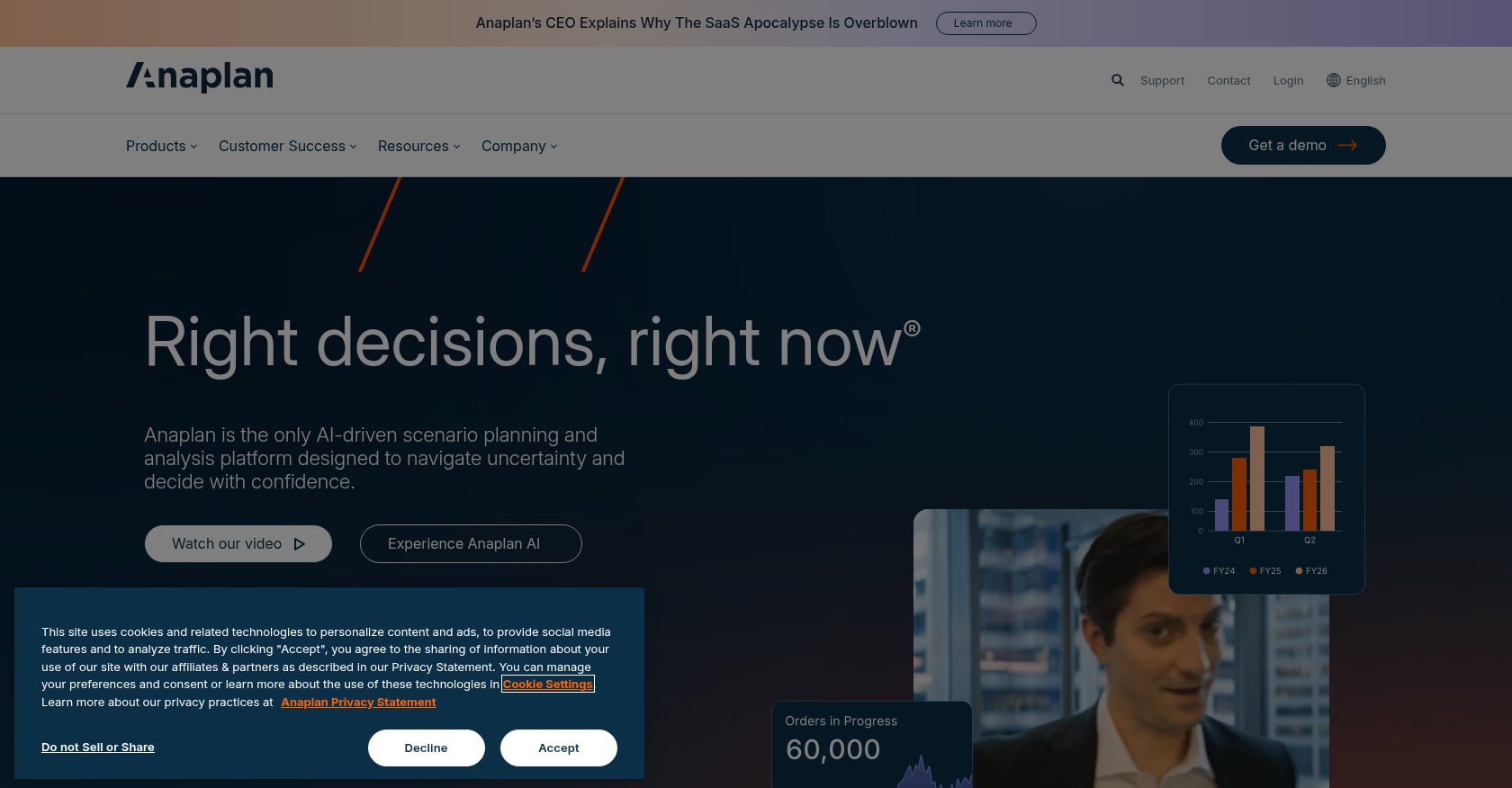
Best for: Large enterprises needing cross-functional connected planning across finance, supply chain, and sales, with dedicated internal planning teams and model builders.
Pricing: Median contract value of approximately $102,032/year based on Vendr data across 51 purchases, with a range of $31,126 to $211,921. Implementation costs typically equal or exceed first-year licensing.
Key features:
- Hyperblock calculation engine for complex, multidimensional modeling
- Cross-functional planning (finance, supply chain, sales) in a connected environment
- Large ecosystem of certified implementation partners
- Mature marketplace and community
Tradeoffs:
- Anaplan projects routinely take six to twelve months and require dedicated platform administrators, external consultants, and substantial change management investment
- Many mid-market organizations lack the dedicated resources (model builders, center of excellence), IT infrastructure, or budget to use it fully
- Reports from CFO Shortlist indicate that Thoma Bravo’s ownership has led to 30–40% price hikes, pushing existing customers to evaluate alternatives
- The collaborative planning features sound good on paper, but collaborative forecasting is mostly theater without real accountability structures
User sentiment: G2 rating of 4.2/5. Practitioners on LinkedIn and Reddit frequently describe Anaplan as “powerful but expensive to maintain,” especially for companies without a dedicated analytics team. For a deeper comparison, see how BetterDemand and Anaplan stack up for mid-market manufacturers.
4. Blue Yonder
Best for: Large retailers (think Walmart or Albertsons scale) with complex promotional calendars, fresh/perishable categories, and the budget for a multi-year implementation.
Pricing: Starts at approximately $100,000 annually. Full implementations are multi-million dollar projects.
Key features:
- AI-powered demand forecasting with promotional lift modeling
- Integrated supply chain execution (warehousing, transportation, fulfillment)
- Category management and space planning
- Claims of 12% improvement in forecast accuracy and 75% improvement in planner efficiency
Tradeoffs:
- Implementation timelines of 12 to 24 months are the norm, not the exception. All users in review forums report that implementation is lengthy and needs constant support
- Multi-million dollar total cost makes it impractical for companies under $1B in revenue
- The platform’s complexity requires dedicated teams to maintain and tune
User sentiment: Gartner Peer Insights reviewers acknowledge Blue Yonder’s strength in retail promotional forecasting but consistently flag the implementation burden. For mid-market companies exploring options beyond Blue Yonder, there’s a useful guide to alternatives for mid-market forecasting.
5. Netstock
Best for: SMB and mid-market distributors and wholesalers who need fast inventory visibility and ERP-connected replenishment without a long implementation.
Pricing: Custom quote required. No free version or free trial available. Positioned for SMB and mid-market budgets.
Key features:
- Extensive out-of-the-box ERP integrations: NetSuite, Sage 300, Sage X3, SYSPRO, Acumatica, Microsoft Dynamics 365
- Intuitive dashboards with inventory classification and replenishment recommendations
- Fast deployment, with the company emphasizing full operation in 90 days or less
- AI-powered demand classification and safety stock optimization
Tradeoffs:
- May underperform in industries with highly volatile or promotional-driven demand unless supplemented by manual adjustments
- Dashboards can feel simplified, lacking deeper drill-down options compared to enterprise planning tools
- G2 reviewers note that although it’s generally easier than many supply chain tools, the initial setup still requires clean data and good internal processes. Companies with messy ERP data may face delays
User sentiment: G2 rating of 4.6/5 across 172+ reviews. Users consistently praise the quick time-to-value. Netstock benchmark data highlights that without predictive, AI-powered planning tools, some SMBs still relied on spreadsheets and manual reviews, struggling to balance inventory while reacting to volatility. The spreadsheet-to-software transition is still happening in mid-market, and the barrier is trust and process, not technology.
6. RELEX Solutions
Best for: Mid-to-large retailers and grocery chains with complex omnichannel operations spanning demand forecasting, replenishment, space planning, and workforce management.
Pricing: Not published. Implementations typically range from six-figure annual contracts for mid-market retailers to multi-million-dollar engagements for large enterprise deployments. Capterra notes that RELEX pricing starts around €3,000 per year, likely a base module.
Key features:
- Unified platform across demand forecasting, replenishment, space planning, and workforce optimization
- Strong AI capabilities for fresh and perishable category planning
- Trusted by 700+ customers globally
- Automated order proposals with waste reduction focus
Tradeoffs:
- Not suited for pure D2C or Shopify-native businesses
- Calendar structure inflexibility noted by users in review forums
- Retail-first heritage means manufacturing-specific capabilities are less developed
- Pricing opacity makes budgeting difficult for mid-market buyers
User sentiment: 93% user satisfaction rating based on 111 reviews. Practitioners praise the fresh category forecasting but note the platform’s retail DNA can feel like a mismatch for non-retail use cases.
7. ToolsGroup
Best for: Mid-to-enterprise manufacturing and distribution companies with complex, volatile demand patterns that need multi-echelon inventory optimization and probabilistic forecasting.
Pricing: Starts at $570 per month for smaller deployments. Modular, quote-based for larger implementations. Recognized in the 2026 Gartner Magic Quadrant for Supply Chain Planning Solutions.
Key features:
- Probabilistic forecasting that models demand as a distribution, not a single number
- Multi-echelon inventory optimization (MEIO)
- Claims of 15–25% average improvement in forecast accuracy
- Inventory reduction of 20–30% while maintaining or improving customer fill rates
- Demand shaping and pricing integration capabilities
Tradeoffs:
- High initial investment and ongoing subscription costs can be a barrier for smaller companies
- Integration with legacy systems can be complex and time-consuming
- Requires skilled data scientists to optimize platform usage, which many mid-market teams don’t have
- The probabilistic approach, while powerful, has a steeper learning curve for traditional planners
User sentiment: Gartner Peer Insights reviewers value the inventory optimization outcomes. The ability to achieve service level lifts without adding inventory is the core promise, and ToolsGroup delivers for organizations with the analytical talent to use it.
8. Logility
Best for: Mid-market consumer goods and manufacturing companies that want demand planning, inventory optimization, and supplier management in an integrated Decision Intelligence platform.
Pricing: Custom. Positioned for mid-market to enterprise.
Key features:
- Integrated demand planning, inventory optimization, supplier management, and order response
- Logility Expert Advisor (LEA) AI capability for automated insights and recommendations
- Production planning and scheduling functionality built into the system
- Supply chain visibility and collaboration features
Tradeoffs:
- Implementation timelines tend to be longer than newer cloud-native competitors
- Less buzz and community momentum compared to o9 or Kinaxis
- The breadth of the platform means depth in any single module may lag behind best-of-breed specialists
User sentiment: Existing customers appreciate the breadth of the platform, though forum discussions suggest the user experience hasn’t kept pace with newer entrants. Mid-market buyers value the integrated workflow but should plan for a longer onboarding period.
9. Kinaxis (Maestro)
Best for: Mid-to-large manufacturers and high-tech companies with global supply chains that need rapid scenario response and concurrent planning capabilities.
Pricing: Custom enterprise pricing. Expect enterprise-scale budgets.
Key features:
- Real-time concurrent planning architecture (a genuine differentiator in the market)
- Handles demand planning, S&OP/IBP, supply, capacity, and inventory planning
- Rapid what-if scenario modeling with immediate impact visibility across the supply chain
- Strong in high-tech, automotive, aerospace, and life sciences verticals
Tradeoffs:
- Enterprise pricing and complexity make it a poor fit for mid-market budgets
- The concurrent planning architecture, while powerful, requires organizational maturity to use well
- Smaller ecosystem of implementation partners compared to Anaplan or SAP
User sentiment: Kinaxis users on Gartner Peer Insights consistently cite the speed of scenario analysis as the platform’s standout capability. The ability to model a disruption and see the cascading impact in minutes (rather than days) is genuinely unique among AI demand forecasting tools.
10. Streamline (GMDH)
Best for: Mid-market manufacturers and distributors ($25M–$500M+) who need sophisticated forecasting and Bill of Materials support without committing to an 18-month enterprise implementation.
Pricing: Typically $30,000 to $80,000+ annually depending on complexity. Implementation timeline of 9 to 12 weeks.
Key features:
- Sophisticated statistical and ML-based forecasting engine
- Bill of Materials (BOM) support for manufacturing planning
- Inventory optimization with automatic replenishment recommendations
- Faster implementation than enterprise suites
Tradeoffs:
- The interface is not very user-friendly, according to multiple user reviews
- Less robust S&OP and collaborative planning features compared to integrated platforms
- Smaller market presence and support ecosystem than larger competitors
User sentiment: G2 rating of 4.5/5. Users appreciate the forecasting sophistication and faster deployment timeline but consistently flag the UI as a weakness. For mid-market manufacturers who prioritize forecast accuracy over interface polish, Streamline delivers solid results.
How to Choose the Right Tool for Your Company Size
The single biggest mistake in evaluating AI demand forecasting tools is picking a solution built for a different company size. An enterprise suite won’t magically scale down, and an SMB tool won’t scale up gracefully.
Under $10M revenue: Start with Netstock or Streamline. If you’re still running forecasts in spreadsheets, even a basic tool will be transformational. The real investment at this stage is process discipline, not software sophistication.
$10M to $5B revenue (the mid-market): This is where the market has the biggest coverage gap. Enterprise tools are overbuilt and overpriced. SMB tools lack the depth for multi-channel complexity, promotional planning, and S&OP facilitation. BetterDemand, Netstock, ToolsGroup, and Streamline all serve parts of this range, with BetterDemand specifically designed for it. For guidance on selecting a mid-market solution, there’s a deeper evaluation framework available.
$5B+ revenue: o9 Solutions, Anaplan, Blue Yonder, RELEX, and Kinaxis are built for this tier. Budget for 6 to 24 month implementations, dedicated internal teams, and multi-year commitments. The sophistication is real, but so is the cost.
See how BetterDemand fits mid-market planning needs
Why Most AI Forecasting Tools Fail Mid-Market Companies
The AI demand forecasting software market was valued at $0.8 billion in 2025 and is projected to reach $2.2 billion by 2036, growing at a CAGR of 9.6%. Operations and supply chain management is expected to be the largest segment of the AI market by 2026. Yet despite this growth, mid-market companies keep getting stuck. Here’s why.
The implementation gap. Enterprise tools take 6 to 18 months to deploy. For a $100M manufacturer, that means living with broken forecasting for another year while paying for software you can’t use yet. Many companies never make it through. They end up in what practitioners call mid-market AI pilot purgatory, where the pilot technically works but never reaches full production.
The staffing gap. McKinsey notes that AI-powered demand planning can cut up to 50% of forecasting inaccuracies and up to 40% of administrative costs. But those gains require someone to manage the models, run the S&OP meetings, and translate forecast signals into purchasing decisions. Most mid-market companies don’t have a VP of Demand Planning or a dedicated analytics team. The software shows up, nobody runs it properly, and the forecast degrades within months.
The process gap. Supply chain analysis consistently shows that algorithm choice matters less than most evaluations assume. Standalone forecasting tools win when mature operational planning already exists. Integrated platforms win for most mid-market manufacturers because forecasting needs to feed planning naturally. But the dirty secret is that neither type wins if the company doesn’t have a disciplined planning process. Software without advisory is a dashboard, not a solution. The tool can be perfect; if nobody runs S&OP or acts on the forecast, accuracy improvements never become inventory improvements. That’s a lot of working capital hiding in inventory that never gets freed up.
This is the core thesis behind the advisory-plus-software model: giving mid-market companies the expert hours they need alongside the AI, rather than expecting them to staff up internally for a capability they’ve never built before.
FAQ
What is AI demand forecasting?
AI demand forecasting uses machine learning and statistical models to predict future product demand based on historical sales, market signals, seasonality, promotions, and external factors. Unlike traditional spreadsheet-based methods, AI demand forecasting tools can process thousands of SKUs simultaneously, detect non-linear patterns, and update predictions continuously as new data arrives. For stable products in stable markets, traditional models can hit 70–75% accuracy at the SKU-store-week level. The hard cases (new product introductions, promotions, competitor stockouts) are where AI consistently outperforms.
How much does AI demand forecasting software cost?
Costs vary dramatically by company size and platform complexity. Cloud-based solutions for small to mid-sized businesses typically start around $15,000 to $20,000 annually. Enterprise solutions from vendors like Anaplan, Blue Yonder, or o9 can exceed $100,000 per year in licensing alone, with implementation costs often doubling that figure. BetterDemand offers transparent published pricing starting at $1,000 per month ($12,000/year) with senior advisory hours included. You can review pricing details directly.
How long does implementation take?
Implementation timelines range from weeks to years depending on the tool. Netstock targets under 90 days. Streamline estimates 9 to 12 weeks. BetterDemand is designed for weeks, not months. Enterprise platforms like Blue Yonder typically require 12 to 24 months, while Anaplan implementations run 6 to 18 months. The more complex the tool and the more data sources involved, the longer the deployment.
Can AI forecasting handle promotions and new product introductions?
This is where AI demand forecasting tools differentiate themselves most clearly. Strong platforms use promotional lift models, analog-based forecasting for new products, and external signal processing to handle these scenarios. Weaker tools fall back to manual overrides. During any vendor evaluation, ask specifically: “Show me how you handle promotional forecasting” and “How does your system handle new product introductions with zero history?” The answers will tell you more than any feature list.
What ERP systems do these tools integrate with?
Most modern AI demand forecasting tools offer integrations with major ERP platforms including NetSuite, SAP, Microsoft Dynamics 365, Sage, SYSPRO, and Acumatica. The depth of integration varies significantly. Some tools simply export a CSV. Others push forecasts directly into ERP purchasing and replenishment modules. Netstock offers particularly broad out-of-the-box ERP connectivity. BetterDemand provides ERP integration support on its Enterprise tier to ensure forecasts drive actual purchasing decisions.
Do I need a data science team to use these tools?
It depends on the tool. Enterprise platforms like o9 Solutions and ToolsGroup often require skilled data scientists to configure and optimize. Mid-market tools like Netstock and BetterDemand are designed for supply chain planners, not data scientists. BetterDemand specifically addresses this by bundling senior supply chain expert hours into every subscription, so you get both the analytical capability and the operational expertise without hiring a dedicated analytics team.
What’s the difference between demand forecasting and demand planning?
Demand forecasting is the statistical or AI-driven prediction of future demand. Demand planning is the broader business process that takes that forecast and turns it into actionable decisions: purchasing plans, production schedules, inventory targets, and S&OP alignment. Many companies buy a forecasting tool and assume they’ve solved demand planning. They haven’t. The forecast is an input. The planning process, the organizational discipline, the cross-functional alignment: that’s where value is created or lost.
Two free playbooks: Cost of Forecast Error and the S&OP Playbook