
Alternatives to Blue Yonder for Mid-Market Forecasting 2026
Alternatives to Blue Yonder for Mid-Market Forecasting 2026
TL;DR
Blue Yonder is built for Fortune 500 supply chains, not mid-market product companies running lean planning teams. If you’re between $10M and $5B in revenue and need demand forecasting that actually fits your budget and headcount, there are nine solid alternatives to Blue Yonder for mid-market forecasting worth evaluating. This guide ranks them by how fast they turn a forecast into better purchasing decisions, with transparent pricing, real practitioner insights, and honest limitations for each. BetterDemand leads the list by combining AI forecasting with embedded supply chain advisory at a fraction of enterprise costs.
Why Mid-Market Companies Outgrow Blue Yonder (or Never Fit in the First Place)
Blue Yonder is a powerful platform. It’s also designed for companies with dedicated planning teams of 10 or more, seven-figure technology budgets, and the patience for 12 to 18 month implementations. If that’s you, stop reading. If it’s not, you’re in the right place.
The numbers paint a clear picture. Blue Yonder operates on quote-only pricing, with annual contracts for mid-size retailers starting around $175,000 and licensing that can run $200,000 to over $1,000,000 per year. Implementations are billed separately, starting at $500,000. For a $200M manufacturer with three planners, that math simply doesn’t work.
G2 reviewer data confirms the mismatch: 69.6% of Blue Yonder Demand Planning reviews come from enterprise users. Only about a quarter come from mid-market companies. The platform was built for Walmart-scale operations, and mid-market teams frequently discover they’re paying for capabilities they’ll never touch.
Practitioners on Reddit’s r/supplychain regularly describe “tool fatigue” with enterprise platforms, where the software technically works but nobody on their small team can operationalize it. The bottleneck isn’t the algorithm. It’s the process around it: the S&OP cadence, exception management, and cross-functional alignment that mid-market teams often lack.
That’s the real reason people search for alternatives to Blue Yonder for mid-market forecasting. Not because the software is bad, but because it demands resources mid-market companies don’t have.
Who This Guide Is For
This comparison is built for a specific buyer:
- Revenue range: $10M to $5B
- Planning team size: 1 to 5 people
- Current state: Running an ERP (NetSuite, SAP Business One, Dynamics) with native forecasting that’s hit its ceiling, or managing demand planning in spreadsheets
- Goal: A forecasting solution that drives better purchasing and replenishment decisions within months, not years
If your supply chain is global, multi-tier, and requires constraint optimization across dozens of factories, some of the enterprise options later in this list (Kinaxis, o9) may fit better. For everyone else, the first few options will likely be the right starting point.
At-a-Glance Comparison Table
| Alternative | Starting Price (Annual) | G2 Rating | Best For | Implementation Time |
|---|---|---|---|---|
| BetterDemand | $12,000 | New to market | Mid-market mfrs/CPG needing forecast + advisory | Days to weeks |
| Netstock | ~$4,800 | 4.6/5 (156 reviews) | Distributors replacing spreadsheets | ~90 days |
| Logility | $25,000–$100,000 | 4.1/5 (114 reviews) | $500M+ manufacturers needing proven planning | 3–6 months |
| ToolsGroup | Enterprise (quote) | 4.5/5 (49 reviews) | Companies with intermittent/long-tail demand | 3–6 months |
| RELEX Solutions | Enterprise (quote) | Strong (Gartner) | Retail/grocery/CPG with merchandising needs | Months |
| Slimstock (Slim4) | Custom | 4.5+ (Gartner) | Mid-market wholesale/distribution in EMEA | Consultant-led |
| Anaplan | ~$102,000 (median) | 4.1/5 (284 reviews) | Cross-functional planning (finance + SC + sales) | 6–12 months |
| Kinaxis | $100,000–$500,000+ | 4.0/5 (12 reviews) | Complex discrete manufacturing | 4–9 months |
| o9 Solutions | ~$280,000+ | 4.2/5 (18 reviews) | Upper mid-market/enterprise wanting advanced AI | Months |
SMBs should generally expect to pay $5,000 to $20,000 per year for demand planning software, while mid-market businesses typically land between $20,000 and $100,000 annually. Anything above that range deserves hard scrutiny on whether you’re buying enterprise capabilities you won’t use.
1. BetterDemand
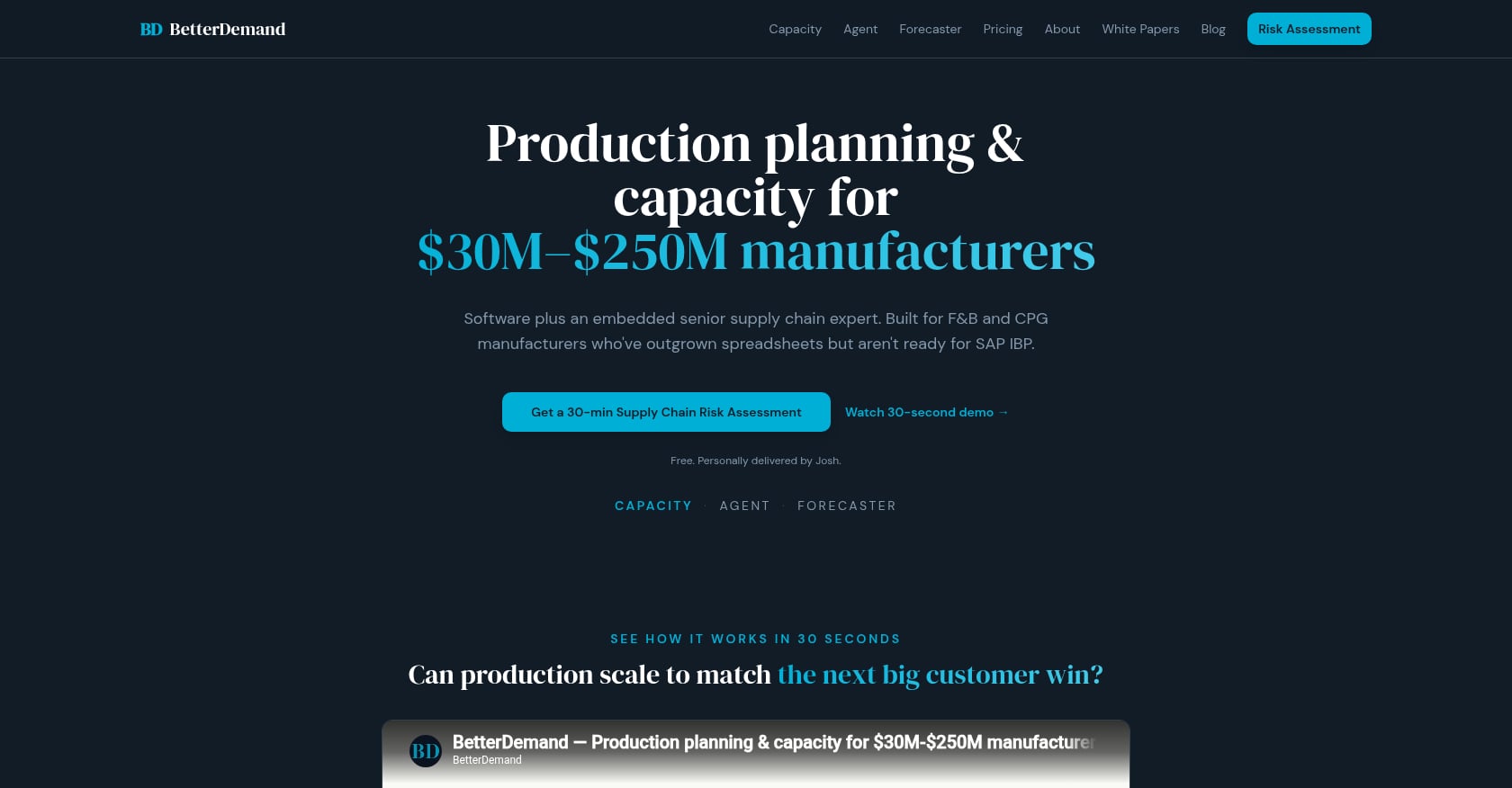
Best for: Mid-market manufacturers, CPG, food and beverage, and distribution companies ($10M–$5B) that need a forecast paired with expert guidance to actually act on it.
BetterDemand takes a fundamentally different approach from every other tool on this list. Instead of selling software and leaving mid-market teams to figure out implementation, model maintenance, and S&OP processes on their own, it bundles AI-powered demand forecasting with dedicated senior supply chain expert hours in a single subscription.
This matters because the most common failure mode in mid-market forecasting isn’t bad algorithms. It’s the gap between generating a forecast and turning it into purchasing and replenishment decisions. Practitioners on Reddit consistently report being “sold the dream” of AI-powered forecasting only to find themselves maintaining models without internal data science support. BetterDemand is designed to close that gap.
Pricing (published and transparent):
- Starter: $1,000/month ($12,000/year)
- Professional: $1,667/month ($20,000/year)
- Enterprise: $3,333/month ($40,000/year)
Every tier includes a 90-day value guarantee tied to measurable improvements in time, efficiency, and inventory. If the guaranteed threshold isn’t met, you get free months of service until it is.
Key capabilities:
- Live multi-horizon demand forecast built on your actual sales and inventory data
- S&OP process design and facilitation included in every plan
- Scenario planning for promotions, new product introductions, and seasonality
- ERP integration support on the Enterprise tier to push forecasts into purchasing
- Dedicated senior supply chain expert hours monthly
Limitations:
- Smaller vendor footprint compared to established enterprise platforms
- Not an end-to-end mega-suite covering TMS, WMS, or quality systems
- Success depends on baseline data quality (though expert hours help mitigate this)
- Less suited for highly regulated, global multi-factory constraint optimization
The pricing tells the story. At $12,000 to $40,000 per year, BetterDemand costs 5 to 15 times less than Blue Yonder while including the human expertise that enterprise tools assume you already have in-house. For mid-market companies where the forecasting mistakes stem from process gaps rather than algorithmic shortcomings, that advisory layer is the actual differentiator.
Explore BetterDemand’s forecasting approach
2. Netstock
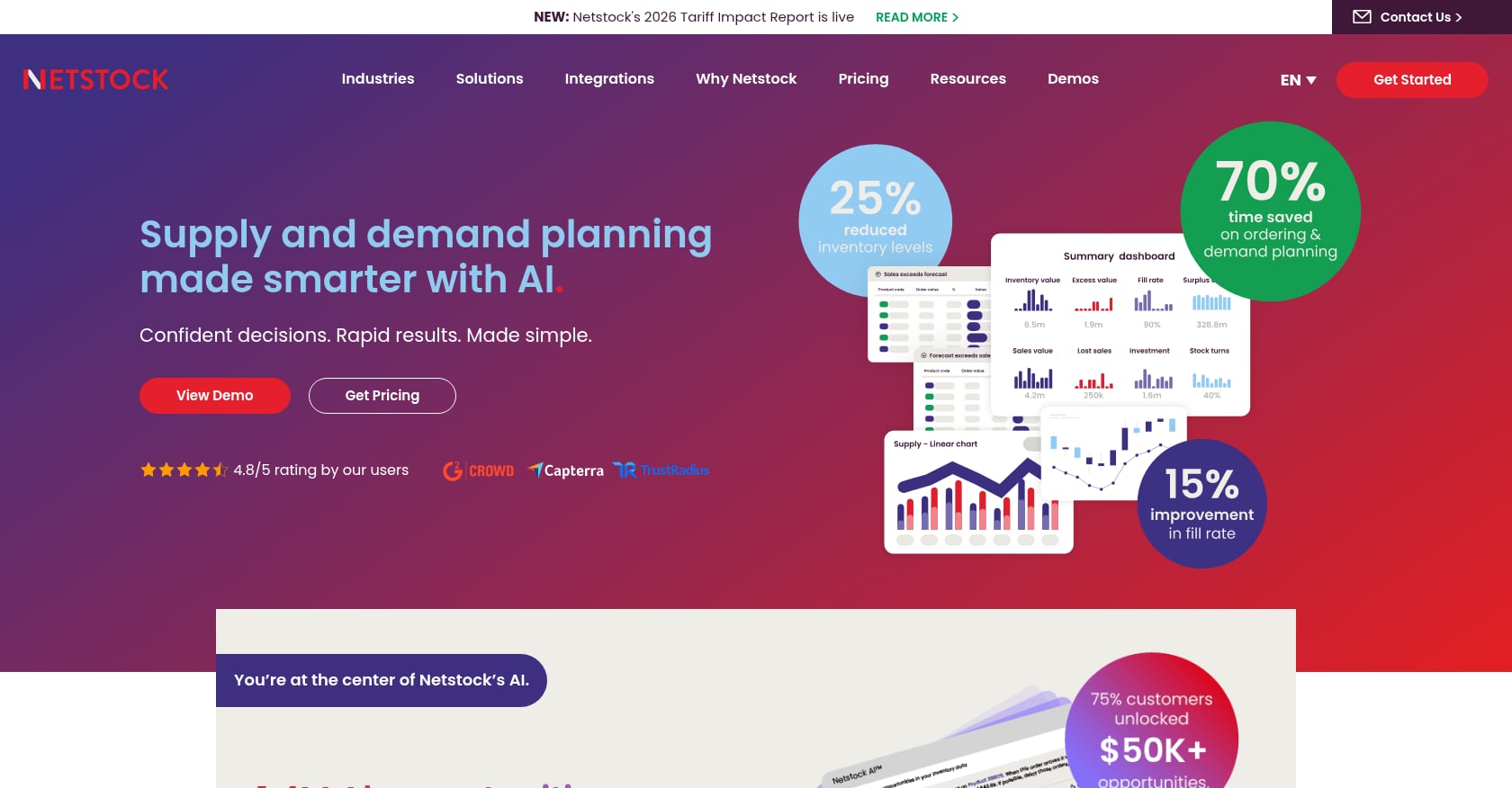
Best for: Small to mid-market distributors and manufacturers replacing spreadsheet-based planning with their first real forecasting tool.
Netstock sits at the opposite end of the spectrum from Blue Yonder. It’s simple, affordable, and deeply integrated with mid-market ERPs. If you’re a distributor with under 20 locations looking for solid inventory management with demand forecasting baked in, Netstock deserves a close look.
Pricing: Starting at approximately $400 per month (~$4,800/year), with custom quotes based on business requirements. No free or freemium plan.
Key capabilities:
- Pivot Forecasting engine enriched with machine learning
- Inventory optimization and replenishment planning
- Supplier performance tracking
- What-if scenario planning
- Strong ERP integration, particularly with NetSuite and SAP Business One
G2 rating: 4.6 out of 5 from 156 reviews, with 51.9% coming from mid-market users, the highest mid-market concentration of any tool on this list.
Limitations:
- Primarily an inventory optimization tool, not a forecast-first platform
- Limited S&OP process support or advanced promotional modeling
- Companies managing complex seasonal patterns or new product introductions will likely outgrow it
- No advisory or implementation support beyond standard onboarding
One GetApp reviewer described Netstock as “critical to our business success” for managing inventory. Review platforms consistently note that Netstock’s support quality rates significantly higher than Blue Yonder’s, and ERP integration is considerably easier for mid-market deployments.
The honest assessment: Netstock is not a Blue Yonder replacement. It’s a simpler, cheaper tool that works well for companies whose primary challenge is working capital hiding in inventory rather than complex demand signal management.
3. Logility
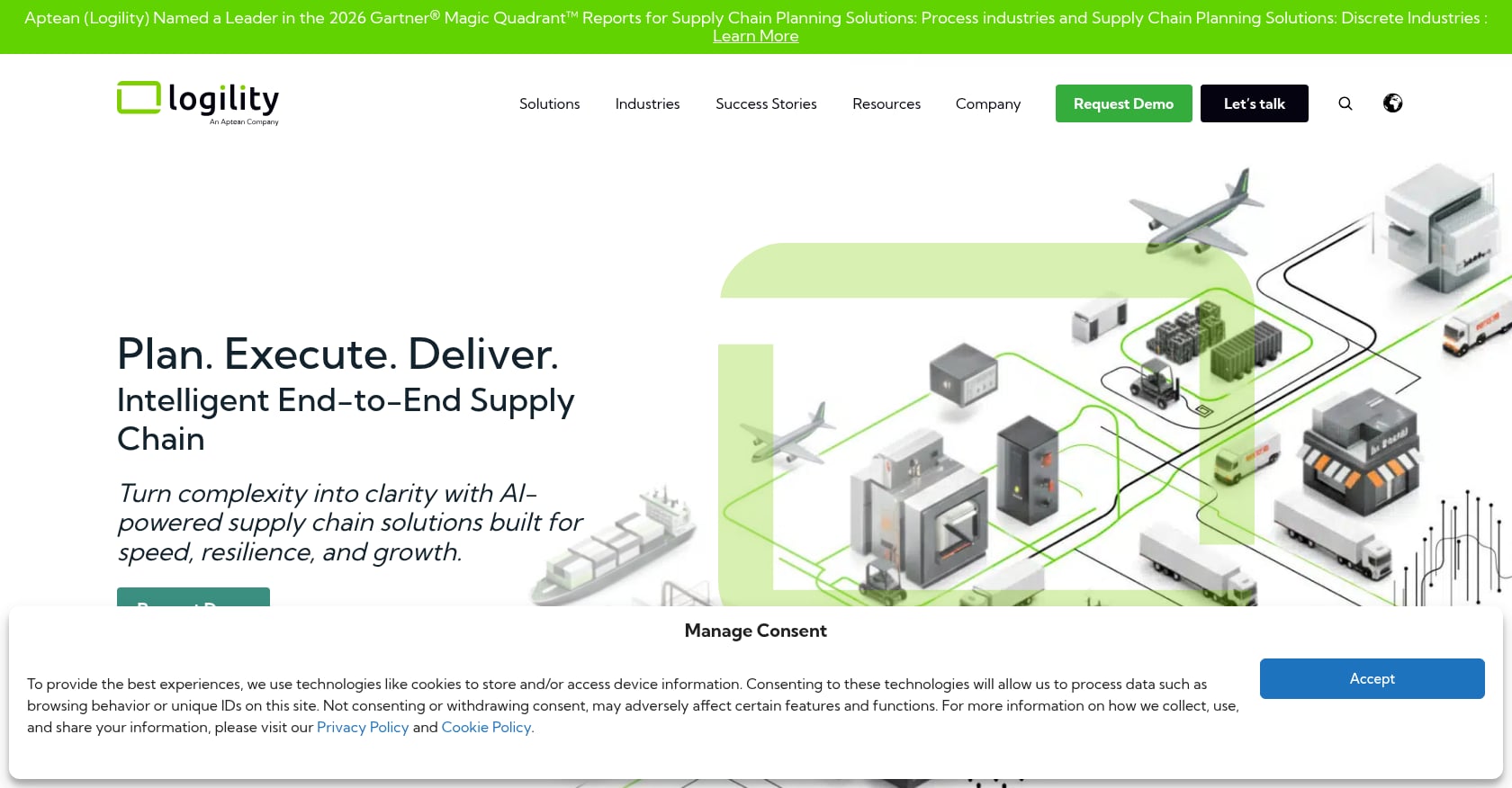
Best for: Manufacturers in the $500M to $5B range needing a proven, mature demand planning suite without bleeding-edge AI requirements.
Logility became a subsidiary of Aptean in April 2025, which significantly expanded its mid-market reach and support infrastructure. Its statistical forecasting engine has been refined over 25 years, and it shows. This is a platform that prioritizes stability and usability over flashy machine learning demos.
Pricing: Annual costs typically range from $25,000 to $100,000 for mid-market deployments. Implementations run $100,000 to $500,000 and take 3 to 6 months.
Key capabilities:
- Mature statistical forecasting engine
- S&OP and IBP workflow support
- Inventory optimization
- Supply and demand balancing
- Strong UI, with 80% of reviews highlighting ease of navigation
Limitations:
- AI/ML capabilities are less cutting-edge than o9 Solutions or newer platforms
- Smaller consulting ecosystem for implementation support compared to SAP or Oracle
- Focused on planning only, with limited execution capabilities
- Implementation cost creates a significant upfront hurdle for companies under $200M
Logility occupies a solid middle ground among alternatives to Blue Yonder for mid-market forecasting. It’s proven enough that you won’t be a beta tester, but modern enough that you’re not stuck with 2010-era technology. The Aptean acquisition gives it better long-term viability for mid-market buyers who worry about vendor stability.
4. ToolsGroup
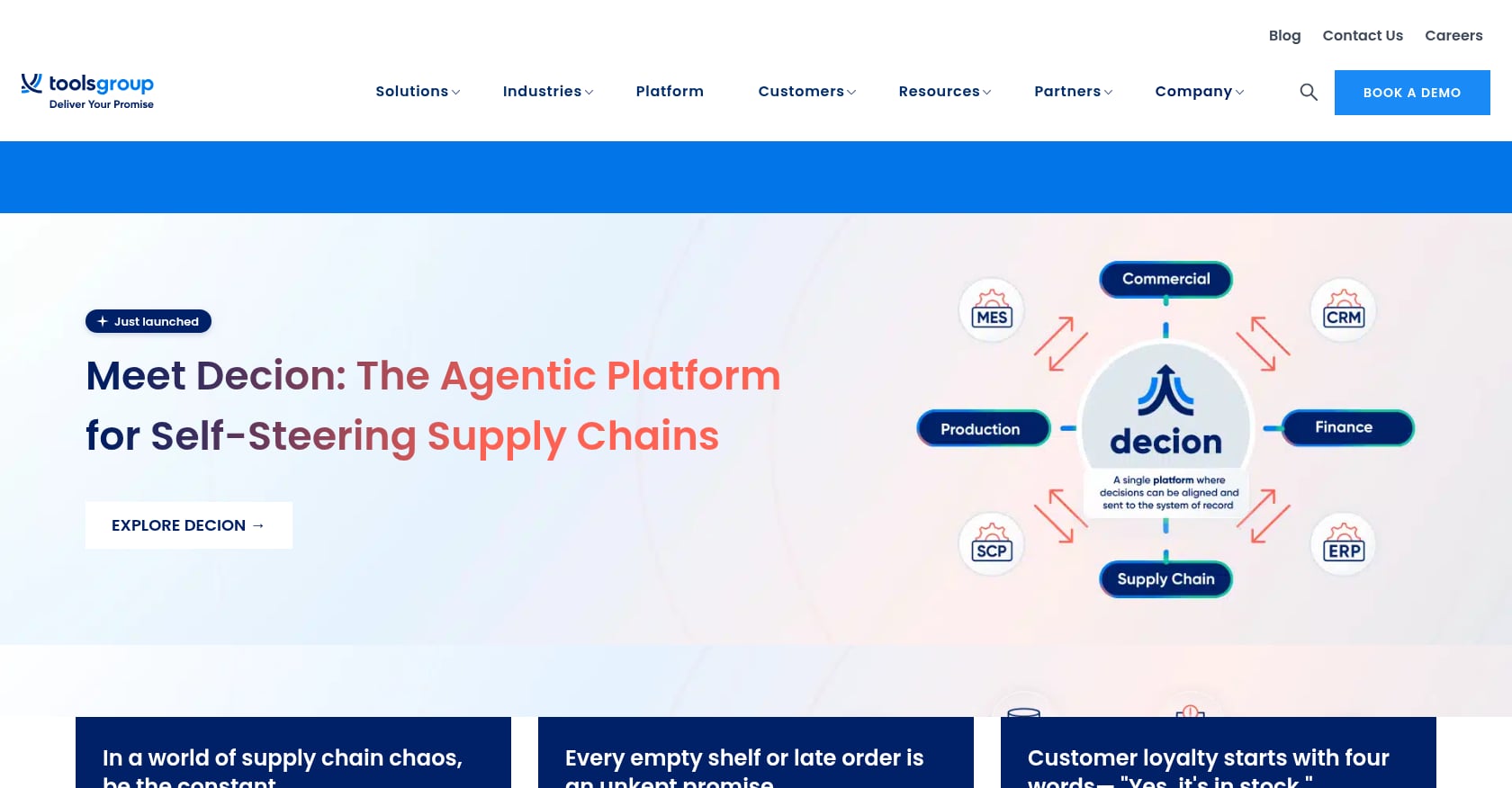
Best for: Companies managing intermittent demand, long-tail SKU portfolios, or service-part/aftermarket planning where probabilistic forecasting matters most.
ToolsGroup has an unusually explicit public commitment to probabilistic forecasting. While most vendors treat uncertainty as an afterthought, ToolsGroup builds its entire planning approach around it. For businesses where traditional time-series methods struggle (spare parts, highly intermittent demand, thousands of slow-moving SKUs), this specialization is genuinely valuable.
Pricing: Enterprise-level, custom quoted. Not transparent, which is a drawback for mid-market buyers trying to budget.
G2 rating: 4.5 out of 5 from 49 reviews, with 46.9% from mid-market users.
Key capabilities:
- Deep probabilistic demand forecasting including intermittent demand modeling
- Multi-echelon inventory optimization
- Demand sensing and collaboration workflows
- New product introduction and promotions planning
- Claims of 15–25% forecast accuracy improvement on average
Limitations:
- Pricing sits at enterprise levels that may strain mid-market budgets
- Public materials don’t clearly explain what’s technically distinctive versus conventional planning math
- The platform assumes a level of planning maturity that very small teams may not have
- Implementation requires 3 to 6 months
If your safety stock formulas aren’t capturing real demand variability, ToolsGroup’s probabilistic approach addresses that head-on. Just be prepared for enterprise-style procurement and pricing conversations.
5. RELEX Solutions
Best for: Retail, grocery, and CPG companies that need demand planning tightly integrated with merchandising, replenishment, and store operations.
RELEX is a strong platform that earns its Gartner recognition. Its automated demand forecasting combines exception-based and collaborative planning workflows to handle new product introductions, seasonal shifts, and promotional lifts. Machine learning predicts the impact of all relevant demand drivers without requiring users to manually configure every variable.
Pricing: Custom and enterprise-oriented. Costs vary based on store count, modules selected, and business size. Targets upper mid-market and enterprise segments.
Key capabilities:
- Unified platform spanning demand planning, merchandising, supply chain, and operations
- ML-driven demand driver identification
- Flexible automation for rapid configuration changes
- Strong promotional uplift modeling
One verified user noted: “RELEX’s flexible automation makes it simple and straightforward to implement changes. The range optimization that we do with RELEX would not have been possible with any other tool.”
Limitations:
- Strong retail/grocery orientation limits applicability for pure manufacturers or industrial distributors
- Cost structure targets upper mid-market and above
- Companies under $500M may find themselves stretching for a platform designed for larger operations
- Less focus on the S&OP advisory dimension that mid-market teams often need
RELEX is an excellent alternative to Blue Yonder if you’re a retail or CPG company in the $500M+ range. For manufacturers or smaller businesses, the retail-centric feature set may be more than you need.
6. Slimstock (Slim4)
Best for: Mid-market wholesale and distribution businesses, particularly those with European supply chains or EMEA headquarters.
Slimstock brings 30 years of supply chain planning expertise to a platform that emphasizes accessibility. Its AI capabilities are designed for mid-market operations without dedicated data science teams, which is a meaningful differentiator when your planning department is three people who also handle procurement.
Pricing: Custom, not publicly listed. Implementation follows a consultant-led model.
Key capabilities:
- AI-powered demand forecasting, inventory optimization, and replenishment
- Designed for accessibility without requiring data science resources
- Verified customer results showing 8–10% inventory reduction while maintaining or improving availability
One G2 reviewer described the platform as a “game-changer” for distributing over 15,000 SKUs from 70+ suppliers, specifically highlighting its ability to optimize inventory by considering lead times, supplier performance, promotions, and seasonal fluctuations.
Limitations:
- Public materials don’t reveal a strong probabilistic framework; the uncertainty model remains underexplained
- European-headquartered with stronger presence in EMEA than the US
- Consultant-led implementation model means timelines depend heavily on the partner
- Pricing opacity makes budgeting difficult before initial conversations
For mid-market distributors evaluating alternatives to Blue Yonder for mid-market forecasting in European markets, Slimstock deserves serious consideration. US-based companies should verify local support depth before committing.
7. Anaplan
Best for: Organizations that need cross-functional connected planning across finance, supply chain, sales, and workforce, and have the budget and IT resources to support it.
Anaplan is a powerful connected planning platform. It is not, however, a purpose-built demand planning tool. This distinction matters enormously for mid-market buyers.
Pricing: The median mid-market contract sits at approximately $102,032 per year based on Vendr data, with a range from $31,126 to $211,921. On top of licensing, expect to spend $1 to $1.50 in professional services for every $1 of software. One customer at a 125-person company reported being quoted $40,000 annually plus $100,000 for a 16-week implementation.
Key capabilities:
- Cloud-native connected planning across multiple business functions
- Flexible modeling environment
- Strong what-if scenario capabilities
- Large partner ecosystem for implementation
Limitations:
- Not purpose-built for demand planning; requires significant configuration
- Implementation complexity and long timelines (6–12 months is common) push costs well beyond initial quotes
- Mid-market ROI justification is consistently flagged by reviewers
- Requires dedicated IT capacity that most mid-market companies lack
Anaplan reviewers on G2 consistently flag the gap between platform capability and what a mid-market team can realistically extract from it. Many mid-market companies end up in what amounts to AI pilot purgatory, where the platform technically works but never delivers operational value.
If you’re specifically comparing Anaplan against more mid-market-focused options, there’s a detailed breakdown of that comparison worth reading.
8. Kinaxis
Best for: Mid-market to enterprise manufacturers with genuinely complex supply chains in automotive, aerospace, pharmaceuticals, or high-tech.
Kinaxis built its reputation on concurrent planning, where all planning domains run simultaneously on a single data model. Change one variable and see ripple effects everywhere in seconds, not days. For complex discrete manufacturing with multi-tier supply networks, this capability is transformative.
Pricing: Annual contracts typically range from $100,000 to $500,000+, with implementations running 4 to 9 months.
Key capabilities:
- Concurrent planning across demand, supply, inventory, and capacity
- Single data model for real-time what-if analysis
- Strong fit for complex BOM structures and multi-tier supply chains
- Mature platform with deep manufacturing domain expertise
Limitations:
- If your supply chain is relatively simple or you’re under $200M in revenue, Kinaxis is likely more horsepower than you need
- Server restarts required for modifications
- Training and knowledge acquisition is costly
- Pricing puts it firmly in enterprise territory
Kinaxis is a genuine Blue Yonder alternative for companies whose supply chain complexity demands it. For mid-market companies with simpler networks, it’s overkill.
9. o9 Solutions
Best for: Upper mid-market and enterprise organizations ($500M+) that want the most advanced AI-driven planning platform and can invest accordingly.
o9 Solutions markets its “Digital Brain” as an AI-powered integrated business planning platform combining demand, supply, and financial planning in a cloud-native architecture. Hundreds of Fortune 500 companies use it. The technology is impressive.
Pricing: Custom enterprise pricing. Comparative data suggests mid-market deployments average around $280,000 annually.
Key capabilities:
- AI/ML-native demand sensing and forecasting
- Integrated business planning across demand, supply, and finance
- Cloud-native architecture built for scalability
- Advanced scenario modeling
Limitations:
- Advanced tools require extensive training for teams unfamiliar with AI-powered systems
- Pricing does not suit small or most mid-market businesses
- Implementation timelines can stretch significantly
- Requires organizational maturity in data management and planning processes
o9 is the right answer for companies genuinely operating at the intersection of mid-market and enterprise. For a $150M manufacturer with two planners, it’s a mismatch on price, complexity, and required internal resources.
How to Choose the Right Alternative
The alternatives to Blue Yonder for mid-market forecasting span a wide range. Narrowing the list comes down to four questions:
1. What’s your revenue and team size?
Under $200M with 1 to 3 planners: BetterDemand, Netstock, or Slimstock. Over $500M with a small but dedicated planning team: Logility, ToolsGroup, or RELEX. Over $500M with complex multi-tier manufacturing: Kinaxis or o9.
2. What’s your SKU and demand profile?
Straightforward demand with seasonal patterns: most tools handle this. Intermittent or long-tail demand: ToolsGroup has a clear edge. Heavy promotional and NPI activity: RELEX or BetterDemand. If your forecast bias hides at the aggregate level, look for platforms that force SKU-level visibility.
3. What’s your ERP, and does the forecast need to flow into it?
A forecast that doesn’t connect to purchasing and replenishment in your ERP is a dashboard, not a planning system. Netstock and BetterDemand (Enterprise tier) prioritize ERP integration for mid-market systems. Enterprise platforms assume custom integration work. For companies specifically looking to plug a forecast into their ERP, this is a make-or-break evaluation criterion.
4. Do you need software, or do you need software plus process?
This is the question most companies skip. And it’s the one that determines whether the investment pays off. The supply chain management software market is projected to reach $56 billion by 2031, growing at 9% CAGR. The tools are getting cheaper and more capable every year. What hasn’t scaled is the expertise to operationalize them in mid-market organizations.
The Missing Piece: Why Software Alone Fails Mid-Market
Here’s the pattern that plays out across mid-market companies buying demand planning software: The tool gets implemented. The dashboards look great. The first few months generate excitement. Then reality sets in.
Nobody owns the S&OP process. The forecast sits in one system while purchasing decisions happen in another (or in someone’s head). Exceptions pile up with no structured review cadence. Within 6 to 12 months, the team reverts to spreadsheets and gut instinct, and the software becomes expensive shelfware.
This isn’t a technology problem. It’s a staffing and expertise gap that the entire enterprise software industry ignores because selling licenses is more profitable than solving operational problems.
Machine learning models that were the exclusive domain of tier-one retailers three years ago are now available in mid-market platforms at a fraction of the previous cost. The algorithms are no longer the bottleneck. The bottleneck is having someone who knows how to run a monthly planning drumbeat, manage exceptions, align sales and operations around one plan of record, and continuously improve forecast value-add.
That’s why an advisory-plus-software model exists. Not as a nice-to-have, but because the alternative, buying a tool and hoping your already-stretched team figures out S&OP on their own, fails predictably and repeatedly.
See how BetterDemand’s advisory model works
Making the Switch From Blue Yonder
If you’re currently on Blue Yonder and evaluating a move, the transition doesn’t have to be traumatic. Most mid-market companies switching from enterprise platforms follow a similar path:
- Run the new tool in parallel for one planning cycle before cutting over
- Start with the highest-value SKU segment rather than trying to migrate everything at once
- Define success metrics upfront, specifically forecast accuracy improvement, inventory reduction, and time savings
- Prioritize ERP connectivity so the new forecast drives action from day one
The demand forecasting vendor selection process for mid-market companies looks very different from enterprise procurement. You’re not running an 18-month RFP. You’re finding a partner who can prove value in 90 days.
Check current availability for BetterDemand onboarding
Frequently Asked Questions
What makes Blue Yonder too expensive for mid-market companies?
Blue Yonder’s annual licensing starts around $175,000 to $200,000, with implementations billed separately starting at $500,000. For a mid-market company spending $5B or more, that’s proportionate. For a $200M manufacturer, it represents an outsized share of the technology budget, especially when the platform’s advanced features target enterprise-scale complexity that mid-market operations rarely need.
Can mid-market companies get AI-powered forecasting without enterprise pricing?
Yes. Cloud-first strategies and maturing ML infrastructure have pushed advanced forecasting capabilities down-market significantly. Platforms like BetterDemand start at $12,000 per year with AI-powered multi-horizon forecasting included. Netstock starts at roughly $4,800. The technology gap between mid-market and enterprise tools has narrowed dramatically since 2023.
What’s the typical implementation timeline for mid-market forecasting alternatives?
It varies widely. BetterDemand measures implementation in days to weeks. Netstock targets around 90 days. Logility and ToolsGroup run 3 to 6 months. Enterprise platforms like Kinaxis, Anaplan, and o9 can take 6 to 12 months or longer. For mid-market companies, speed to value should be a primary evaluation criterion since a forecast that takes a year to implement delivers zero value for a year.
Do I need a dedicated data science team to use these tools?
For most mid-market alternatives, no. Netstock, Slimstock, and BetterDemand are specifically designed for organizations without data science resources. ToolsGroup and Logility assume some planning sophistication but not data science staffing. o9 and Anaplan are more likely to require dedicated technical resources for model maintenance and customization.
How important is ERP integration for demand forecasting?
Critical. A forecast that doesn’t flow into your ERP’s purchasing and replenishment workflows is just a report. Mid-market companies should prioritize platforms that can push recommended orders, safety stock levels, and reorder points directly into their system of record. Otherwise, someone is manually translating the forecast into purchase orders, which reintroduces the errors you were trying to eliminate.
What’s the difference between inventory optimization tools and demand forecasting platforms?
Inventory optimization (Netstock, Slimstock) starts from current stock positions and works backward to determine what to order. Demand forecasting (BetterDemand, Logility, ToolsGroup) starts from predicted future demand and works forward into purchasing recommendations. The best mid-market solutions combine both, but understanding which is the primary lens matters for tool selection. Companies whose main pain is excess stock may start with inventory optimization. Companies struggling with stockouts, promotional planning, or new product launches need forecast-first approaches.
Should I choose a specialized demand planning tool or a broader planning platform?
If your primary need is better demand forecasts driving smarter purchasing, choose a specialized tool. Broader platforms like Anaplan and o9 make sense when you need financial planning, workforce planning, and supply chain planning on a single model. But that breadth comes with significant implementation cost and complexity. Most mid-market companies get better ROI from a focused demand planning solution integrated with their existing ERP than from trying to consolidate everything onto one platform.
What’s the biggest risk when switching from Blue Yonder to a mid-market alternative?
Losing institutional knowledge embedded in the current system’s configuration. Before switching, document your current forecasting logic, exception rules, and any custom reports your team depends on. The second risk is underestimating the process change: a new tool requires new workflows. This is exactly why platforms that include advisory support (rather than just software) tend to show faster time-to-value for mid-market teams making the transition.
Two free playbooks: Cost of Forecast Error and the S&OP Playbook