Selecting a Mid Market Demand Planning Solution: 2026 Guide
Choosing new software can feel overwhelming, especially when it’s for something as critical as your supply chain. For mid market companies, the stakes are high. You’ve likely outgrown spreadsheets, the basic modules in your ERP, and rear‑view‑mirror forecasting, but you can’t afford the multi‑year, multi‑million‑dollar projects of a Fortune 500 giant. The key to successfully selecting a mid market demand planning solution is to follow a structured process focusing on your specific business needs, the right technology, and a strong vendor partnership. The good news is that this process doesn’t have to be a mystery.
This guide breaks down the entire selection journey into manageable steps, from initial self assessment to final vendor evaluation. We’ll cover everything you need to know to find a tool that not only improves your forecasts but transforms your planning process from reactive firefighting into a proactive, strategic advantage.
Part 1: Laying the Groundwork for Success
Before you even look at a single demo, the most important work happens internally. Getting your own house in order first makes the entire process of selecting a mid market demand planning solution smoother and far more likely to succeed.
Define Your Business Needs and Requirements
First, you need to understand the why behind this project. A Business Need Assessment is about identifying the core problems you need to solve. Are you struggling with constant stockouts? Is excess inventory tying up all your cash? Is your team spending more time arguing over forecast numbers than agreeing on a plan? If that sounds familiar, run a one‑number forecast audit to expose where multiple versions of the truth are creeping in.
Getting this right is critical. Companies that define clear business outcomes before they start shopping see a 29% improvement in process efficiency within the first year. Once you know your “why,” you can move to the “what” with Software Requirement Definition. This is where you translate your business pains into a specific list of features and capabilities the software must have. This detailed list becomes your scorecard for evaluating vendors. Don’t skip this step; a Project Management Institute (PMI) study found that 47% of projects that fail to meet their goals cite inaccurate requirements as a primary cause.
Set Your Targets and Prepare Your Team
With your needs defined, it’s time to establish how you’ll measure success. KPI and ROI Target Setting is about defining what victory looks like in clear, measurable terms. Will you aim to increase forecast accuracy by 20%? Reduce inventory by 15%? Cut down on expensive expedited freight? Having these targets keeps the project focused on delivering real business value. Use this cost of forecast error framework to quantify where accuracy gains will pay back fastest.
Finally, think about your people. A new tool means new processes. Change Management is the structured approach to getting your team ready, trained, and bought into the new way of working. Technology projects are more likely to fail because of people issues than technical glitches. It’s about communication, training, and managing the human side of the transition to ensure the software is actually adopted, not ignored.
Part 2: Evaluating Core Technology and Features
Once your foundation is set, you can start evaluating the software itself. The right technology should not only solve today’s problems but also set you up for future growth.
The Modern Tech Stack: AI and Cloud
Today, AI and Cloud‑Native Capability are table stakes. Modern solutions use artificial intelligence to spot patterns, improve forecasts, and automate decisions. For example, using AI in demand planning can slash forecast errors by up to 50%. Be mindful of the five forecasting mistakes that can neutralize those gains. Cloud native architecture means the software is scalable, accessible from anywhere, and updated continuously by the vendor without you having to manage servers.
From Data to Decisions
At the heart of any planning solution is its ability to turn data into actionable insights. This starts with a Unified Data Repository, which serves as a single source of truth for all your planning data. When sales, operations, and finance all work from the same numbers, you eliminate confusion and wasted time.
This unified data fuels several key capabilities:
- Forecast Accuracy: This is the cornerstone of good planning. Inaccurate forecasts are incredibly costly, leading to what’s known as inventory distortion (a combination of overstocks and stockouts) which costs retailers an estimated $1.77 trillion globally each year. Improving accuracy, even by a few percentage points, has a massive impact (see how forecast accuracy drives safety stock and service).
- Inventory Optimization: An advanced solution doesn’t just forecast demand; it recommends the optimal amount of inventory to hold. The goal is to meet your service targets with the least amount of cash tied up in stock. It’s common for companies to reduce inventory by 20-30% after implementing these tools. As you evaluate, make sure you can quantify the true cost of safety stock, not just plug a formula.
- Inventory Visibility Dashboard: You can’t manage what you can’t see. A clear, real time dashboard that shows what inventory you have, where it is, and what’s in transit is essential for making smart, quick decisions.
- Collaboration Capability: Great planning is a team sport. The software should support your Sales & Operations Planning (S&OP) process, allowing different departments to collaborate on a single, consensus‑based plan. Here’s a primer on aligning demand forecasts across sales, supply, and finance.
Connecting Planning to Execution
A great plan is useless if you can’t execute it. Look for solutions with strong Order Management and Supplier Performance capabilities. This means the system can help you monitor supplier reliability (like on time delivery) and efficiently manage the entire customer order fulfillment process. You also need to consider End-to-End Suite Coverage. Do you need a single massive suite that does everything, or a specialized, best of breed tool that excels at planning? For many mid market companies, a focused solution that integrates well with their ERP is the more practical and cost effective choice. Finally, Industry-Specific Functionality can be a huge plus. If a solution is pre‑built with features for your industry (like lot tracking for food and beverage), it can mean a faster implementation and a better fit right out of the box (if you’re in F&B, watch for these four supply chain gaps in food & beverage).
Part 3: Evaluating the Vendor and the Project
The software is only one part of the equation. The company you partner with and the way the project is managed are just as important for long term success. This is a vital phase in selecting a mid market demand planning solution.
Finding and Vetting the Right Partners
The process starts with Vendor Research and a Shortlist. Cast a wide net initially using analyst reports, online reviews, and peer recommendations. Then, narrow your list down to 3 to 5 vendors who seem to be the best fit for your size, industry, and core needs.
Once you have your shortlist, the real evaluation begins. Look at their approach to Implementation and Onboarding. A messy, drawn out implementation can kill a project’s momentum and budget. You want a vendor with a clear, proven process that fits your team’s capabilities. A key metric to focus on here is Time to Value (TTV), which is how quickly you’ll start seeing a return on your investment. Long projects are risky; one Gartner report noted that when implementations go beyond 18 months, the probability of realizing the expected benefits drops by over 50%.
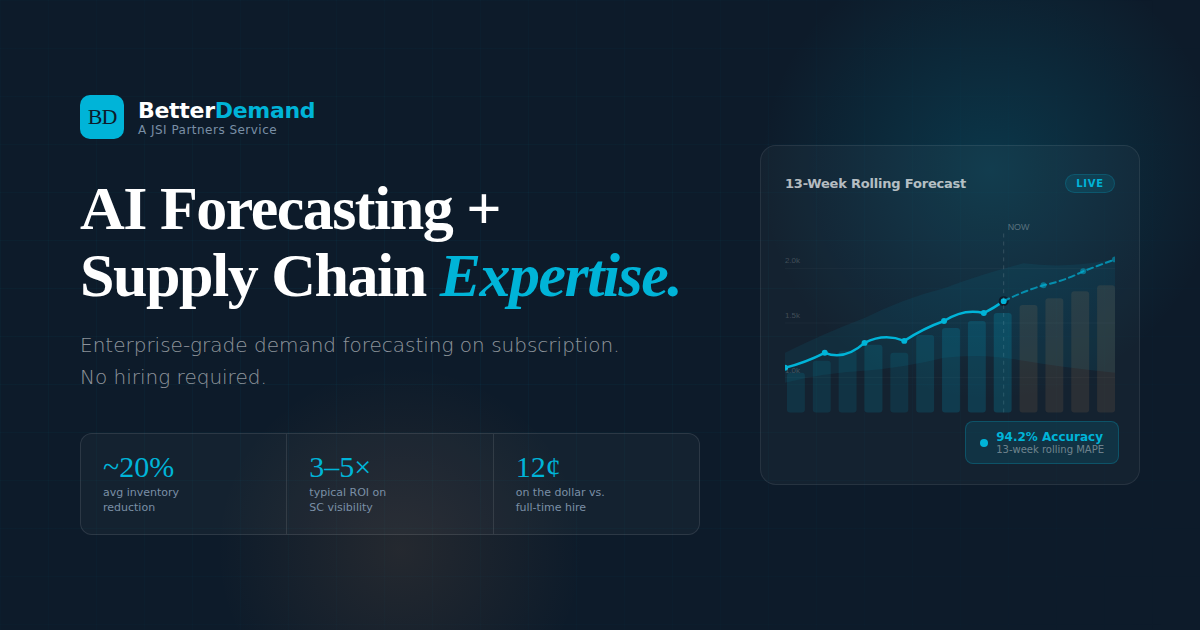
Services like BetterDemand are built specifically for the mid market, focusing on rapid time to value with guarantees to deliver tangible inventory and efficiency gains within 90 days.
Understanding the True Cost and Long-Term Relationship
Don’t be fooled by the sticker price. You need to calculate the Total Cost of Ownership (TCO), which includes implementation, training, support, and internal resource costs over several years. Cloud solutions often have a lower TCO because they reduce the need for in house hardware and IT maintenance.
Beyond the initial project, you’re entering a long term relationship. Evaluate the Vendor Roadmap and Long-Term Partnership potential. Is the vendor continuing to invest and innovate in their product? Do they have a culture of customer success? A good partner will grow with you. Lastly, never underestimate Support and Training. Your team will need help, and a vendor with responsive, knowledgeable support and comprehensive training resources is invaluable for driving user adoption and getting the most out of your investment.
Part 4: Ensuring a Great User Experience
Even the most powerful software will fail if your team finds it difficult or frustrating to use. The final set of criteria focuses on the day to day reality of living with the system.
Usability and Empowerment
Ease of Use is paramount. If the system is clunky or unintuitive, your team will find workarounds, often reverting to the very spreadsheets you’re trying to replace. A clean, logical interface that makes planners’ jobs easier is a must have.
Along with usability comes empowerment through Self-Service Administration. Can your team add new users, create reports, or tweak settings without needing to call (and pay) the vendor for every little change? This agility allows the system to evolve as your business changes.
Connectivity, Growth, and Security
In today’s world, no software is an island. Strong Integration Capability is non negotiable. The solution must be able to seamlessly connect and share data with your other key systems, especially your ERP. Poor integration creates manual work and data silos, which is exactly what you’re trying to eliminate.
The solution must also be able to grow with you. Scalability refers to the system’s ability to handle more users, more products, and more transaction data as your business expands, without its performance slowing to a crawl. And finally, you must be confident in its Security. With the average cost of a data breach now reaching over $4 million, ensuring the vendor has robust security measures to protect your sensitive supply chain data is a critical final check.
Choosing the right software is a strategic decision that can pay dividends for years. By thoroughly evaluating your needs, the technology, the vendor, and the user experience, you can be confident in your process for selecting a mid market demand planning solution.
If you’re ready to see how a combination of AI powered forecasting and hands on expert guidance can transform your supply chain, explore a new approach to demand planning.
Frequently Asked Questions
1. What is the first step in selecting a mid market demand planning solution?
The most crucial first step is a thorough Business Need Assessment. Before you look at any software, you must clearly define the specific problems you’re trying to solve, such as reducing stockouts, lowering inventory costs, or improving planner efficiency. This internal alignment is the foundation for a successful selection process.
2. How important is AI in a modern demand planning tool?
Artificial intelligence is extremely important. AI algorithms can analyze complex patterns, seasonality, and external factors far more effectively than traditional methods. Solutions leveraging AI can significantly improve forecast accuracy, with some studies showing they can reduce forecast errors by up to 50%, leading directly to better inventory management and higher service levels.
3. What is S&OP and why is it important for demand planning?
S&OP, or Sales & Operations Planning, is a monthly business process that brings together sales, marketing, operations, and finance to agree on a single, unified plan. A good demand planning solution is the engine for S&OP, providing the data and collaborative platform needed to create a consensus forecast and align the entire organization.
4. How long should an implementation take for a mid market company?
While it varies, mid market companies should look for solutions that offer a rapid Time to Value (TTV), ideally seeing initial benefits within a few months, not years. Long, complex projects are risky and expensive. Look for vendors with streamlined onboarding processes and clear timelines, as a fast implementation means a faster return on your investment.
5. What’s the difference between a software suite and a specialized planning tool?
An end to end suite (like a large ERP) aims to do everything from finance to warehouse management. A specialized or “best of breed” planning tool focuses exclusively on doing one thing, like demand forecasting and inventory optimization, exceptionally well. For many mid market companies, a specialized tool that integrates tightly with their existing ERP offers more powerful planning capabilities without the cost and complexity of a full suite replacement.
6. Is it better to focus on features or the vendor partnership?
Both are critical, but a strong partnership can be more important in the long run. Features can be added over time, but a vendor with a poor support model or a product roadmap that doesn’t align with your goals will cause problems for years. The process of selecting a mid market demand planning solution should weigh the vendor’s culture, support, and long term vision just as heavily as its current feature set.
7. How do I calculate the Total Cost of Ownership (TCO)?
TCO includes much more than the initial software price. You must factor in all costs over a 3 to 5 year period, including the software subscription or license, implementation and consulting fees, data integration costs, training expenses, ongoing support fees, and the cost of your internal team’s time on the project.
8. Why is a unified data model so important?
A unified data model ensures everyone in the company is working from a single source of truth. It eliminates the problem of different departments using conflicting spreadsheets and reports. This consistency builds trust in the numbers and allows for faster, more confident decision making across the entire supply chain.
Two free playbooks: Cost of Forecast Error and the S&OP Playbook