2026: Alternatives to Anaplan for Mid-Market Demand Planning
2026: Alternatives to Anaplan for Mid-Market Demand Planning
TL;DR
Anaplan is a powerful connected-planning platform, but its enterprise pricing, long implementations, and FP&A-centric DNA make it a poor fit for most mid-market demand planning needs. Specialist tools like Netstock (starting at $900/month), Forecast Pro (around $3,000/user/year), and advisory-plus-software models like BetterDemand ($1,000 to $3,333/month) deliver faster time-to-value at a fraction of the cost. The right choice depends on your ERP stack, demand complexity, team capacity, and budget, so the framework and comparison table below will help you narrow the field in minutes.
Why Mid-Market Teams Are Looking for Alternatives to Anaplan for Demand Planning
Anaplan built its reputation on governed, cross-functional planning models that connect finance, sales, and operations. For large enterprises running complex what-if models across hundreds of cost centers, it earns its price tag. But mid-market product companies ($10M to $1B in revenue) shopping for demand planning software keep running into the same problems.
First, total cost. Independent analysis from CFO Shortlist flags Anaplan’s subscription and implementation costs as substantially higher than specialist demand planning tools, with contract terms that feel opaque to mid-market buyers. Second, time-to-value. Implementations measured in months (sometimes quarters) are standard for Anaplan’s model-building approach, while mid-market teams need forecasts driving purchase orders within weeks. Third, the platform’s DNA leans toward financial planning and analysis, not out-of-the-box supply chain execution like replenishment, safety stock optimization, or S&OP facilitation.
The result: mid-market manufacturers, CPG brands, food and beverage companies, and distributors increasingly look for alternatives to Anaplan for mid-market demand planning that match their actual scope, budget, and timeline.
This guide covers 11 tools that mid-market teams actually buy, with real pricing where available, implementation timelines, ERP compatibility, and candid tradeoffs sourced from practitioner communities and review platforms.
How to Choose: A 5-Minute Decision Framework
Before comparing vendors, answer five questions. They will cut your shortlist in half.
1. What is your ERP anchor?
NetSuite, Dynamics 365, SAP Business One, or something else? Your ERP determines which native planning modules are available and which third-party tools integrate most cleanly. Microsoft’s documentation on D365 demand forecasting shows how native tools work, but practitioners on Reddit report that native modules hit limits quickly as demand complexity rises.
2. How complex is your demand?
Stable, repeatable demand with few promotions is different from seasonal spikes, frequent new product introductions, promotional lifts, and multi-echelon inventory across regions. Simple demand can stay in-ERP. Complex demand needs a specialist layer.
3. What is your team’s capacity?
Some tools require dedicated model builders. Others come with embedded operators who run S&OP meetings and push plans into your ERP. If your planning team is two people wearing five hats, that distinction matters. A demand planning maturity model can help you assess where your team actually stands.
4. What is your budget and timeline?
Sub-$25k/year tools exist and work well for focused forecasting. Full planning suites run $50k to $250k+. Enterprise mega-suites cost more. Implementation ranges from 4 weeks to 6+ months depending on the category.
5. How clean is your data?
Practitioners on Reddit’s supply chain forums are blunt: predictive tools fail if you feed “shaped demand” history without cleansing one-offs and anomalies. The forecast looks precise yet ends up wrong. Data quality matters more than algorithm sophistication for most mid-market teams.
At-a-Glance Comparison Table
| Tool | Best For | Starting Price | Typical Implementation | Key Differentiator | User Sentiment |
|---|---|---|---|---|---|
| BetterDemand | Software + embedded S&OP operators | $1,000/mo | Weeks | Advisory bundled with AI forecasting | New, strong advisory background |
| Netstock | NetSuite/Sage shops wanting fast ROI | $900/mo | 6-10 weeks | Broad ERP integrations, Pivot Forecasting | Positive on Reddit, active G2 profile |
| Slimstock Slim4 | Multi-location distributors/manufacturers | Quote-only | Moderate | Multi-echelon inventory + S&OP | Repeatedly endorsed on Reddit, solid Gartner PI |
| ToolsGroup SO99+ | Complex networks, service-level targets | Quote-only | Longer | Probabilistic forecasting + MEIO | G2 praises accuracy, flags UI/maintenance |
| Logility | Mid-market wanting integrated planning suite | Quote-only | Moderate-long | AI-first demand sensing | Solid Gartner PI, some feature gaps noted |
| StockIQ | Distributors with ERP-driven replenishment | Quote-only | Moderate | Deep ERP parameterization, SIOP support | Reddit users cite calmer planning cadence |
| DemandCaster | Mid-market manufacturers (Plex ecosystem) | Quote-only | ~60 days (case study) | Forecast-to-MRP continuity | Positive independent reviews |
| Forecast Pro | Pure forecasting workbench, budget-friendly | ~$3,000/user/yr | Fast | Classical statistics, model transparency | Reddit planners praise reliability |
| D365 Demand Planning | D365 shops keeping it native | Tied to D365 licensing | N/A (already in-ERP) | XGBoost-based signals, no extra vendor | Mixed, good for basics |
| NetSuite Demand Planning | Small NetSuite shops, simple demand | Add-on module pricing | N/A (already in-ERP) | Zero integration friction | Reddit: OK for basics, breaks under complexity |
| Flowlity | EU-leaning SMB retail/distribution | SKU-based subscription | Lighter | AI lead-time variability modeling | G2 reviewers cite good visibility |
See BetterDemand pricing tiers in detail to compare against quote-only vendors.
The 11 Alternatives to Anaplan for Mid-Market Demand Planning
1. BetterDemand
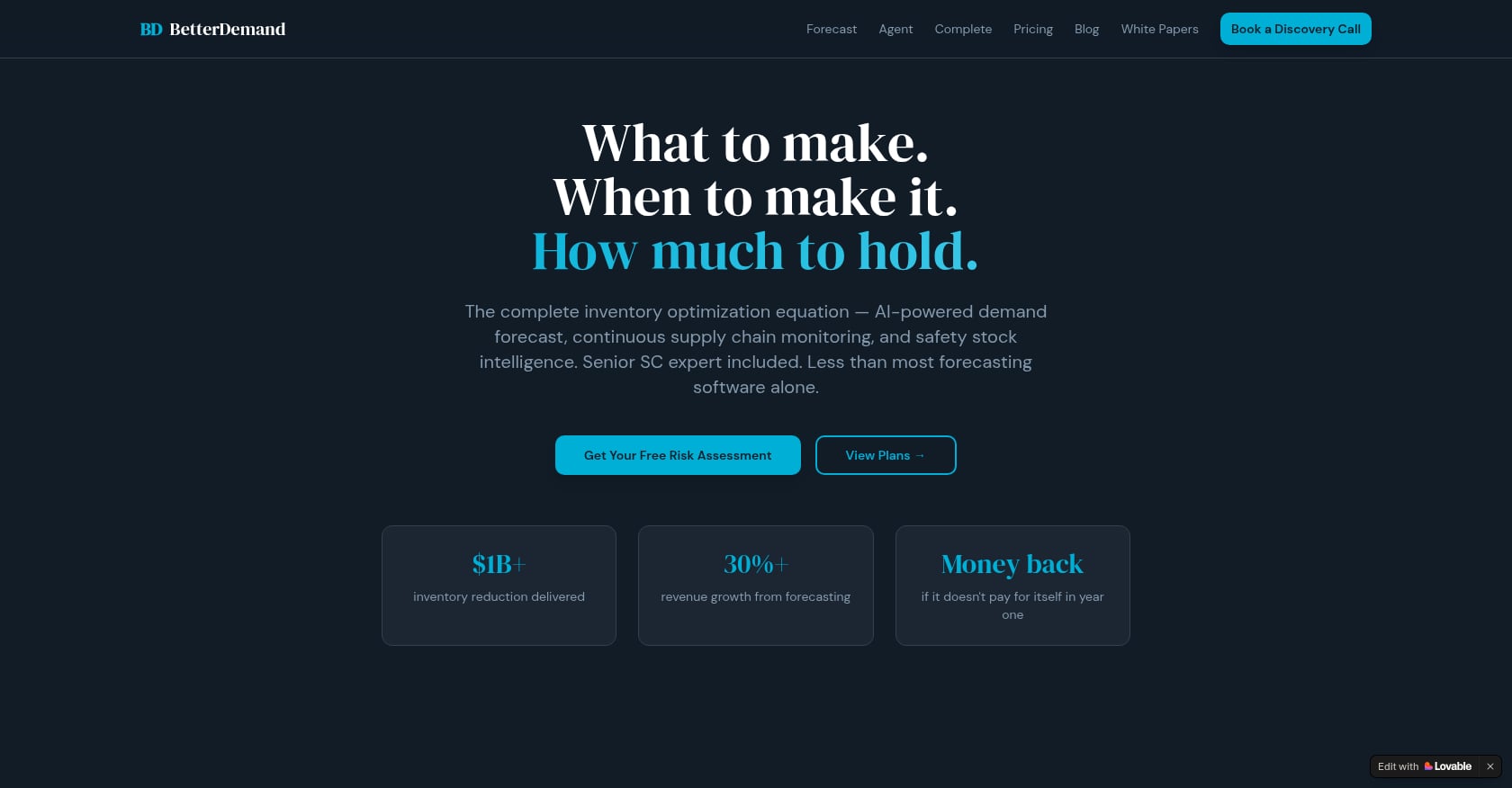
Best for: Mid-market manufacturers, CPG, food and beverage, and distributors wanting software plus embedded expert operators to run S&OP and push plans into ERP, without a six-figure software commitment.
Pricing (as of April 2026):
- Starter: $1,000/month ($12,000/year)
- Professional: $1,667/month ($20,000/year)
- Enterprise: $3,333/month ($40,000/year)
Every tier includes dedicated senior supply chain expert hours each month, not just software access. Value guarantees are tied to measurable time, efficiency, and inventory improvements within 90 days, or you receive free months of service until the guarantees are met.
Key capabilities:
- Live multi-horizon AI demand forecast built on your actual sales and inventory data
- S&OP/IBP process design and facilitation with a structured monthly cadence
- Inventory optimization across SKU portfolio with scenario planning for promos, NPIs, and seasonality
- ERP integration support (Enterprise tier) so forecasts directly drive purchasing and replenishment in your system of record
- Exception-driven workflows designed for teams of 2 to 10 planners, not 50
Tradeoffs:
- Smaller vendor footprint with fewer public references than established platforms
- Not an end-to-end mega-suite (no TMS, WMS, or factory scheduling)
- Success depends on baseline data quality, though embedded expert hours help mitigate this
Who should look here: If your core gap is that nobody owns the demand plan and nobody pushes it into buying decisions, BetterDemand fills both the software and the operator gap. The transparent pricing is a notable contrast to most competitors on this list.
Request a proposal if you want to see how BetterDemand maps to your SKU complexity and ERP.
2. Netstock
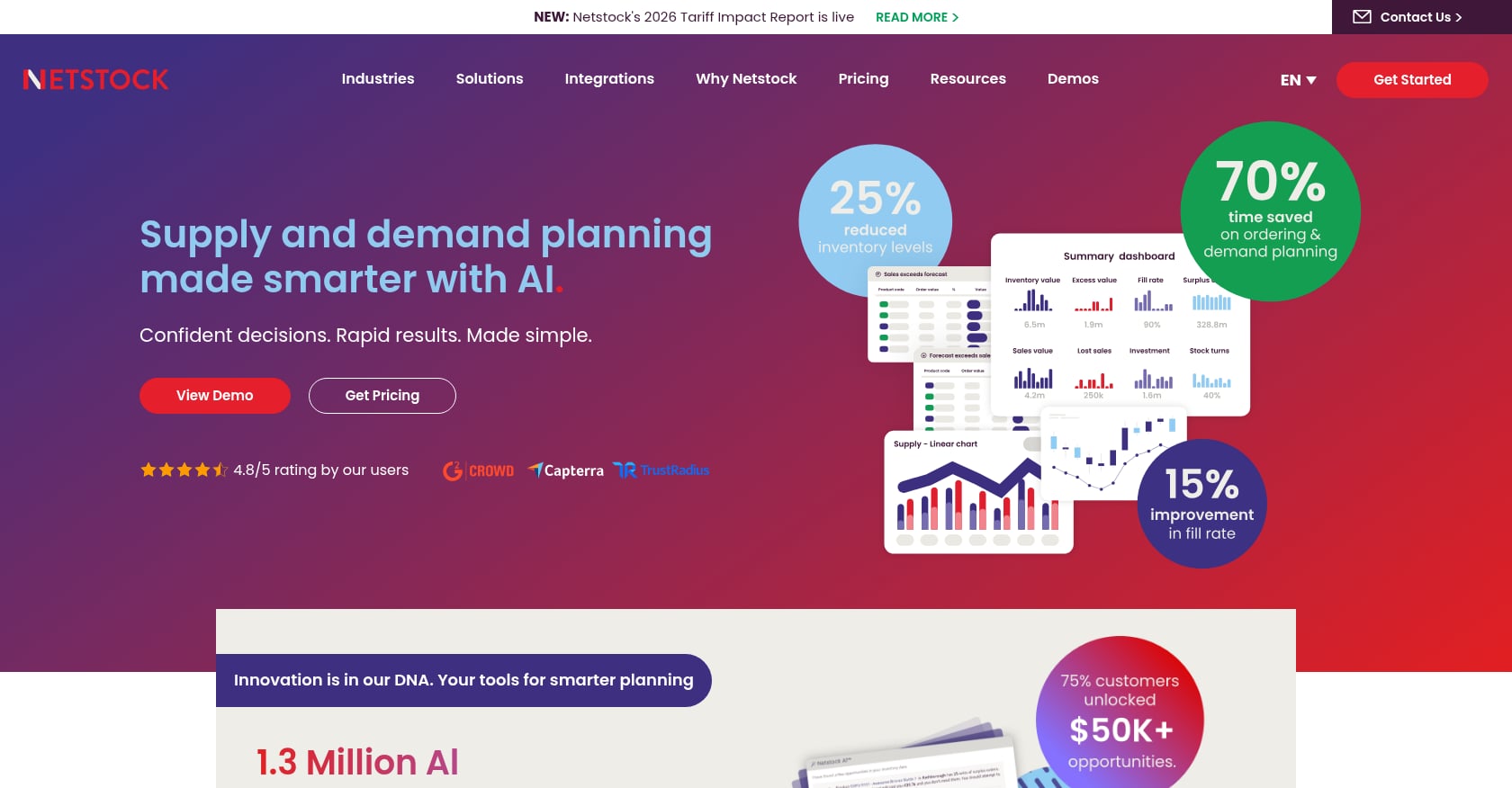
Best for: Mid-market teams on NetSuite, Sage, Acumatica, or Dynamics wanting fast time-to-value and clearer replenishment decisions.
Pricing: Starts at $900/month with annual subscription. Typical implementation takes 6 to 10 weeks.
Key capabilities:
- Demand planning, inventory optimization, ordering, and supplier performance tracking
- “Pivot Forecasting” and AI pack for demand sensing
- Pre-built integrations with NetSuite, Sage, Acumatica, Dynamics, and SAP Business One
- Classification-driven inventory policies (segments SKUs by demand pattern)
- Dashboard and exception-based workflows
Tradeoffs:
- Less depth than top enterprise suites for multi-echelon or concurrent planning
- Analytics depth can push teams back to spreadsheets for advanced analysis
- Limited S&OP process facilitation compared to advisory-bundled options
Practitioner perspective: Netstock is popular among NetSuite users on Reddit as a practical planning layer, with multiple threads discussing its value at sub-$2,000/month budgets. G2 reviews show a mid-market skew in the reviewer base, which is a good sign for fit.
3. Slimstock Slim4
Best for: Mid-market to lower-enterprise companies with multi-location stock, varied demand patterns, and the need for a mature planning suite.
Pricing: Quote-only. Enterprise-lite pricing with global delivery capabilities. ISO 27001:2022 certified.
Key capabilities:
- Demand forecasting, inventory optimization (including multi-echelon), and supply planning
- Integrated S&OP/IBP and scenario planning
- Handles promotional and seasonal patterns with statistical and ML-based methods
- Strong presence in European and global mid-market distribution and manufacturing
Tradeoffs:
- Heavier implementation than lighter SMB tools
- UI feels traditional according to some independent commentary
- Quote-only pricing makes budget planning harder upfront
Practitioner perspective: Slim4 is repeatedly called out in Reddit supply chain threads as a tool that “delivers value” for distributors and manufacturers. Gartner Peer Insights reviewers report improved availability and reduced stock levels after implementation.
4. ToolsGroup SO99+
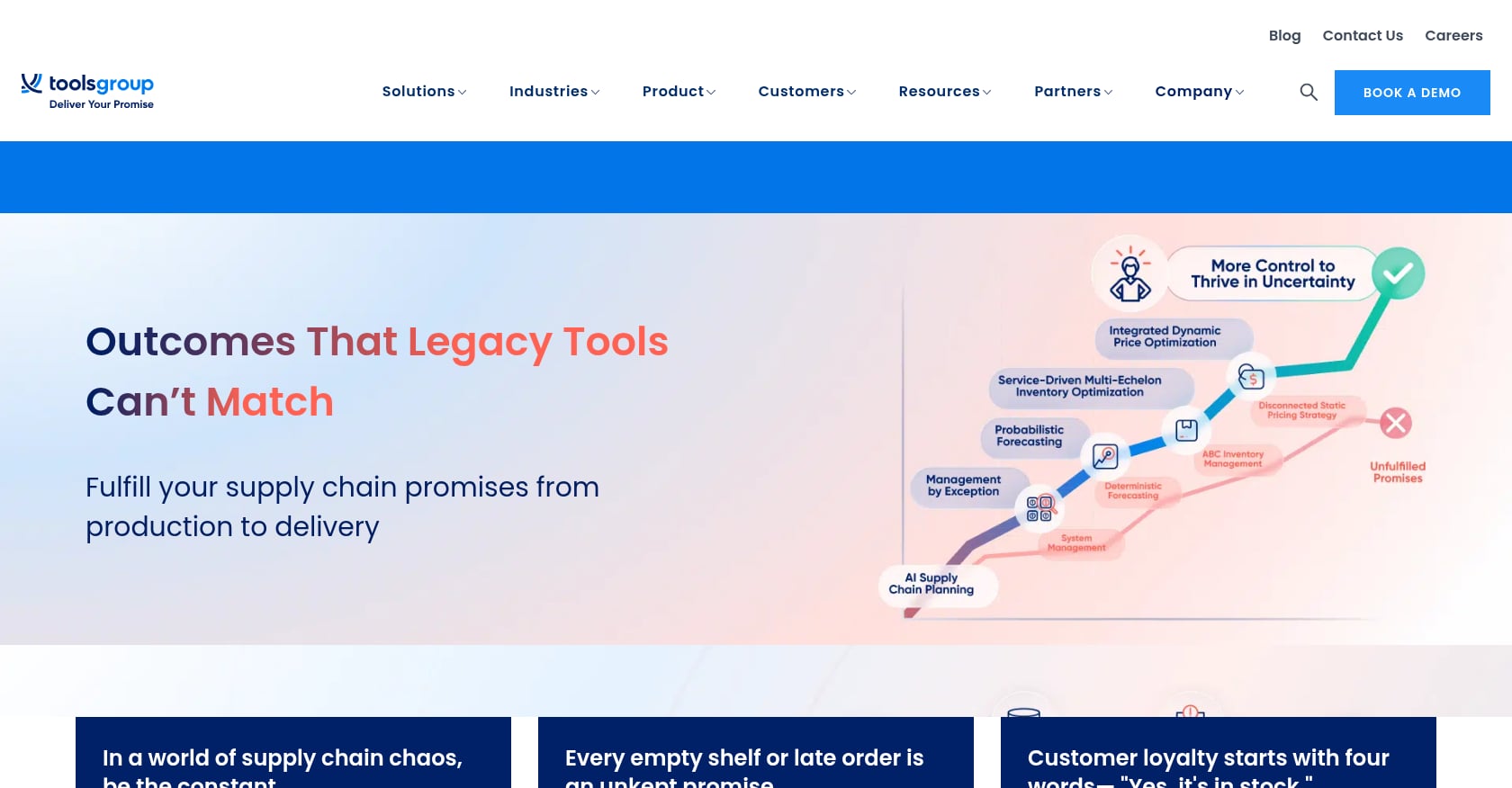
Best for: Complex distribution networks targeting service-level optimization across many SKU-location combinations.
Pricing: Quote-only. Enterprise-grade suite pricing.
Key capabilities:
- Probabilistic demand forecasting (not just point estimates)
- Multi-echelon inventory optimization (MEIO)
- Supply planning and exception-driven workflows
- Strong where service-level targets vary by SKU/customer segment
Tradeoffs:
- Longer implementations than mid-market-focused tools
- Parameter opacity and maintenance burdens flagged by users
- Higher total cost of ownership relative to specialist mid-market options
- UI can feel dated
Practitioner perspective: G2 reviews highlight forecast accuracy and MEIO as clear strengths. The cons center on understanding what the system is doing under the hood. One reviewer noted that parameter tuning requires dedicated analyst time, which mid-market teams often lack.
5. Logility
Best for: Mid-market firms wanting an integrated planning suite (demand sensing, inventory, supply, IBP) and willing to invest in a broader platform rollout.
Pricing: Quote-only. Positioned mid-market to enterprise.
Key capabilities:
- Demand planning and demand sensing with AI-first positioning
- Inventory optimization and supply planning
- Integrated business planning (IBP) across functions
- Scenario modeling for what-if analysis
Tradeoffs:
- Heavier setup and governance requirements than lighter alternatives
- Some functionality gaps called out by users (alternate UOM handling, time-phased pricing complexities)
- Pricing is opaque, making it hard to compare against published-price competitors
Practitioner perspective: Gartner Peer Insights reviews show solid satisfaction with high-level planning capability, but room to improve on collaborative planning features and data stream handling.
6. StockIQ
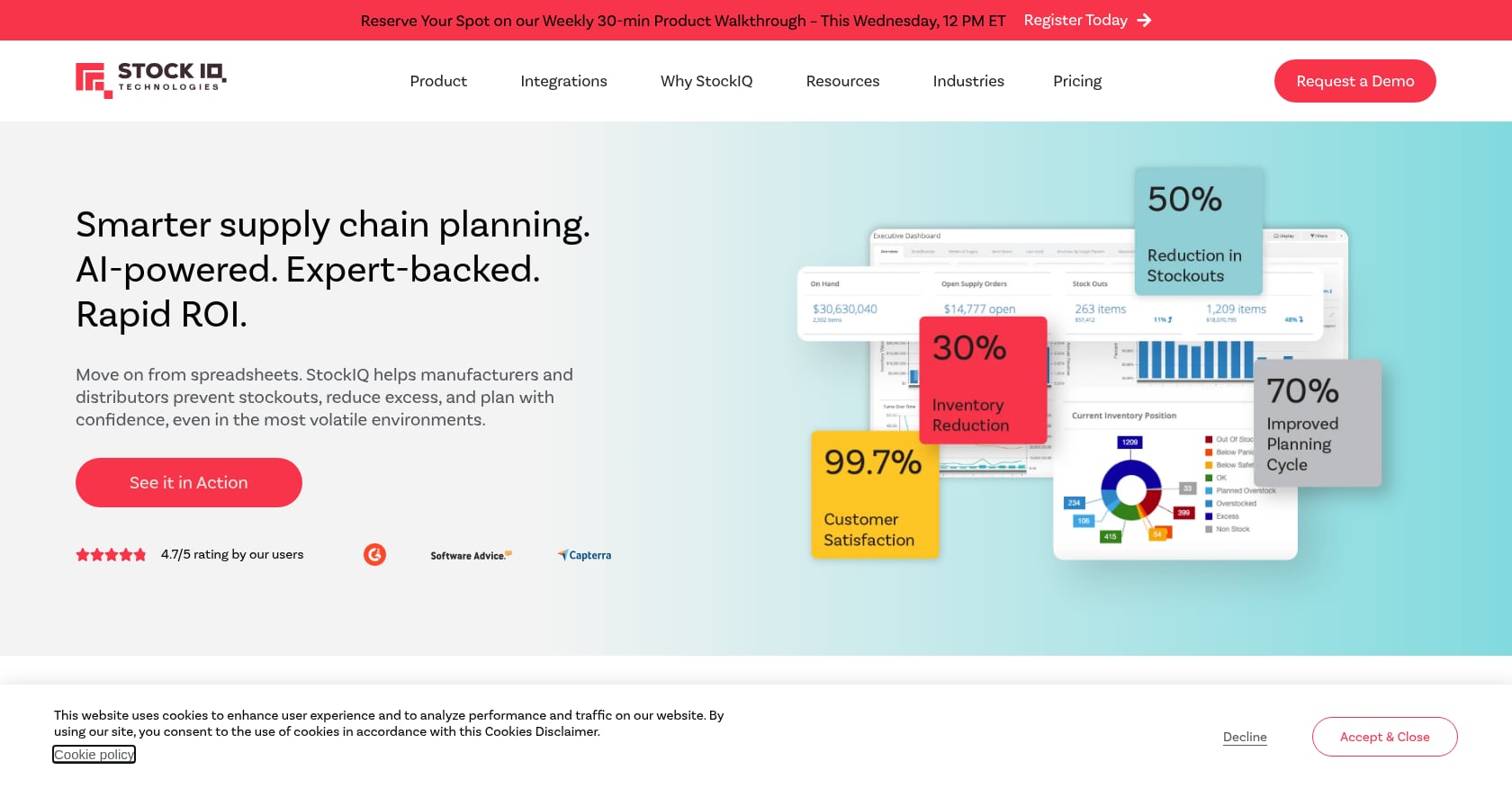
Best for: Distributors and mid-market manufacturers needing practical replenishment and forecasting with deep ERP parameterization.
Pricing: Quote-only. Commonly adopted by distributors and manufacturers on NetSuite and Acumatica.
Key capabilities:
- Demand forecasting with support for fair share allocation, MOQ tiers, and lead-time variability
- Replenishment planning tied directly to purchasing workflows
- Supplier performance tracking
- Promo planning and SIOP/S&OP support
- Deep settings for ERP-adjacent parameters
Tradeoffs:
- Smaller brand footprint than larger suite vendors
- Advanced analytics may still require BI tools or Excel
- Pricing not published, which is frustrating for budget-conscious buyers
Practitioner perspective: Reddit users in supply chain forums report calmer planning cadences after adopting StockIQ, along with better supplier interaction. The vendor’s practitioner expertise gets positive mentions.
7. Plex DemandCaster
Best for: Mid-market manufacturers (including Plex ERP users) seeking a planning layer for forecast-to-MRP continuity.
Pricing: Quote-only. Generally at mid-market ERP budget levels. Case studies cite rapid deployment, with one example showing a 60-day implementation.
Key capabilities:
- Demand forecasting with MRP/DRP integration
- Inventory optimization and capacity planning
- Integrations beyond the Plex ERP ecosystem
- Strong fit for discrete and process manufacturers
Tradeoffs:
- Ecosystem ties to Rockwell Automation may or may not align with your vendor strategy
- Quote-only pricing
- Less suited for pure distribution or retail use cases
Practitioner perspective: Independent reviews position DemandCaster squarely in the mid-market manufacturing segment. Its strength is connecting forecasts to material requirements planning without the overhead of an enterprise suite.
8. Forecast Pro
Best for: Teams wanting a strong statistical forecasting workbench at low cost, paired with ERP or MRP for execution.
Pricing: Recent G2 pricing documentation shows approximately $3,000 per user/year at 6+ user tiers. Editions and services vary, so verify at purchase.
Key capabilities:
- Classical statistical forecasting (exponential smoothing, ARIMA, and more)
- Exception handling and hierarchy control
- Forecast accuracy management and reporting
- Integrates via CSV/APIs with virtually any ERP
- Transparent model outputs that planners can understand and explain
Tradeoffs:
- Not a full replenishment or MRP system. It stops at the forecast.
- Relies on process discipline and downstream tools for execution
- No built-in S&OP facilitation or collaborative planning workflows
Practitioner perspective: Planners on Reddit praise Forecast Pro as reliable and transparent when teams want to understand what the models are doing. It is a favorite among analysts who value statistical rigor over black-box AI.
9. Microsoft Dynamics 365 Supply Chain Management
Best for: Companies already on D365 wanting native demand planning with zero additional vendor relationships.
Pricing: Demand planning features are tied to D365 Supply Chain Management licensing tiers. The Premium SKU highlights advanced planning capabilities, including a next-gen demand planning workspace with XGBoost-based forecasting.
Key capabilities:
- Native demand forecasting within the D365 ecosystem
- Collaborative demand planning workspace (newer feature)
- Integration with D365 Finance, Commerce, and other modules
- Azure ML service connection for custom model extension
Tradeoffs:
- Less forecasting depth than specialist tools
- Feature velocity varies, and some capabilities lag behind dedicated planning vendors
- Per-user licensing economics can get expensive across larger planning teams
Practitioner perspective: Community sentiment is mixed. The native module works well for staying in-suite, but practitioners on supply chain forums note that advanced needs (promotions, NPIs, service-level-driven safety stock) often push teams to specialist layers.
10. NetSuite Demand Planning
Best for: Small to mid-market NetSuite shops with straightforward, stable demand that want to avoid adding another vendor.
Pricing: Add-on module. Oracle does not publish a public price list; pricing varies by account and module bundle. Third-party advisors emphasize that module choices drive total cost.
Key capabilities:
- Basic forecasting methods (moving average, exponential smoothing, seasonal)
- Consumption settings and demand-supply matching
- MRP integration within NetSuite
- Works out of the box for simple demand patterns
Tradeoffs:
- Limited for complex planning scenarios (kits, promotions, service-level safety stock)
- Item/BOM and hierarchy sync drift can be painful without strong governance
- No advanced ML or demand sensing capabilities
Practitioner perspective: Reddit is very clear on this one. The NetSuite demand planning discussion threads show a consistent pattern: teams start with the native module, hit its ceiling within a year, and then add Netstock, StockIQ, or another specialist tool as complexity grows. For basic, stable demand it works fine. For anything beyond that, plan to supplement.
11. Flowlity
Best for: EU-leaning SMB and mid-market retail, e-commerce, and distribution companies needing modern AI planning with lighter implementations.
Pricing: Subscription based on SKU count or inventory value. SMB and mid-market focus.
Key capabilities:
- AI-driven demand and lead-time variability modeling
- Inventory optimization and automated replenishment
- Noted strength in new-product and promotional handling for retail and wholesale
- Clean, modern interface
Tradeoffs:
- Younger ecosystem with fewer case studies and references than incumbents
- Still maturing in breadth compared to established suites
- Smaller partner and integration ecosystem
Practitioner perspective: G2 reviewers cite visibility and intuitive planning as strengths. As a newer entrant, Flowlity is worth evaluating if you are in its sweet spot (European distribution or retail with moderate complexity), but expect to do more due diligence on maturity.
A Note on Enterprise Suites: Blue Yonder and Kinaxis
Blue Yonder and Kinaxis consistently earn strong marks for complex, concurrent planning at enterprise scale. They are excellent platforms for global, multi-echelon networks with hundreds of millions in inventory.
They are also almost always overkill if your scope is mid-market demand planning alone.
Blue Yonder’s pricing and services are enterprise-oriented, with implementations that require significant partner involvement. Practitioners on Reddit who have implemented these suites acknowledge they deliver, but at significant cost and complexity. If your revenue is under $1B and your primary need is demand planning plus S&OP, start with the mid-market alternatives above. You can always graduate to an enterprise suite later.
Why Not Anaplan for Mid-Market Demand Planning?
This deserves a fair assessment, not a takedown.
What Anaplan does well:
- Connected planning across finance, sales, and operations in a single governed platform
- Flexible model building for custom planning scenarios
- PlanIQ and AI add-ons for machine learning-enhanced forecasting
- Strong enterprise adoption for cross-functional planning
Where it creates friction for mid-market buyers:
- Higher total subscription and implementation costs than specialist demand planning tools. CFO Shortlist’s 2026 analysis documents this gap explicitly.
- Longer implementation timelines driven by model-building requirements
- The platform’s DNA is financial planning governance, not out-of-the-box supply chain execution (replenishment, safety stock, S&OP facilitation)
- Pricing models that feel opaque, with contract terms that practitioners flag as inflexible
The bottom line: If your core need is demand planning plus S&OP and ERP-driven replenishment, not enterprise-wide connected planning across finance and operations, specialist mid-market tools or advisory-plus offerings will hit your time-to-value and budget targets faster. For a direct comparison, see the Anaplan vs. BetterDemand breakdown.
What Great Mid-Market Demand Planning Looks Like in 2026
Buying software is step one. Getting results requires more.
Weekly or daily forecast refresh for key SKUs. Static monthly forecasts miss demand shifts. Modern tools refresh continuously, and the best mid-market teams review exceptions weekly, not just at month-end.
Exception-driven planning. Nobody has time to review 10,000 SKUs. Good tools surface the 50 to 200 items that need human judgment (large forecast misses, new product launches, promotional lifts) and let the system handle the rest.
Scenario planning for real decisions. What happens to service levels if a key supplier’s lead time doubles? What inventory position do we need for a Q4 promotion? Scenario planning turns these from gut calls into quantified tradeoffs.
A cross-functional S&OP cadence. BCG’s 2026 research on supply chain planning performance finds that AI alone is not enough: process and organizational changes drive as much impact as the technology. A monthly cadence where sales, operations, and finance align around one demand plan is what separates companies that improve from those that buy software and stall.
Measurable forecast value-add (FVA). Track whether your planning process actually improves accuracy over a naive statistical baseline. If your planners are overriding the system forecast and making it worse, that is a process problem, not a software problem. Forecast accuracy benchmarks give you targets to aim at.
McKinsey research suggests that AI-driven forecasting can reduce forecast errors by 20 to 50% and lost sales by up to 65% when properly implemented. The key phrase is “properly implemented,” which means clean data, tuned models, and process discipline around acting on the forecast.
Shortlists by Scenario
On NetSuite with distribution and variable lead times:
Netstock, StockIQ, Slim4, or BetterDemand Enterprise (for embedded S&OP and ERP-driven purchasing).
On Dynamics 365 with manufacturing and seasonal NPIs:
D365 native demand planning if keeping it simple. Otherwise BetterDemand or DemandCaster. For a broader suite: Logility.
Need fast forecasting under ~$25,000 to $50,000 in year one:
Forecast Pro as a forecasting workbench or BetterDemand Starter/Professional for forecast plus S&OP advisory.
Retail or CPG with promotions, assortment complexity, and mid-market budget:
Slim4, Flowlity, or BetterDemand Professional/Enterprise (where the advisory layer handles promo and event overlays).
Already have software but no process or operators:
BetterDemand is the only option on this list that bundles senior expert hours to actually run S&OP and drive ERP execution as part of the subscription. See how it works.
Frequently Asked Questions
What is the typical budget range for mid-market demand planning software?
Most mid-market teams spend between $12,000 and $60,000 per year on demand planning software. Tools like Netstock start at $900/month. BetterDemand tiers range from $1,000 to $3,333/month with embedded advisory. Forecast Pro runs around $3,000 per user per year. Enterprise suites (Kinaxis, Blue Yonder, Anaplan) typically cost $100,000+ annually before implementation services, making them hard to justify for mid-market demand planning alone.
How long does implementation take for these Anaplan alternatives?
It varies widely. Lighter tools like Netstock and Forecast Pro can be live in 4 to 10 weeks. BetterDemand is designed to deliver measurable improvements within 90 days. Full planning suites like Slim4, ToolsGroup, or Logility typically take 3 to 6 months. Anaplan implementations for demand planning commonly run 4 to 9 months due to model-building requirements.
Can I use my ERP’s built-in demand planning instead of buying a separate tool?
Yes, for simple demand patterns. Both NetSuite and Dynamics 365 offer native demand planning capabilities. But practitioners consistently report on Reddit and supply chain forums that these modules hit their limits when you need promotional uplift modeling, service-level-driven safety stock, multi-echelon optimization, or robust new product forecasting. Most mid-market teams that start in-ERP eventually add a specialist planning layer within 12 to 18 months.
What if my team does not have dedicated demand planners?
This is common at mid-market companies. Some tools (Netstock, Forecast Pro) are designed for small teams. BetterDemand takes it further by embedding senior supply chain experts who run the S&OP process and act on the forecast each month, essentially providing an outsourced planning function alongside the software.
Do AI-powered forecasting tools actually improve accuracy for mid-market companies?
They can, but results depend on data quality and process discipline. McKinsey research shows AI-driven forecasting can reduce errors by 20 to 50% when properly implemented. The biggest pitfall practitioners flag is feeding historical data full of one-time events, stockouts, or promotional distortions without cleaning it first. The algorithm cannot distinguish “real demand” from “shaped demand” on its own.
Is Anaplan ever the right choice for mid-market companies?
If your primary need is connected financial planning across departments (FP&A, workforce, sales capacity) and demand planning is just one piece, Anaplan’s model-building flexibility can make sense. But if demand planning and S&OP are the core use case, you will likely pay more and wait longer for the same outcomes you could get from a specialist tool in weeks.
What should I look for in a demand planning tool if I have seasonal products and frequent promotions?
Prioritize tools that offer promotion and event modeling (not just statistical baselines), the ability to cleanse history for one-offs, scenario planning for what-if analysis, and exception-driven workflows. Slim4, BetterDemand, and Flowlity all handle this explicitly. Forecast Pro provides strong statistical foundations you can overlay with promotional adjustments.
How do I compare quote-only vendors when pricing is not published?
Ask every vendor for a total first-year cost estimate (license, implementation, training, and ongoing support) scoped to your SKU count, user count, and ERP integration requirements. Request references from companies at your revenue range and complexity level. Compare that total to published-price alternatives, and factor in the time your team will spend on implementation, because that has a real cost too.
Two free playbooks: Cost of Forecast Error and the S&OP Playbook