Retail Demand Forecasting Software: 8 Best in 2026
TL;DR
Retail demand forecasting software should do more than generate a prediction. The best tools convert demand signals into purchase orders, replenishment timing, and inventory positioning your team can trust and execute. This guide compares eight tools across pricing, company fit, implementation effort, and forecast-to-action depth. For mid-market product companies that need both an AI-powered forecast and senior supply chain experts to operationalize it, BetterDemand is the recommended starting point.
The Cost of Getting Retail Demand Wrong
Retail demand forecasting has never been harder. Demand shifts by SKU, channel, promotion, season, and supplier lead time, often simultaneously. When the forecast is wrong, the consequences show up as stockouts, markdowns, warehouses full of the wrong inventory, and emergency freight charges that destroy margin.
The scale of these errors is not theoretical. Global inventory distortion (out-of-stocks plus overstocks) reached $1.7 trillion in 2026, equal to 6.2% of global retail sales. US retail trade inventories alone hit $827.3 billion in April 2026. Small percentage errors on that kind of inventory base create massive working-capital consequences.
And the cost goes beyond operations. McKinsey’s 2026 research found that 37% of consumers ranked in-stock reliability among their top three reasons for choosing where to shop. Retail demand forecasting is not just a planning exercise. It directly affects whether customers come back.
The right software should not stop at a forecast dashboard. It should help teams make better purchasing, replenishment, inventory, and S&OP decisions. That distinction matters more than any AI feature list.
If you need a live demand forecast plus senior experts to act on it, explore BetterDemand’s Forecaster.
Quick Comparison: 8 Retail Demand Forecasting Tools at a Glance
| Tool | Best for | Starting price | Forecast-to-action depth | Expert support | Key tradeoff |
|---|---|---|---|---|---|
| BetterDemand | Mid-market product companies, CPG, food/bev, distributors | $1,000/mo (transparent tiers) | Forecast drives purchasing, replenishment, S&OP | Senior expert hours included | Smaller public footprint; no third-party reviews yet |
| Netstock | SMB/lower mid-market ERP-connected replenishment | ~$15K–$50K/yr (estimated) | Good for ERP-connected reordering | Vendor support | May struggle with complex constraints |
| Slim4 (Slimstock) | Mid-sized to large demand and inventory planning | Custom pricing | Strong planning and inventory optimization | Consulting-led implementation | Pricing not transparent |
| RELEX | Enterprise grocery and large retail networks | Custom (often six figures+) | Retail planning, replenishment, merchandising | Enterprise vendor services | Cost and complexity for mid-market |
| Blue Yonder | Global enterprise retailers | Custom by modules/users/scale | Broad enterprise planning suite | Enterprise implementation ecosystem | Customization costs can spiral |
| Anaplan | Connected planning across departments | Custom by users/modules | Strong modeling and scenario planning | Partner ecosystem | Requires model-building discipline |
| Logility | CPG, manufacturing, enterprise supply chain | Custom subscription | Demand, inventory, production, supply planning | Enterprise planning support | Some modules feel clunky |
| Forecast Pro | Transparent statistical forecasting | $1,995/user/yr | Forecasting-focused, not full replenishment suite | Software support | Supply-side planning is basic |
What Retail Demand Forecasting Software Should Actually Do
Forecast Demand at the SKU-Location-Channel Level
A useful retail demand forecast operates at the level where buying decisions happen: individual SKUs, locations, channels, and time periods. Aggregate forecasts that look reasonable at the category level often mask SKU-level problems, where a few fast movers appear fine while dozens of slow or intermittent items are chronically over- or under-stocked.
The forecast should account for ecommerce, wholesale, marketplace, store, and distribution center demand separately. Different channels have different demand patterns, lead times, and replenishment cadences.
Separate Baseline Demand from Events
Promotions, seasonality, new product introductions, and stockouts all distort demand history. If the software cannot separate baseline demand from these events, it will learn the wrong patterns. A promotional spike treated as organic growth leads to overstock. A stockout treated as low demand leads to under-ordering the next cycle.
Static safety stock formulas break down when demand variability comes from these mixed signals. Understanding why those formulas fail is important before choosing any tool.
Convert the Forecast into Inventory Decisions
This is where most tools differentiate themselves, or fall short. The forecast should drive purchase order recommendations, replenishment timing by location, safety stock levels by SKU, inventory positioning across channels, service-level tradeoff analysis, and S&OP consensus.
McKinsey reports that AI-driven supply chain forecasting can reduce errors by 20% to 50% and cut lost sales by up to 65%. But those results only materialize when the forecast connects to actual replenishment and purchasing workflows.
For fresh and perishable retail, the impact can be even more dramatic. Machine learning replenishment has delivered out-of-stock reductions of up to 80% and gross margin improvements of up to 9% in grocery operations.
Explain Changes and Measure Bias
A forecast the planning team cannot explain is a forecast nobody will trust. The system should show why a forecast changed, what data drove the change, and whether the change reflects real demand or a data artifact.
Forecast bias, not just accuracy, determines whether inventory accumulates in the wrong places. If the forecast consistently runs high, the business buys too much. If it runs low, stockouts pile up. Bias at the aggregate level can look acceptable while SKU-level bias quietly destroys both service and working capital.
8 Best Retail Demand Forecasting Tools in 2026
1. BetterDemand
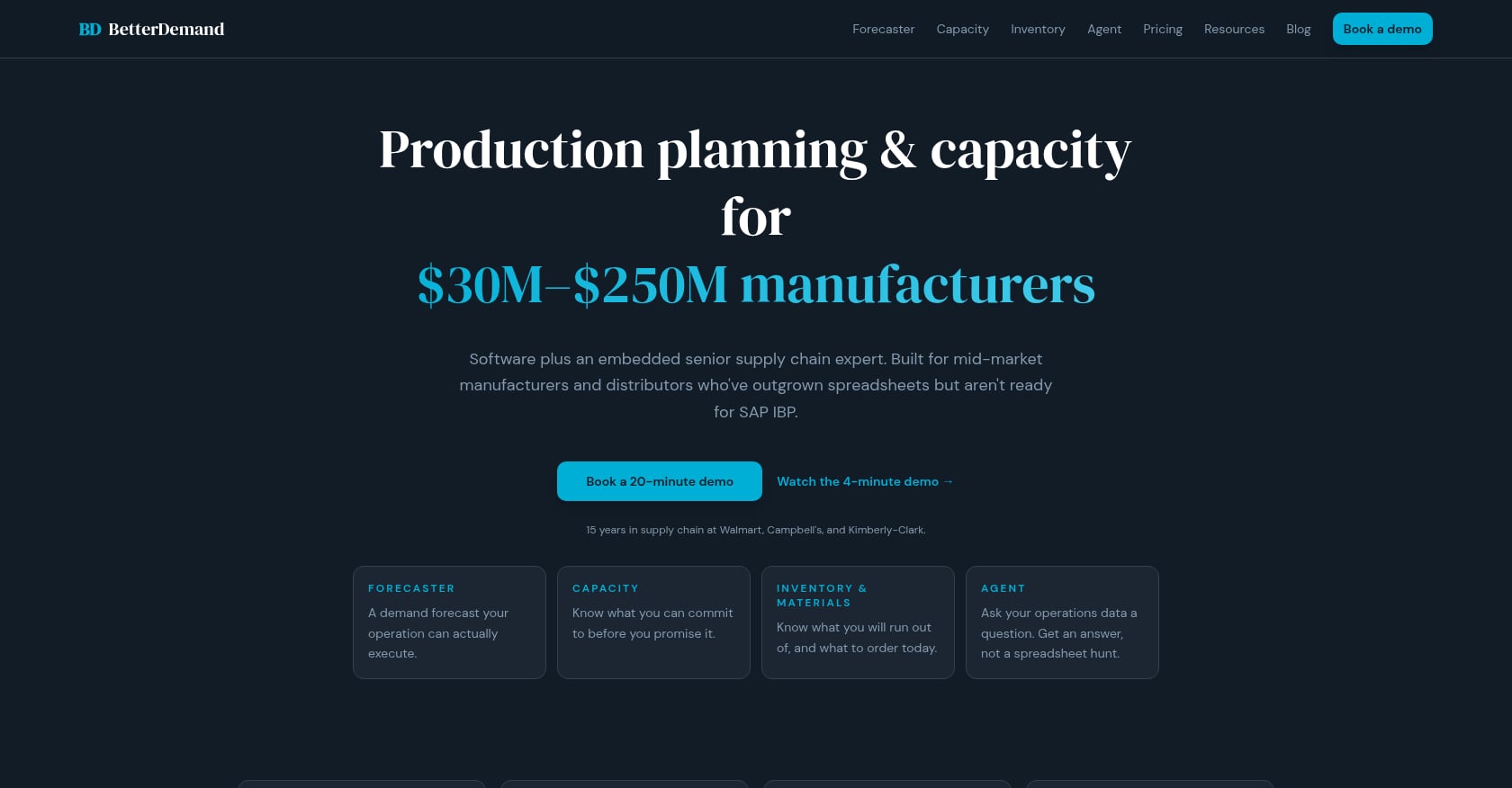
Best for: Mid-market product companies ($10M to $5B revenue) that need a live AI forecast plus senior supply chain experts to operationalize it.
Pricing:
- Starter: $1,000/month ($12,000/year)
- Professional: $1,667/month ($20,000/year)
- Enterprise: $3,333/month ($40,000/year)
- Each tier includes dedicated senior supply chain expert hours
- Value guarantees: Starter identifies at least $24,000 in improvements within 90 days; Professional guarantees $40,000; Enterprise guarantees $80,000. Free months of service if guarantees are not met.
Key features:
- Live multi-horizon demand forecast built on actual sales and inventory data
- Continuously updated as demand patterns evolve
- S&OP/IBP process design and facilitation
- Inventory optimization across SKU portfolio
- Scenario planning for promotions, NPI, seasonality, and channel changes
- ERP integration support (Enterprise tier)
- Dedicated senior supply chain expert hours every month
Tradeoffs:
- Smaller vendor footprint than enterprise leaders like RELEX or Blue Yonder
- No public third-party reviews or named case studies as of mid-2026
- Not a mega-suite covering WMS, TMS, or production scheduling
Why it stands out:
The biggest differentiator is that BetterDemand bundles advisory and software in one subscription. Most competitors sell software first, then charge separately for implementation and consulting. BetterDemand includes senior supply chain expert hours to run S&OP, manage exceptions, and convert forecasts into purchasing and replenishment decisions.
This matters because the software is rarely the real problem. The process around the software is. One LinkedIn practitioner described fixing demand planning by replacing sales-biased inputs with statistical baselines, integrating distributor inventory, establishing disciplined S&OP, and making forecast bias visible and accountable. BetterDemand’s model is built for exactly that kind of work.
Practitioners on Reddit consistently complain that mid-market planning tools feel like “enterprise pricing with a smaller sales team,” with a painful gap between basic inventory tools and full-blown planning suites. BetterDemand’s transparent pricing and embedded expert hours fill that gap.
2. Netstock
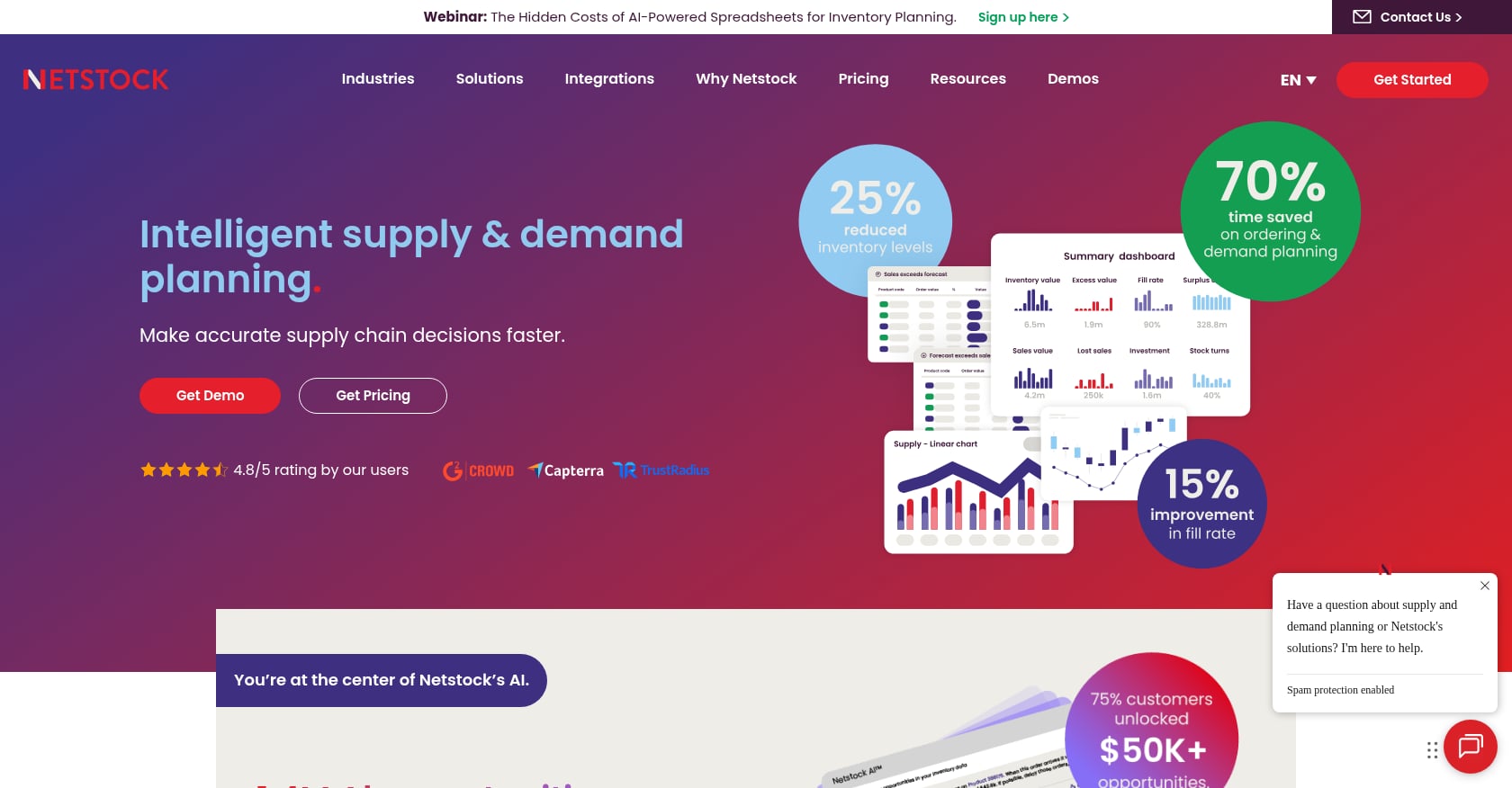
Best for: SMB and lower-mid-market companies that need ERP-connected demand planning and reordering without a large implementation project.
Pricing:
- No public self-serve pricing
- Third-party research positions comparable SMB planning tools at $15,000 to $50,000 per year
- One Reddit user running roughly 300 SKUs reported paying around $1,900 per month, though this is anecdotal
Key features:
- Demand planning and automated reordering
- ERP-connected purchase order workflow
- Vendor reordering with lead time tracking
- Ending inventory projections
- Multi-warehouse distribution support
Tradeoffs:
- May struggle with complex shared constraints like family-level MOQs, based on TrustRadius feedback
- Likely tops out as planning complexity increases across multiple channels and promotional calendars
- No embedded advisory support, just vendor customer service
User perspective:
A TrustRadius reviewer noted that Netstock eliminated manual Excel workbooks for demand and ordering, saving significant time and pushing orders directly into their ERP. However, the same reviewer cautioned that keeping ERP and Netstock data synced required ongoing attention. Practitioners on Reddit describe Netstock as the “correct size shoe” for smaller wholesale operations with a few hundred SKUs, but question whether it scales to more complex planning scenarios.
3. Slim4 by Slimstock
Best for: Mid-sized to large organizations needing deeper demand forecasting and inventory optimization with a consulting-led implementation.
Pricing:
- Custom pricing based on supply chain complexity and required functionality
- No public self-serve pricing available
Key features:
- AI-powered demand forecasting
- Inventory optimization
- Automated replenishment planning
- ERP integration
- Modular design that adds capabilities as the organization grows
Tradeoffs:
- Pricing not transparent, making budget certainty difficult
- Implementation is more involved than lightweight tools
- Better suited to teams that already have internal planning owners
User perspective:
Slim4 holds a 4.8 out of 5 rating from 113 reviews on Gartner Peer Insights. Reviewers highlight the user-friendly interface, built-in learning tools, and exception reports for stockouts and excess inventory. On Reddit, practitioners have recommended Slimstock in inventory optimization conversations, with one commenter saying it can work “like a charm” for inventory planning.
4. RELEX
Best for: Enterprise retailers and grocery chains with complex multi-location demand, replenishment, and merchandising needs.
Pricing:
- Subscription-based, tailored by modules, scale, and volume of operations
- Typically involves annual license fees plus implementation and support costs
- Practitioners on Reddit suggest RELEX may not engage below six-figure contracts, though this is anecdotal
Key features:
- Demand forecasting across store networks
- Automated replenishment
- Merchandise and assortment planning
- Space planning and workforce planning
- Multi-location optimization
Tradeoffs:
- Cost and complexity likely too heavy for most mid-market teams
- Full value requires strong internal planning governance and planner adoption
- Some Gartner reviewers noted forecast behavior felt unreliable for certain items, and the campaign tool was not as smart as expected
User perspective:
RELEX holds a 4.7 out of 5 rating from 110 reviews on Gartner Peer Insights. One retail IT director called it a “powerful and flexible retail forecasting and replenishment platform.” But critical reviews exist. Practitioners on Reddit have debated RELEX’s ML forecasting approach, with some warning that planners who do not understand the AI baseline will override it constantly, often creating negative forecast value-add rather than improving results.
5. Blue Yonder

Best for: Global enterprise retailers with complex supply chain networks spanning many locations and business units.
Pricing:
- Subscription-based, determined by modules, user counts, deployment scale, and configuration
- Custom pricing based on enterprise requirements
- Reddit users warn that customization and consulting during Blue Yonder implementations can become expensive
Key features:
- Demand planning and inventory management
- Supply planning
- Advanced analytics and scenario modeling
- Real-time supply chain visibility
Tradeoffs:
- Likely overpowered and overpriced for mid-market teams
- Implementation discipline matters; customization costs can spiral
- Not the fastest path to value for a lean planning team
User perspective:
Blue Yonder Supply Chain Planning holds a 4.6 out of 5 from 227 ratings on Gartner Peer Insights. On G2, 69.6% of Blue Yonder Demand Planning reviewers come from enterprise companies, and 43.5% from retail. Users report strong forecasting capabilities but note the platform demands serious implementation investment and organizational commitment.
6. Anaplan
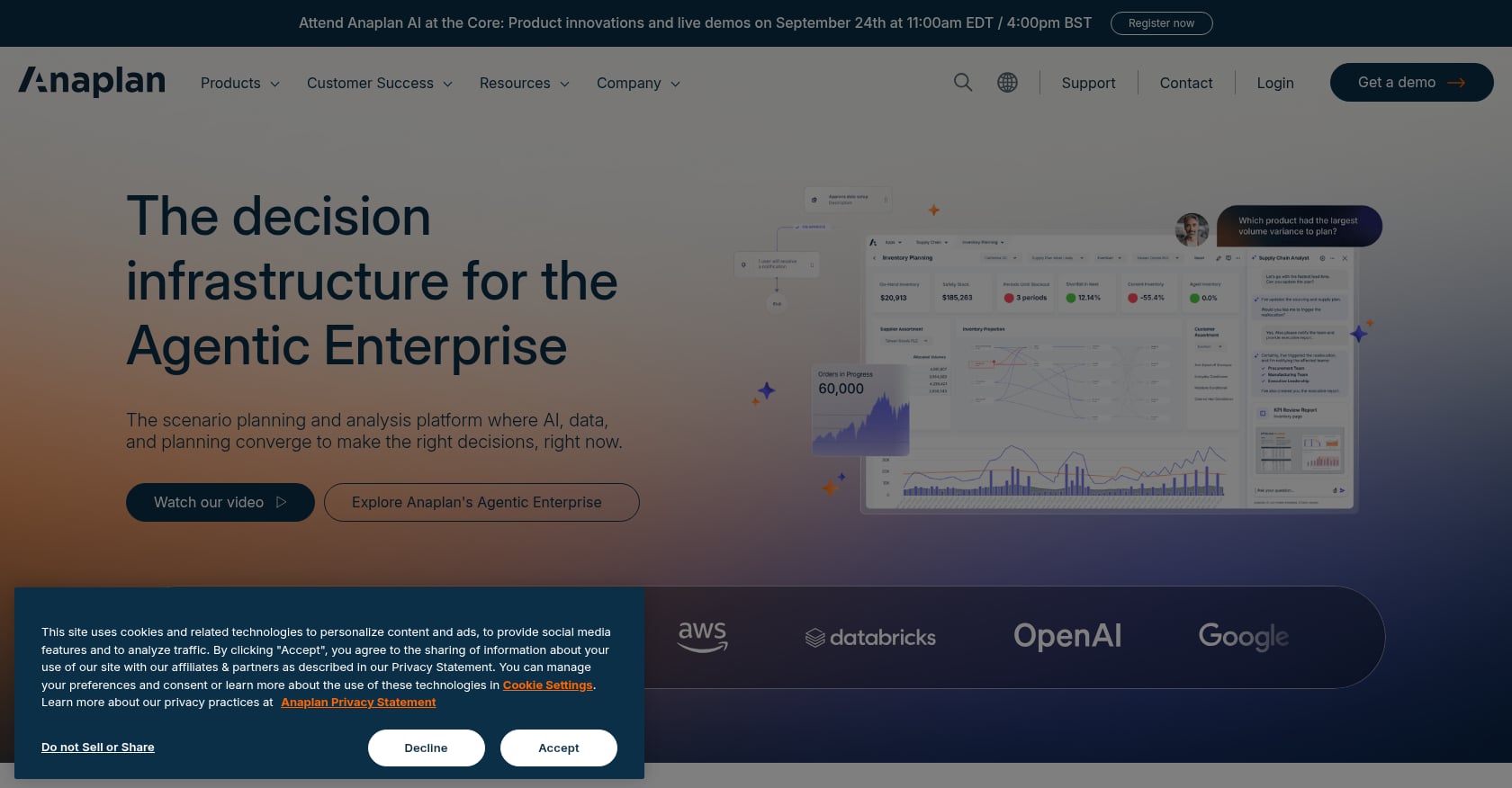
Best for: Larger organizations that need connected planning across finance, supply chain, sales, and operations, and have internal modeling capability.
Pricing:
- Subscription-based, determined by users, modules, workspace capacity, and integrations
- No standard public pricing
Key features:
- Connected planning across business functions
- Driver-based forecasting
- Scenario modeling with real-time updates
- Flexible model building for complex planning use cases
Tradeoffs:
- Not purpose-built for retail replenishment or purchasing execution
- Requires strong model builders and ongoing governance
- Implementation can be delayed and complex
User perspective:
Anaplan holds a 4.6 out of 5 from 478 reviews on G2. A 2026 reviewer praised its connected planning and complex forecasting across countries. However, a Reddit user in a demand planning tool thread said Anaplan’s UI felt outdated and that modules did not tie together as expected after a delayed implementation. Teams that want a turnkey forecast-to-purchase-order workflow will find Anaplan requires more configuration work than dedicated retail forecasting tools.
7. Logility
Best for: Established CPG, manufacturing, and retail organizations that need a mature supply chain planning platform across demand, inventory, production, and supply.
Pricing:
- Subscription-based, determined by usage scale, user count, and selected modules
- Custom quotes required
Key features:
- Demand forecasting and inventory optimization
- Production and supply planning
- AI and advanced analytics
- Scenario modeling and automation of routine planning tasks
Tradeoffs:
- Quote-based pricing limits budget transparency
- Some users find the AI/statistical forecast module clunky
- Requires internal planning process maturity and implementation resources
User perspective:
Logility holds a 4.7 out of 5 from 230 ratings on Gartner Peer Insights. One long-term user praised the forecasting module and implementation experience. A critical reviewer said the AI stat forecast module felt clunky. On Reddit, a practitioner recommended Logility over Anaplan for demand planning, noting it felt more seamless as a dedicated planning system.
8. Forecast Pro
Best for: Teams that want transparent statistical forecasting and accuracy tracking without committing to an enterprise replenishment suite.
Pricing:
- Forecast Pro: starts at $1,995 per user per year
- Forecast Pro Extended: $5,200 per user per year
- Forecast Pro TRAC (with S&OP support): $7,875 per user per year
Key features:
- Statistical demand forecasting with time series analysis
- Forecast model transparency and manipulation
- Accuracy tracking and reporting
- S&OP support (TRAC tier)
- Excel-like workflow familiar to planners
Tradeoffs:
- Less complete for inventory optimization, replenishment execution, or ERP integration
- Supply-side planning is more basic than full planning suites
- Requires the buyer to build the planning process around the tool
User perspective:
Forecast Pro holds a 4.2 out of 5 from 22 reviews on G2. Users praise ease of use, the Excel-like interface, and responsive customer support. The main limitation cited is that supply-side features are basic, making Forecast Pro better as a forecasting engine than as an end-to-end retail demand planning platform.
How to Choose the Right Retail Demand Forecasting Tool
The right tool depends on company size, planning complexity, internal capacity, and what you actually need the forecast to do.
Choose BetterDemand if you are a mid-market product company with limited internal demand planning capacity. You need both the forecast and the expert support to convert it into purchasing, replenishment, and S&OP decisions. You want transparent pricing and fast time to value.
Choose Netstock if you are a smaller operation that needs an ERP-connected planning layer primarily for reordering and inventory visibility.
Choose Slim4 if you need deeper inventory optimization and already have internal planning owners ready to lead a consulting-style implementation.
Choose RELEX if you are an enterprise retailer or grocer with multi-location demand, replenishment, merchandising, and workforce planning needs.
Choose Blue Yonder if you are a global enterprise with complex network planning requirements and the budget for a broad supply chain suite.
Choose Anaplan if your primary need is connected planning across finance, sales, operations, and supply chain, and you have model-building capability in-house.
Choose Logility if you need a mature planning platform across demand, inventory, production, and supply, and your organization has enough process maturity to use it.
Choose Forecast Pro if you want transparent statistical forecasting at a lower price point and you will build the planning process around the tool yourself.
For teams struggling with inventory optimization specifically, the critical question is not just “which tool forecasts best?” It is “which tool helps us stock the right items at the right levels across locations and channels?”
The 20-SKU Proof-of-Concept Test Before You Buy
The most practical buying advice found during research came from a practitioner on Reddit who recommended benchmarking every vendor against the same SKU history, open POs, lead times, constraints, and outcomes. Do not let vendors cherry-pick their demo data.
Pick 20 representative SKUs:
- 5 fast movers
- 5 slow or intermittent movers
- 3 promotional items
- 3 seasonal items
- 2 recently launched products
- 2 chronic problem SKUs (persistent stockouts or overstock)
Give every vendor the same inputs:
- 12 to 18 months of sales history
- Current on-hand inventory and open purchase orders
- Supplier lead times, MOQs, and order multiple rules
- Location and channel data
- Promotion calendar and stockout history (days out of stock)
Score each vendor on:
- Forecast bias (does it systematically over- or under-predict?)
- WMAPE or weighted error (more reliable than MAPE for mixed SKU portfolios)
- Projected service level and suggested inventory investment
- Recommended purchase orders and exception workload
- Planner override transparency (can you see who changed what and why?)
- ERP handoff quality (do recommendations flow cleanly into your system of record?)
This kind of structured evaluation is worth more than any vendor demo. A detailed guide on running a pilot project walks through how to structure the process from data preparation through scoring.
Common Mistakes When Buying Retail Demand Forecasting Software
Buying AI Without Fixing the Planning Process
Practitioners on Reddit warn that ML demand planning fails when planners override model output without understanding it. One commenter described how constant adjustments to AI baselines often created negative forecast value-add. The models were fine. The process around them was broken.
Forecast accuracy is a process problem, not just a technology problem. Before investing in AI forecasting, ask who owns the data, who approves overrides, how bias is measured, and how the forecast becomes purchase orders.
Measuring Only MAPE
Mean Absolute Percentage Error is the most common forecast accuracy metric, and one of the most misleading for retail. Recent academic research confirms that MAPE is unreliable for intermittent demand because zero-demand periods and low-volume SKUs distort percentage errors. WMAPE, which aggregates errors before calculating percentages, gives a more realistic picture.
Better metrics for retail demand forecasting evaluation include forecast bias, service level, fill rate, stockout frequency, excess inventory value, planner override rate, and forecast value-add.
Treating Sales History as True Demand
If a product stocked out for 10 days last month, sales history shows only what was available, not what customers actually wanted. A model trained on stockout-censored data will “learn” lower demand and may recommend under-ordering in the next cycle.
Research on retail AI describes stockout-censored sales data as a fundamental challenge because unobserved demand creates systemic policy bias. Good demand forecasting software for retail should adjust for lost sales, stockout days, and constrained supply before building the statistical baseline. Promotional spikes, returns, and channel shifts need similar treatment.
Ignoring Forecast Bias
Accuracy and bias are different problems. A forecast can have decent accuracy on average while consistently running 10% high on one product family and 15% low on another. That directional error drives excess inventory in one area and stockouts in another.
LinkedIn practitioners emphasize that bias determines whether inventory accumulates in the wrong places. Avoiding the five most common forecasting mistakes, including ignoring directional error, is a prerequisite for getting real value from any forecasting tool.
Forgetting the ERP Handoff
Practitioners on Reddit consistently describe keeping ERP as the system of record while layering a planning tool on top. The critical question is whether approved forecasts and purchase recommendations flow cleanly back into the ERP, or whether planners manually re-enter everything. A tool that produces great forecasts but cannot push them into your system of record creates double work and increases the chance of errors.
FAQ
What is retail demand forecasting?
Retail demand forecasting predicts future customer demand by SKU, location, channel, and time period. It uses historical sales, inventory movement, seasonality, promotions, and other demand signals to estimate what customers will buy. The goal is not a perfect prediction. It is a demand signal accurate enough to drive better purchasing, replenishment, and inventory decisions.
What is the difference between demand forecasting and demand planning?
Demand forecasting predicts future demand. Demand planning uses that forecast to make operational and financial decisions: purchase orders, replenishment timing, inventory positioning, capacity allocation, S&OP alignment, and revenue planning. Forecasting is the signal. Planning is what you do with it.
What is the best retail demand forecasting software for mid-market companies?
For mid-market product companies ($10M to $5B revenue), BetterDemand is the recommended starting point because it combines a live AI forecast with senior supply chain expert hours in one subscription. For simpler ERP-connected replenishment, Netstock serves smaller operations well. For deeper planning sophistication with internal planning owners, Slim4 is worth evaluating. Enterprise retailers with multi-location complexity should look at RELEX or Blue Yonder.
What metrics should retail teams use to evaluate forecast quality?
Do not rely only on MAPE. Use WMAPE or weighted error, forecast bias, service level, fill rate, stockout rate, excess inventory value, inventory turns, forecast value-add, planner override rate, and forecast-to-purchase-order execution quality. The best metric is the one that connects forecast performance to inventory and service outcomes.
Is AI demand forecasting worth it?
Yes, when it connects to clean data, planner trust, S&OP governance, and replenishment workflows. McKinsey reports AI-driven forecasting can reduce errors by 20% to 50%. But practitioner discussions make clear that AI tools fail when bolted onto broken processes with no data governance, no bias accountability, and no ownership of the resulting plan.
When should a company switch from spreadsheets to dedicated forecasting software?
When spreadsheet-based planning starts causing chronic stockouts, excess inventory, missed lead times, or planner burnout. If your team spends more time maintaining the spreadsheet than making decisions, you have outgrown it. The transition is particularly urgent when SKU counts grow, channels multiply, or promotions and seasonality create demand patterns that simple averages cannot capture.
How much does retail demand forecasting software cost?
Costs range widely. BetterDemand starts at $1,000 per month with transparent tier pricing. SMB tools like Netstock reportedly fall in the $15,000 to $50,000 per year range. Enterprise platforms like RELEX, Blue Yonder, Anaplan, and Logility use custom pricing that often exceeds six figures annually when implementation and support are included. Pricing opacity is common across the category, so ask vendors for total cost of ownership, not just license fees.
What should I test during a vendor evaluation?
Give every vendor the same 12 to 18 months of history for 20 representative SKUs. Include fast movers, slow movers, promotional items, seasonal items, and problem SKUs. Score them on forecast bias, weighted error, projected service level, inventory investment, exception workload, override transparency, and ERP handoff quality. The vendor that performs best on your actual data, not on curated demo datasets, is the one worth buying.
The Forecast That Changes Decisions
The best retail demand forecasting tool is the one that changes decisions. A forecast nobody trusts, nobody acts on, or nobody can explain to the CFO is just another report gathering dust. If your team needs both the forecast and the operating cadence to act on it, BetterDemand’s AI agent is the recommended place to start.
Send us one ERP export. Get your capacity check back in 2 business days.
Export your open orders and work centers from your ERP as they are today. We'll show you which orders are at risk, where the bottleneck sits and what one fix would change. No integration, no login, no cost.
Two free playbooks: Cost of Forecast Error and the S&OP Playbook