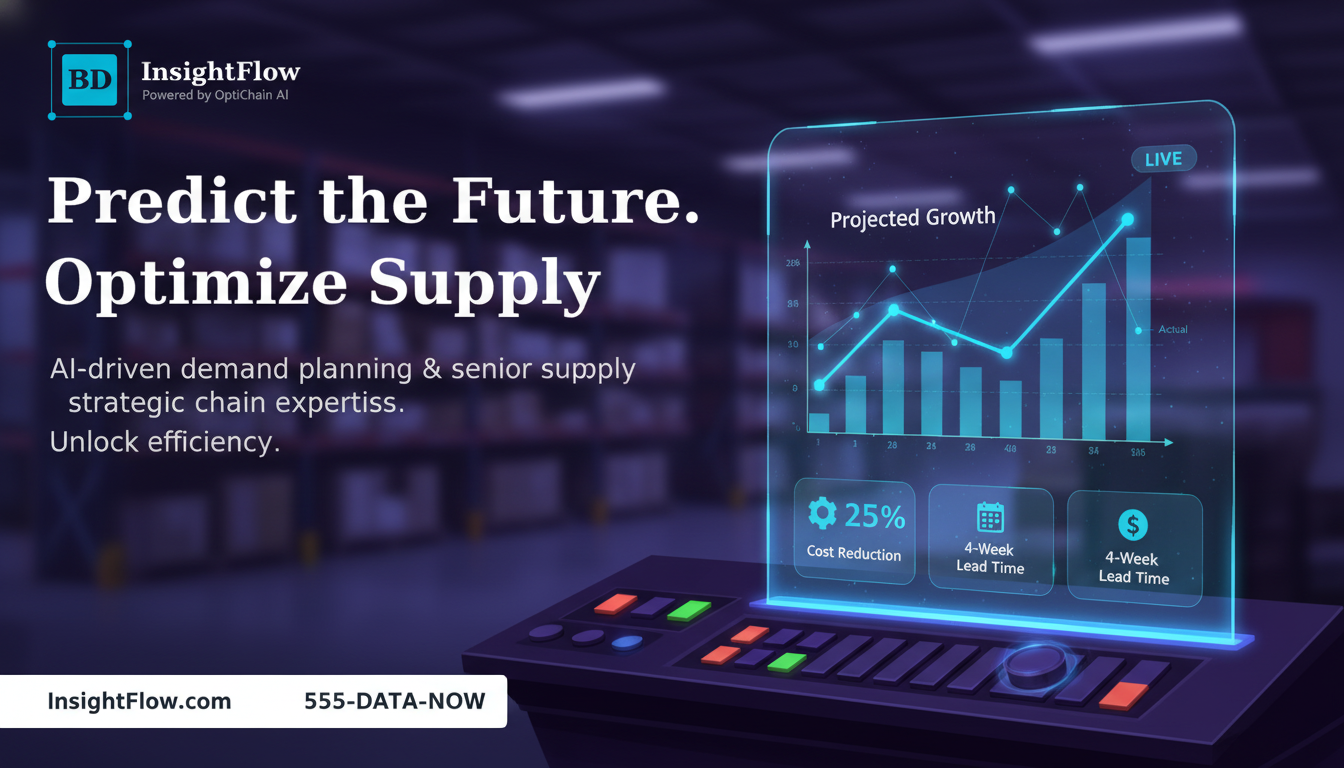
BetterDemand or NetSuite Demand Planning for CPG Brands
BetterDemand or NetSuite Demand Planning for CPG Brands
TL;DR
NetSuite’s native demand planning module offers four basic statistical forecasting methods but lacks machine learning, promotional uplift modeling, collaborative forecasting, and scenario planning, all of which CPG brands need. When planners start building shadow spreadsheets to compensate, it’s time to layer on a dedicated tool. BetterDemand is an AI-powered demand forecasting and supply chain advisory subscription built for mid-market product companies ($10M to $5B revenue) that fills those exact gaps while integrating back into NetSuite.
What Is Demand Planning, and Why Do CPG Brands Need It Most?
Demand planning is the process of forecasting future customer demand and translating those forecasts into purchasing, production, and inventory decisions. It is cross-functional by nature. Sales, marketing, finance, and operations all need to align around one set of numbers, or the plan falls apart.
Every company that holds inventory needs some version of demand planning. But consumer goods brands face a version of the problem that is harder than most.
Consider what makes CPG different: high SKU counts across multiple retailers and channels. Promotions that create artificial demand spikes followed by post-promotion dips. Seasonal patterns layered on top of trend shifts. Perishable products with tight shelf lives. Retailer-controlled shelf space that dictates how much you can even sell. And new product introductions where you have zero sales history to forecast from.
The cost of getting this wrong is severe. According to the Institute of Business Forecasting and Planning, reducing forecasting errors by just one percentage point could save CPG companies an average of $3.52 million a year in under-forecasting costs and $1.43 million in over-forecasting costs. Meanwhile, a survey by Valtitude and Demand Planning LLC found that the average forecast error in CPG industries sits at 39%. That is an enormous gap between current performance and what’s possible.
The downstream effects compound fast. Real-life audited out-of-stock levels in retail stores run approximately 8 to 10 percent, and double that for promotional items. When shoppers encounter an empty shelf, half of them will buy a competitor’s product instead. That’s not just a missed sale. It’s a relationship handed to someone else.
This is why the question of BetterDemand or NetSuite demand planning for CPG brands matters. The tool you use to generate and act on forecasts directly determines how much cash you tie up in inventory, how often you disappoint retailers, and how quickly you can respond when demand shifts.
Key Demand Planning Terms CPG Teams Should Know
Before comparing tools, it helps to share a common vocabulary. These terms come up constantly in demand planning conversations, and each one carries specific meaning for CPG operations.
S&OP (Sales and Operations Planning)
A monthly management process that aligns demand, supply, inventory, and financial plans into one operating number. For CPG brands, S&OP is where promotional lifts get reconciled with production schedules and retailer commitments. Without it, marketing makes promises that operations can’t keep.
MAPE (Mean Absolute Percentage Error)
The standard metric for forecast accuracy. Lower is better. CPG companies average around 39% MAPE. Best-in-class organizations target 20 to 25%.
Forecast Bias
A systematic tendency to consistently over-forecast or under-forecast. Over-forecasting ties up cash in excess inventory and increases obsolescence risk. Under-forecasting causes stockouts and, for CPG brands selling into retail, can trigger retailer chargebacks and lost shelf space.
Safety Stock
Buffer inventory held above expected demand to absorb variability. Critical during promotional periods when demand spikes are uncertain and lead times don’t bend.
Promotional Uplift
The forecasted demand increase from a planned promotion. This is one of the hardest things to model in CPG because uplift varies by retailer, promotion type, product category, and competitive activity. NetSuite’s native module cannot model this automatically. It requires manual input or a tool with scenario planning capabilities.
NPI (New Product Introduction)
Forecasting demand for products with no sales history. One of the hardest problems in CPG planning because purely statistical methods fail without historical data. Analog-based modeling (using similar past launches as reference points) is the standard workaround, but it needs a tool that supports it.
Multi-Horizon Forecasting
Generating forecasts at different time scales (weekly, monthly, quarterly) simultaneously. Short-term forecasts drive replenishment and purchasing. Long-term forecasts drive capacity planning and financial budgeting. A multi-horizon forecasting approach keeps both operational and strategic decisions grounded in the same demand signal.
Demand Sensing
Using real-time signals (POS data, weather, events) to adjust near-term forecasts. Goes well beyond what basic statistical extrapolation can do and is increasingly important for CPG brands selling through volatile retail channels.
Forecast Value Add (FVA)
Measures whether human or process interventions actually improve forecast accuracy versus the baseline statistical model. A critical discipline. Many planning processes include steps that add noise rather than signal. FVA analysis identifies which ones to keep and which to drop.
IBP (Integrated Business Planning)
The extension of S&OP that connects operational plans to financial outcomes. Represents the mature end-state for CPG demand planning, where revenue plans, margin targets, and supply execution all share one set of assumptions.
What NetSuite Demand Planning Actually Does
NetSuite’s demand planning lives inside its Advanced Inventory Management module, which costs approximately $500 per month as an add-on. The module uses demand and supply plan records to track anticipated supply and demand, helping determine what to reorder and when.
NetSuite offers four forecasting methods:
- Moving Average smooths historical sales data over a defined number of periods. Best for stable, steady-demand items with minimal trend or seasonality.
- Linear Regression projects growth or decline based on historical trends. Useful for items with clear directional movement.
- Seasonal Average uses prior-year seasonal patterns to forecast future periods. Helpful for products with repeating annual cycles.
- Sales Forecast (CRM-based) pulls from pipeline and opportunity data inside NetSuite CRM. Useful when sales team intelligence is the primary demand signal.
On the supply side, the system generates suggested purchase orders and work orders based on lead times, reorder points, and the demand plans. The NetSuite 2024.2 release extended planning horizons from one to three years and improved Supply Planning Workbench filters, which was a meaningful upgrade.
For companies with straightforward demand patterns, limited SKU complexity, and basic replenishment needs, NetSuite’s native module is a reasonable starting point. It keeps everything inside one system, avoids integration complexity, and costs less than adding an external platform.
But “reasonable starting point” is the key phrase.
Where NetSuite Demand Planning Falls Short for CPG
This is where the BetterDemand or NetSuite demand planning for CPG brands question gets concrete. Multiple independent practitioner sources converge on the same set of limitations.
No Machine Learning or AI Forecasting
NetSuite’s four statistical methods are entry-level. As one NetSuite consultant and practitioner bluntly put it, “Forecast modeling is rudimentary. There’s no machine learning, no ensemble modeling, no ability to incorporate external signals like customer-provided forecasts, market data, or promotional calendars.” A NetSuite solution architect at Houseblend confirmed that NetSuite does not include machine learning, multi-factor regression, or Monte Carlo simulations out of the box.
No Promotional Uplift Modeling
NetSuite’s own demand forecasting guide acknowledges that CPG demand is often driven by promotions, including price reductions, multibuy offers, and endcap displays. Yet the native module cannot model these lifts automatically. Planners must override forecasts manually, which is slow, error-prone, and doesn’t scale across hundreds of SKUs and dozens of promotions per quarter.
No Collaborative Forecasting Workflow
There’s no structured mechanism in NetSuite to blend a statistical baseline with sales team input, customer-provided forecasts, or marketing intelligence. For CPG brands where the sales team has retailer-specific knowledge and marketing has promotional calendars, this is a major gap. The forecast lives in one silo. The context lives in people’s heads and inboxes.
No Scenario Modeling
You can’t run side-by-side what-if comparisons. What happens to inventory if a promotion pulls 20% more than expected? What if a supplier lead time extends by two weeks? NetSuite’s module doesn’t support these questions natively.
No Error Learning
The system does not adjust based on past forecast versus actual deviations. As Houseblend noted, each demand plan calculation uses only actual demand history, with no automatic feedback loop. The forecast doesn’t get smarter over time.
The UI Breaks at Scale
Planners who spend their day in NetSuite’s planning interface tend to build shadow spreadsheets to compensate. That’s a signal, not a workaround. It means the tool isn’t doing the job.
The Shadow Spreadsheet Problem
This deserves its own discussion because it’s the most reliable indicator that a CPG brand has outgrown native NetSuite demand planning.
The pattern is predictable. A demand forecast in one spreadsheet. An order plan in another. A capacity model in a third. NetSuite becomes the system of record for transactions. Excel becomes the system of record for decisions.
This works until it doesn’t. The breaking points are familiar: the spreadsheet gets too large to run reliably, ownership becomes unclear when the person who built it leaves, version control breaks down during S&OP cycles, and the data feeding the model is always one export behind reality.
Practitioners on Reddit’s r/NetSuite community confirm this pattern. In supply chain discussion threads, users recommend layering a dedicated planning tool on NetSuite for forecasting and scenarios, then pushing clean decisions back into NetSuite for execution. The consensus is clear: NetSuite is good at running the business transactionally, but it needs help on the planning side.
One practitioner summarized it well: “NetSuite is a strong ERP for finance and transactional operations. It is not a strong planning platform for companies with meaningful demand variability, production complexity, or a need for collaborative S&OP.”
What Is BetterDemand? How It Compares
BetterDemand is an AI-powered demand forecasting and supply chain advisory subscription built for mid-market product companies with $10M to $5B in revenue. It’s designed to fill the specific gaps that NetSuite’s native module leaves open.
Here’s what makes BetterDemand different from a typical software purchase:
Advisory and software in one subscription. Every plan includes dedicated senior supply chain expert hours each month. These aren’t junior support agents reading from a knowledge base. They’re experienced operators who design and facilitate S&OP processes, handle exception management, and help the team act on the forecast, not just look at it.
Live multi-horizon demand forecast. Built on the customer’s actual sales and inventory data, updated continuously as patterns evolve. Short-term signals drive replenishment. Long-term forecasts drive capacity and financial planning.
S&OP and IBP process design and facilitation. BetterDemand doesn’t just give you a forecast and walk away. It helps build the monthly cadence that aligns sales, operations, and finance around one plan of record.
Scenario planning. Promotions, new product introductions, seasonality shifts, channel changes. The what-if questions that NetSuite can’t answer are core functionality here.
ERP integration support. On the Enterprise tier, forecasts can drive purchasing and replenishment decisions directly inside NetSuite through direct ERP integration. The forecast doesn’t sit in a separate system waiting for someone to manually re-key it.
Transparent pricing. Starter at $1,000/month, Professional at $1,667/month, Enterprise at $3,333/month. Each tier comes with a 90-day value guarantee tied to measurable improvements in time, efficiency, and inventory. If BetterDemand doesn’t deliver, you get free months of service until it does.
This pricing is worth contextualizing. NetSuite’s total ERP cost typically runs $30,000 to $100,000+ per year depending on modules and users. Adding BetterDemand’s Professional tier at $20,000 per year means you’re spending roughly 20 to 65% more for dramatically better planning capabilities, embedded expertise, and a guarantee structure that shifts the risk.
A LinkedIn practitioner raised a point that maps directly to BetterDemand’s model: organizations often hire a demand planner before they invest in the infrastructure that makes demand planning effective. For early and mid-stage CPG companies, the process and data foundation matters more than the individual hire. BetterDemand’s bundled advisory addresses this by providing the expertise and process structure alongside the technology.
Decision Framework: Stay Native or Layer a Planning Tool?
Choosing between BetterDemand or NetSuite demand planning for CPG brands isn’t a one-size-fits-all decision. The right answer depends on where your business sits today and where it’s heading.
| Signal | Stay With NetSuite Native | Layer BetterDemand or Another Tool |
|---|---|---|
| SKU complexity | Under 200 steady sellers | 200+ SKUs with promotions, seasonality, NPI |
| Forecast method need | Basic trend/average is close enough | Need ML, promotional modeling, external signals |
| S&OP maturity | Informal or no structured process | Need monthly cadence with cross-functional alignment |
| Spreadsheet dependence | Minimal | Planners maintain shadow Excel models |
| Team size | One person handles planning part-time | Dedicated planner needed, or need for embedded expertise |
| Budget | Under $1,000/month for planning tools | $1,000 to $5,000/month acceptable for measurable ROI |
| Integration need | Basic reorder points are sufficient | Forecast must drive POs and replenishment inside ERP |
One seasoned NetSuite consultant recommends asking three questions before talking to any vendor: What is Excel currently failing to do? What does your data actually look like? And what will your team realistically use day to day?
The first question exposes capability gaps. The second exposes readiness. The third exposes adoption risk, which kills more planning tool implementations than any technical limitation.
If you want to quantify the potential impact before committing, BetterDemand’s ROI calculator can help frame the financial case in concrete terms.
How External Demand Planning Tools Integrate With NetSuite
For CPG brands evaluating BetterDemand or NetSuite demand planning as complementary systems (rather than either/or), the integration question matters.
NetSuite supports several integration mechanisms:
- SuiteQL for flexible data queries
- REST and SOAP APIs for programmatic data exchange
- CSV exports as a simpler fallback for initial setups
Data typically flows in both directions. Item master data, demand history, and inventory positions flow from NetSuite into the planning tool. Planned purchase orders, forecasts, and replenishment recommendations flow back.
The critical question to ask any vendor: “How do planned orders flow back into NetSuite, as requisitions, as draft POs, or as released orders?” The answer determines how much manual intervention your team still needs in the execution loop.
On implementation timelines, expect reality to differ from vendor estimates. One practitioner who has managed multiple NetSuite planning integrations puts it plainly: “The vendor will tell you it takes two weeks. Budget for six.” His realistic estimate for a clean mid-market implementation is 4 to 6 months, extending to 6 to 9 months if data cleanup is significant.
Data audit and cleanup is consistently the longest and most underestimated phase. BetterDemand’s embedded expert hours are designed in part to address this, helping customers get their data foundation right before expecting the forecast to perform.
The Broader Demand Planning Tool Landscape
BetterDemand isn’t the only option for NetSuite users evaluating external planning tools. Here’s how the broader landscape breaks down based on practitioner assessments:
| Platform | Best Fit | Approximate Monthly Cost |
|---|---|---|
| BetterDemand | Mid-market CPG/F&B/manufacturing needing advisory + AI forecasting | $1,000 to $3,333 |
| Streamline (GMDH) | Distributors/manufacturers, 500 to 5K SKUs | $2,000 to $5,000 |
| Netstock | Distribution, inventory carrying cost optimization | $1,000 to $3,000 |
| Inventory Planner | Distribution/e-commerce, purchasing focus | $500 to $2,000 |
| Kinaxis / o9 | Enterprise complexity, multi-tier networks | Six-figure implementations |
Source for competitor data: Tim Dietrich and Coefficient.io
The demand planning software market is expected to reach approximately $26.9 billion by 2035, growing at 11.5% CAGR. That growth reflects a market-wide recognition that native ERP planning modules are insufficient for the complexity that modern supply chains face.
What separates BetterDemand from most of the platforms in this table is the advisory component. Most tools sell software licenses. You still need to hire a demand planner, build the S&OP process, clean your data, and figure out how to operationalize the forecast. BetterDemand bundles the expertise alongside the technology, which is a fundamentally different value proposition for mid-market teams that don’t have a dedicated planning organization.
Bottom Line
NetSuite is a strong ERP for finance, order management, and transactional operations. It is not a strong demand planning platform for CPG brands dealing with promotional volatility, seasonal complexity, new product launches, or collaborative S&OP needs.
The signal is simple: when your planners are building shadow spreadsheets, you’ve outgrown native NetSuite demand planning.
BetterDemand fills that gap with AI-powered forecasting, embedded senior supply chain advisory, S&OP process facilitation, and scenario planning, all at mid-market pricing with a 90-day value guarantee. For CPG brands already running NetSuite, it’s designed to complement what you have rather than replace it.
If you’re weighing BetterDemand or NetSuite demand planning for your CPG brand and want to see how the numbers work for your specific situation, book a demo or review BetterDemand’s pricing tiers to find the right fit.
Frequently Asked Questions
Can NetSuite handle demand planning for CPG brands on its own?
For very simple businesses with under 200 steady-demand SKUs, no promotions, and no seasonal complexity, NetSuite’s native module can work. But most CPG brands quickly hit its limitations: no machine learning, no promotional uplift modeling, no collaborative forecasting, and no scenario planning. When planners start building Excel workarounds, that’s the clearest sign you need something more.
What does BetterDemand cost compared to NetSuite’s demand planning module?
NetSuite’s Advanced Inventory Management module (which includes demand planning) costs approximately $500 per month as an add-on. BetterDemand’s subscriptions range from $1,000 to $3,333 per month, but include AI-powered forecasting, dedicated senior supply chain expert hours, S&OP process facilitation, and a 90-day value guarantee. The comparison isn’t just software to software; BetterDemand bundles advisory services that would otherwise require a separate hire or consulting engagement.
Does BetterDemand replace NetSuite?
No. BetterDemand is designed to complement NetSuite, not replace it. NetSuite remains the system of record for transactions, financials, and order management. BetterDemand handles the planning layer (forecasting, S&OP, scenario modeling) and can push planned orders back into NetSuite through ERP integration on its Enterprise tier.
How long does it take to implement an external demand planning tool alongside NetSuite?
Vendor estimates tend to be optimistic. Practitioners report that a clean mid-market implementation typically takes 4 to 6 months. If significant data cleanup is needed, expect 6 to 9 months. The data audit phase is consistently the longest and most underestimated part of the process.
What is the average forecast error for CPG companies?
Industry surveys put the average CPG forecast error at approximately 39% MAPE. Best-in-class companies target 20 to 25%. Even a one percentage point improvement in forecast accuracy can save millions in inventory carrying costs and lost sales.
What’s the “shadow spreadsheet” problem?
It’s the pattern where planners build Excel models alongside their ERP to fill planning gaps. The demand forecast lives in one spreadsheet, the order plan in another, the capacity model in a third. This creates version control issues, ownership risk when the spreadsheet builder leaves, and a perpetual lag between the data in the model and reality. It’s the most common and most reliable indicator that a company has outgrown its native ERP planning capabilities.
Can BetterDemand handle promotional uplift and new product introductions?
Yes. Scenario planning for promotions, new product introductions, seasonality shifts, and channel changes is core functionality. This is one of the primary gaps it fills relative to NetSuite’s native module, which requires manual overrides for any demand event that deviates from historical patterns.
Do I need a dedicated demand planner before investing in a tool like BetterDemand?
Not necessarily. One of the advantages of BetterDemand’s model is that every subscription includes dedicated senior supply chain expert hours monthly. This means companies can access planning expertise without making a full-time hire first, which is especially valuable for mid-market CPG brands that need the process and data foundation built alongside the technology.
Two free playbooks: Cost of Forecast Error and the S&OP Playbook